10 Best TED Talks Explained

Aug 13, 2026
12 min read
8 views
Last updated: August 2026
This is a ten-talk sequence from the TED archive, ordered as a path rather than a ranking. It is built for founders who want the talks that change how you read evidence, users, and your own certainty.
The full set runs about three hours. These are the talks that keep getting cited years after they were given, from Hans Rosling on global data to Chimamanda Ngozi Adichie on the danger of a single story.
The videos on this list, in the order to watch them, are:
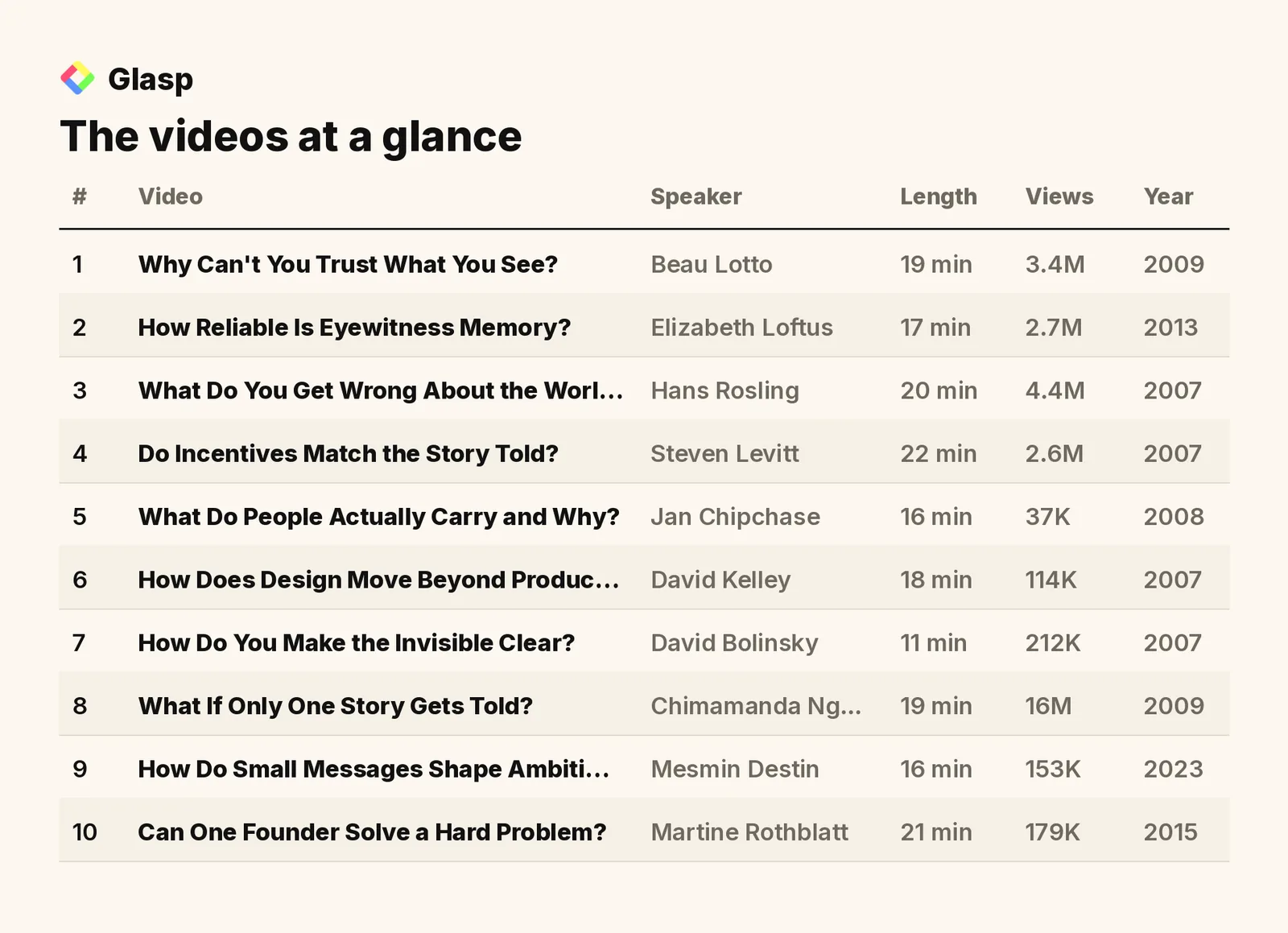
Why Can't You Trust What You See? (Beau Lotto)
How Reliable Is Eyewitness Memory? (Elizabeth Loftus)
What Do You Get Wrong About the World? (Hans Rosling)
Do Incentives Match the Story Told? (Steven Levitt)
What Do People Actually Carry and Why? (Jan Chipchase)
How Does Design Move Beyond Products? (David Kelley)
How Do You Make the Invisible Clear? (David Bolinsky)
What If Only One Story Gets Told? (Chimamanda Ngozi Adichie)
How Do Small Messages Shape Ambition? (Mesmin Destin)
Can One Founder Solve a Hard Problem? (Martine Rothblatt)
Total: 10 videos, 179 minutes of watch time (2 hours 59 minutes), and 29.9M combined views.
1. Why Can't You Trust What You See?

"Optical illusions show how we see | Beau Lotto" · Beau Lotto · 19 min · 3.4M views · 2009
In short: Color and every other sensory signal only gains meaning from context, so your brain reports its interpretation, not the raw world.
Start here, because everything after this list depends on accepting that you do not see reality directly. Lotto uses color illusions to show that identical physical stimuli look different depending on what surrounds them. It answers the question of why two people can look at the same evidence and come away with different readings.
Key takeaways
The same physical stimulus appears as a different color depending on the surrounding elements, because perception is assembled from context rather than from raw light.
The brain learns to see by finding patterns, relationships, and associations in sensory information, which is meaningless until it is interpreted.
The brain continually redefines what counts as normal based on past experience, which is the reason optical illusions work on everyone.
Bumblebees, with far simpler brains, also experience illusions and rely on contextual cues to navigate their environment.
Watch on YouTube · Read the summary and Q&A
2. How Reliable Is Eyewitness Memory?

"How reliable is your memory? | Elizabeth Loftus" · Elizabeth Loftus · 17 min · 2.7M views · 2013
In short: Memory is reconstructive, so suggestion and misinformation can rewrite it, and faulty eyewitness memory has sent innocent people to prison.
If perception is constructed, so is the record you keep of it. Loftus shows that memory is not a recording device and that leading questions can plant recollections that feel completely real. This is the talk to watch before you trust your own account of what a customer said last month.
Key takeaways
Steve Titus was convicted after an incorrect identification by a victim and later exonerated, one case within a broader pattern of wrongful convictions.
Memory does not work like a recording device, and information encountered after an event can reshape what a person recalls about it.
Leading questions and suggestive information distort memories, causing people to recall events differently from how they actually happened.
Planted false memories can be vivid, emotionally distressing, and lasting enough to change a person's later preferences and aversions.
Watch on YouTube · Read the summary and Q&A
3. What Do You Get Wrong About the World?
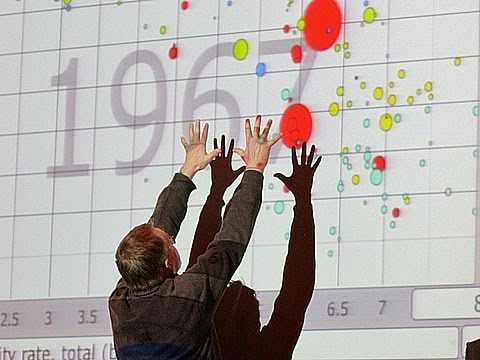
"The best stats you've ever seen | Hans Rosling" · Hans Rosling · 20 min · 4.4M views · 2007
In short: Students scored below chimpanzees on global development questions, showing that preconceived ideas about rich and poor countries beat actual data.
Rosling moves the problem from the individual to the entire worldview. He tests educated students on basic global development facts, finds them beaten by random chance, and then shows what the real data looks like when you animate it. This is the case for checking your market assumptions against numbers instead of intuition.
Key takeaways
Swedish undergraduate students scored worse than chimpanzees on questions about global development, showing a measurable gap between confident belief and actual data.
Child mortality and fertility rates vary widely between countries, which breaks the simple split between the Western world and the third world.
Health improvements correlate with economic growth, and countries that prioritized investment in health experienced faster advancement than those that did not.
Global development data sits hidden inside databases, so making it searchable and visual is what turns it into something policymakers and entrepreneurs can use.
Watch on YouTube · Read the summary and Q&A
4. Do Incentives Match the Story Told?
"The freakonomics of McDonalds vs. drugs | Steven Levitt" · Steven Levitt · 22 min · 2.6M views · 2007
In short: A gang's own financial records showed foot soldiers earning $3.50 an hour, so the glamour of drug dealing did not survive the numbers.
Rosling shows you what data does to a worldview. Levitt shows you what it does to a single story everybody believed. He got hold of a gang's actual books and found an organization structured like a franchise, with terrible pay at the bottom and lethal risk attached.
Key takeaways
Foot soldiers in the gang earned $3.50 an hour, while the top leaders could make up to $400,000 per year.
Gang members faced a death rate of 7% per person per year, which was higher than the death rate for convicts on death row.
The gang was organized like McDonald's, with a board of directors, regional leaders, and franchisees who ran local territories.
A lack of legitimate opportunity led many young men to treat the gang as their best available chance at success despite the risks.
Watch on YouTube · Read the summary and Q&A
5. What Do People Actually Carry and Why?

"Jan Chipchase: The anthropology of mobile phones" · Jan Chipchase · 16 min · 37K views · 2008
In short: Across cultures and genders people carry keys, money, and a mobile phone, because each one serves a basic survival purpose.
Having established that you cannot trust perception, memory, or received stories, the next move is going out and looking. Chipchase does his research on the street in India, China, Brazil, and Africa rather than in a lab. It answers what field research actually produces that a survey cannot.
Key takeaways
Across cultures and genders, the three things people carry are keys, money, and a mobile phone, and all three are carried for survival reasons.
Mobile phones let people transcend space and time, which is why they now rank alongside keys and money as essential to carry.
People rely on reflection moments, tapping their pockets, and keeping a designated center of gravity to remember what they are carrying.
The research happened in India, China, Brazil, and Africa rather than in a lab, because the street is a source of innovation and local solutions.
Watch on YouTube · Read the summary and Q&A
6. How Does Design Move Beyond Products?

"David Kelley: The future of design is human-centered" · David Kelley · 18 min · 114K views · 2007
In short: Human-centered design builds behaviors and personalities into products, shifting the work from shaping objects to shaping the experience around them.
Field observation is only useful if it changes what you build. Kelley walks through the shift at IDEO from designing physical objects to designing behavior and experience, with the Prada store and the Science Museum wall as worked examples. This is the talk on how research becomes a product decision.
Key takeaways
IDEO shifted from designing physical technological objects to human-centered design, where behaviors and personalities are integrated into the product itself.
The firm formed internal video-production groups to build experience prototypes that demonstrate the man-machine relationship and the intended use of a design.
The Prada store in New York used RF tags on merchandise and interactive displays in dressing rooms to reshape the retail experience.
Design became integrated into business strategy, with designers trusted as important contributors rather than brought in at the end.
Watch on YouTube · Read the summary and Q&A
7. How Do You Make the Invisible Clear?

"David Bolinsky: Visualizing the wonder of a living cell" · David Bolinsky · 11 min · 212K views · 2007
In short: Animation turns molecular machines into something students can see, closing the gap between scientific truth and the beauty that makes it memorable.
The shortest talk on the list and the clearest argument for visual explanation. Bolinsky animates the inside of a living cell so that molecular machinery becomes something a student can hold in their head. It answers how you explain a complex system to someone who has no context for it.
Key takeaways
Molecular machines made of strings of amino acids power how cells move, replicate, and function throughout the human body.
Each person carries about 100,000 kinesins in each of their 100 trillion cells, delivering proteins to different parts of the cell.
Education compartmentalizes subjects, which reduces the visibility of the truth and beauty that make a field worth entering.
Animation gives students an internalized view of biology, which sparks the imagination and passion needed to make new discoveries.
Watch on YouTube · Read the summary and Q&A
8. What If Only One Story Gets Told?
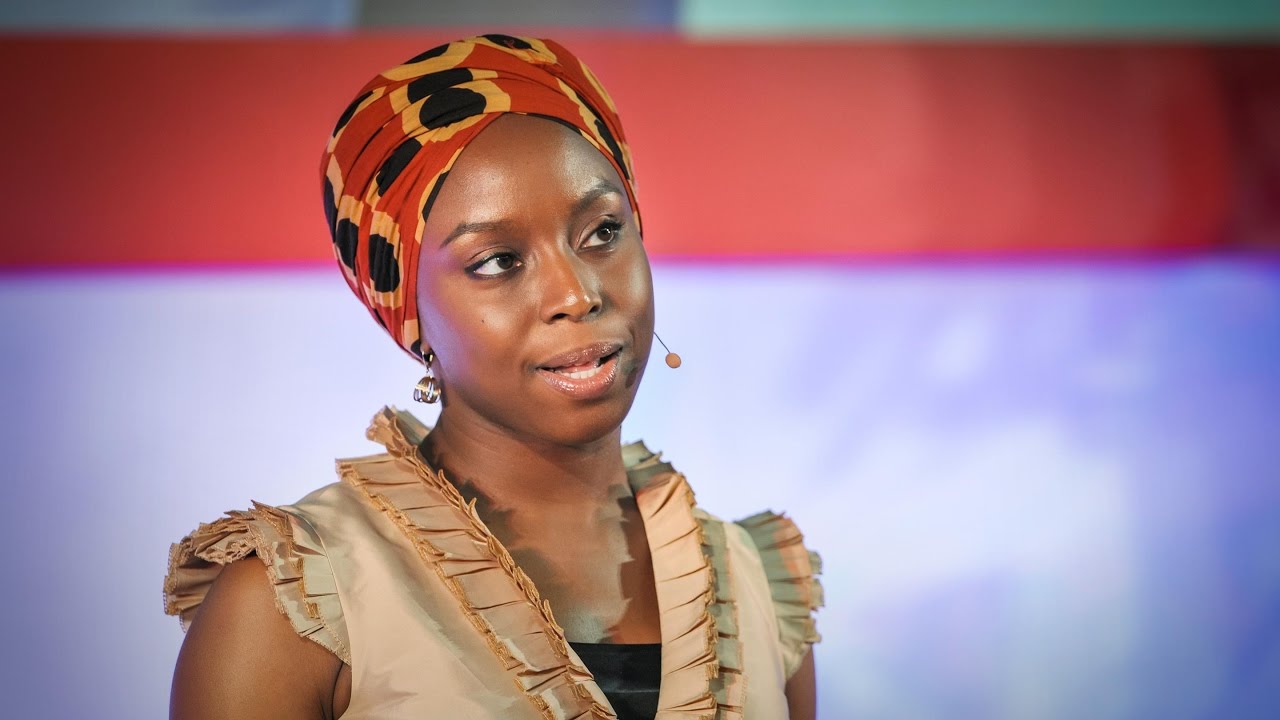
"Chimamanda Ngozi Adichie: The Danger of a Single Story | TED" · Chimamanda Ngozi Adichie · 19 min · 16M views · 2009
In short: A single story creates stereotypes that flatten complex identities, rob people of dignity, and hide the humanity we actually share.
The most watched talk here, and the one that turns the list outward. Adichie traces how a single narrative about a place or a person becomes the only one anyone believes. For anyone writing a pitch, a job description, or a marketing page, it is a direct warning about the story you are putting into the world.
Key takeaways
Reading only British and American children's books led the speaker to believe that literature had to feature foreigners rather than people like her.
Discovering African books changed her view of literature by showing that people with her skin color and hair type could exist in it.
An American roommate held a single story of Africa as poverty, war, and helplessness, which stripped dignity from the people it described.
Stories are shaped by power, so those in positions of power get to define how everyone else is described.
Watch on YouTube · Read the summary and Q&A
9. How Do Small Messages Shape Ambition?

"How Everyday Interactions Shape Your Future | Mesmin Destin | TED" · Mesmin Destin · 16 min · 153K views · 2023
In short: Everyday messages either shrink or expand a person's sense of possibility, which then shows up in motivation, persistence, and academic performance.
Adichie covers the stories told about groups. Destin covers the ones delivered one sentence at a time. His research shows that messages linking a person's identity to their strengths measurably raise persistence, which is the mechanism behind good and bad management alike.
Key takeaways
Messages people receive from others and from the systems around them can either shrink or expand their sense of self and possibility.
Messages that link a person's identity to their strengths and capabilities raise self-esteem and increase willingness to persist through challenges.
Information about access to resources such as financial aid significantly changes how students perceive their own future possibilities.
Navigating barriers takes a toll on physical health, so maintaining social connections matters alongside any message pushing someone toward a goal.
Watch on YouTube · Read the summary and Q&A
10. Can One Founder Solve a Hard Problem?
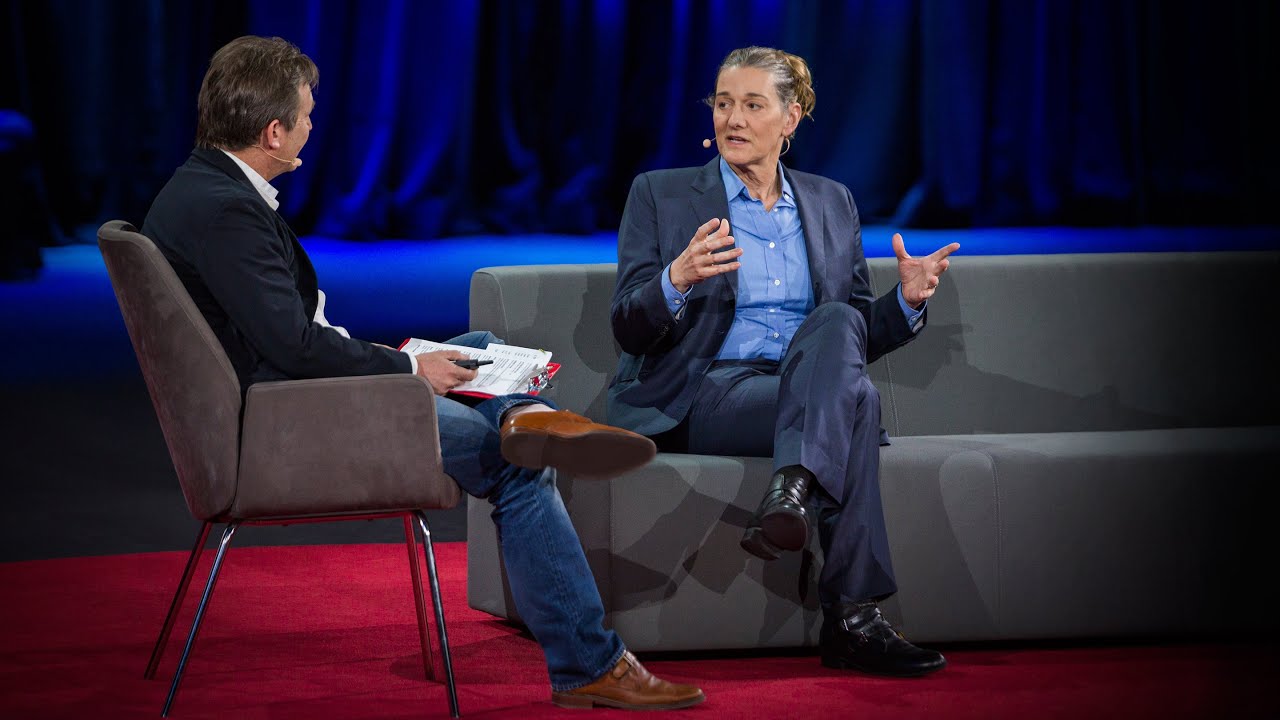
"Martine Rothblatt: My daughter, my wife, our robot, and the quest for immortality" · Martine Rothblatt · 21 min · 179K views · 2015
In short: Rothblatt turned a daughter's fatal diagnosis into a working medicine, then applied the same persistence to organ supply and mind files.
The closing talk, because it is all of the above applied to one working life. Rothblatt built satellite radio, then researched a rare disease until a treatment existed, then moved on to transplantable organs and preserved consciousness. It answers what happens when someone refuses the story that a problem is unsolvable.
Key takeaways
Rothblatt used satellites to build nationwide satellite radio, revolutionizing the radio industry and leading to the creation of Sirius XM.
After a diagnosis of pulmonary arterial hypertension, Rothblatt researched the disease and developed a medicine that saved their daughter's life and generates significant revenue.
Rothblatt is genetically modifying pig organs to be compatible with the human body in order to create an unlimited supply of transplantable organs.
Rothblatt argues that consciousness can be preserved in mind files, creating digital versions of people that process information and provide companionship.
Watch on YouTube · Read the summary and Q&A
Frequently asked questions
What are the best TED talks of all time?
The most enduring include Chimamanda Ngozi Adichie on the danger of a single story, Hans Rosling on global development data, and Elizabeth Loftus on the unreliability of memory. Each has been cited for well over a decade.
How long does it take to watch all ten talks?
About three hours in total. The shortest is David Bolinsky at 11 minutes and the longest is Steven Levitt at 22 minutes, so each one fits into a single sitting.
What is the danger of a single story?
It is the way one repeated narrative about a place or person hardens into a stereotype, flattening complex identities and robbing people of dignity. Adichie's answer is a balance of stories rather than a single dominant one.
Is eyewitness testimony reliable?
Often not. Elizabeth Loftus shows that memory is reconstructive rather than recorded, and that faulty eyewitness memory has been a major factor in wrongful convictions.
What did Hans Rosling's chimpanzee comparison show?
Swedish undergraduate students scored worse than chimpanzees on basic global development questions, meaning their answers were worse than random. Rosling used it to show that preconceived ideas beat data in most people's heads.
What is human-centered design?
It is design that builds behaviors and personalities into a product rather than treating it as a physical object alone. David Kelley describes it as a shift from designing things to designing the experience around them.
Is drug dealing actually profitable?
Not for most people in it. Steven Levitt found foot soldiers earning $3.50 an hour while facing a 7% annual chance of death, a rate higher than convicts on death row.
Are older TED talks still worth watching?
Yes. Six of these ten were recorded between 2007 and 2009, and their subjects, perception, memory, data literacy, incentives, and design, have not aged out.
Which TED talk should a founder watch first?
Beau Lotto on optical illusions, because it establishes that your brain reports an interpretation of context rather than the world itself. Every other talk on this list builds on that.
How to use this list
Watch these in the order listed. The sequence moves from how you perceive (Lotto), to how you remember (Loftus), to how you check yourself against data (Rosling and Levitt), to how you go find out what is true about users (Chipchase and Kelley), and finally to how you explain and tell it (Bolinsky, Adichie, Destin, Rothblatt). If you only have twenty minutes, start with Beau Lotto on optical illusions, since it sets up the assumption every other talk here relies on. If you want the single talk to send to someone else, send Adichie.
Related lists
💡 Want summaries and transcripts for any YouTube video? Try YouTube Summary with ChatGPT & Claude.