10 Best Study Technique Videos on YouTube

Aug 13, 2026
12 min read
222 views
Last updated: August 2026
This is a curated list of ten YouTube videos on how to study, ordered as a learning path rather than by view count. It is for founders and self taught learners who need to absorb unfamiliar material quickly and still have it available months later.
Total watch time is about three hours. The set is canonical because it covers the full loop, from attention and note taking through reading, active recall, spaced repetition, and the Feynman Technique, using the videos that introduced each of those ideas to a general audience.
The videos on this list, in the order to watch them, are:
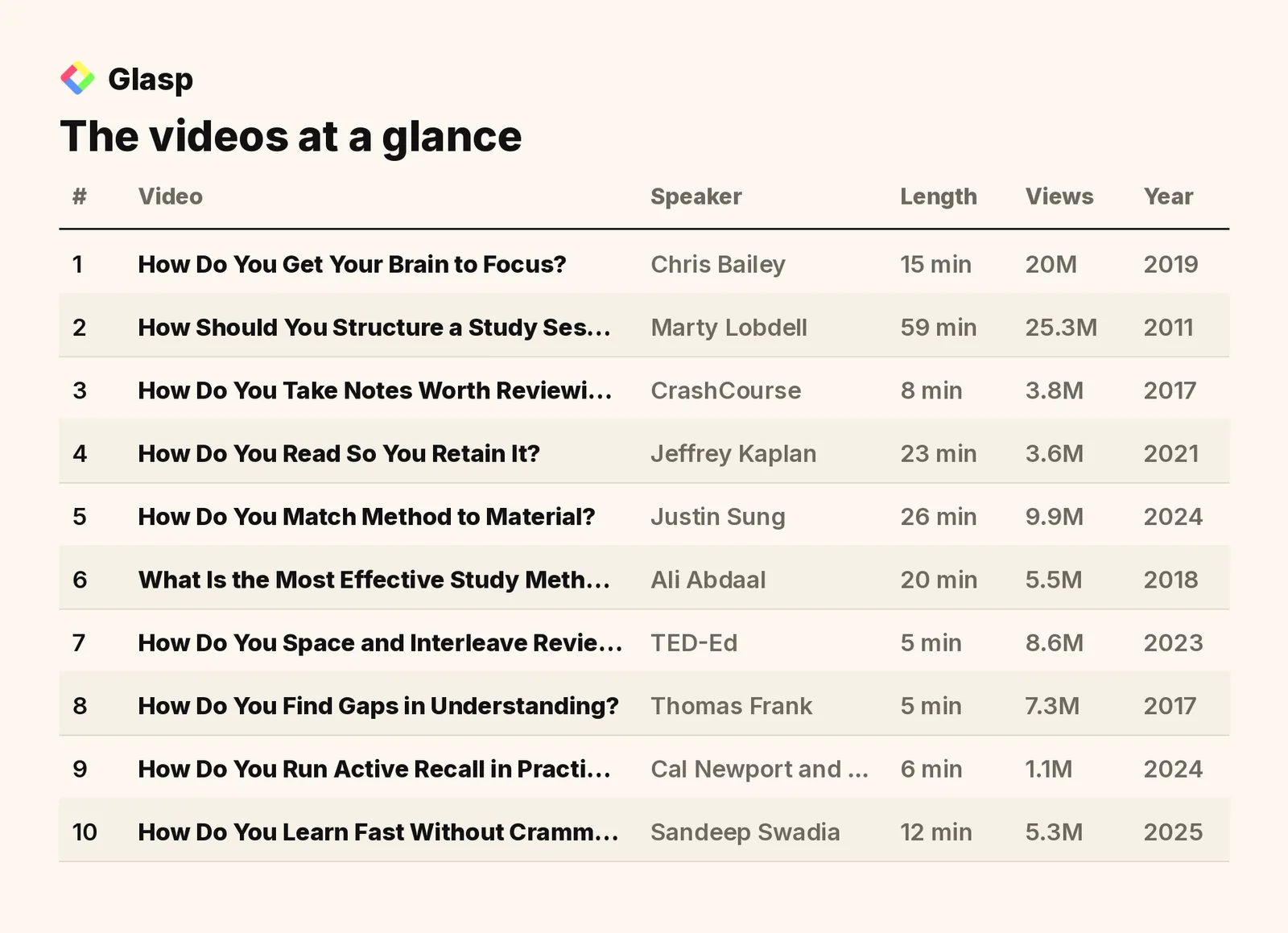
How Do You Get Your Brain to Focus? (Chris Bailey)
How Should You Structure a Study Session? (Marty Lobdell)
How Do You Take Notes Worth Reviewing? (CrashCourse)
How Do You Read So You Retain It? (Jeffrey Kaplan)
How Do You Match Method to Material? (Justin Sung)
What Is the Most Effective Study Method? (Ali Abdaal)
How Do You Find Gaps in Understanding? (Thomas Frank)
How Do You Run Active Recall in Practice? (Cal Newport and Andrew Huberman)
How Do You Learn Fast Without Cramming? (Sandeep Swadia)
Total: 10 videos, 179 minutes of watch time (2 hours 59 minutes), and 90.4M combined views.
1. How Do You Get Your Brain to Focus?
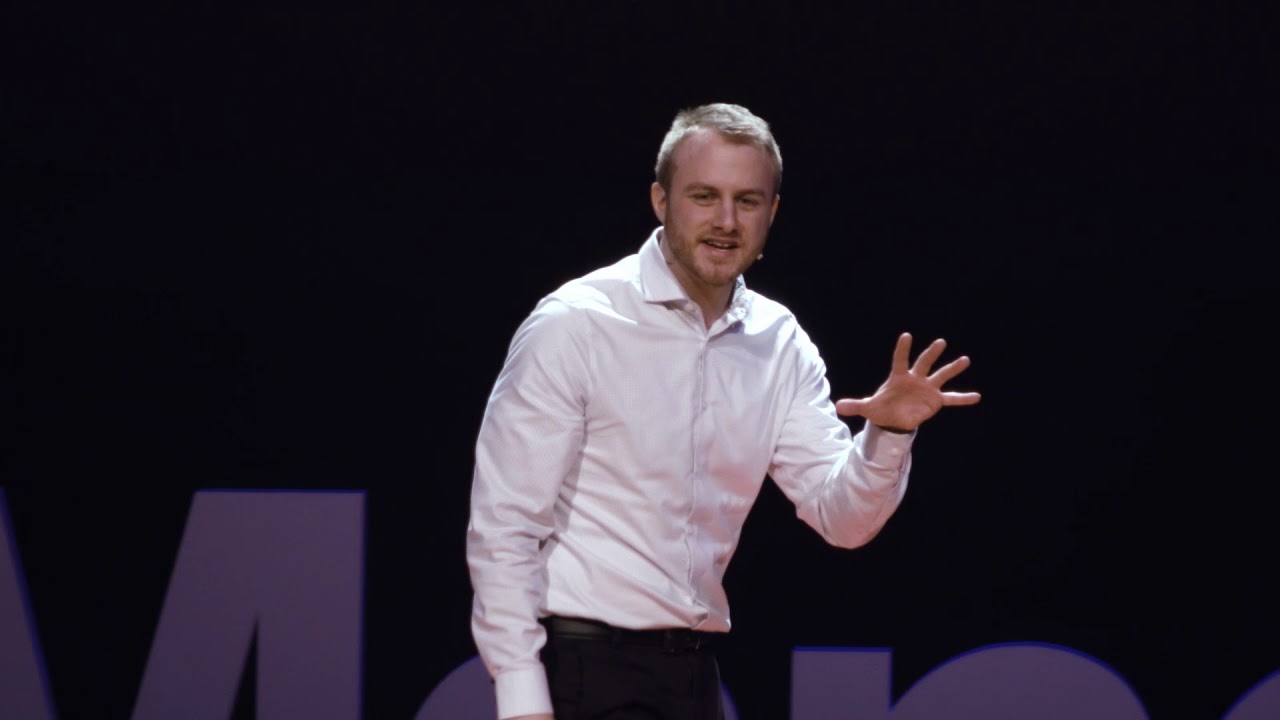
"How to Get Your Brain to Focus | Chris Bailey | TEDxManchester" · Chris Bailey · 15 min · 20M views · 2019
In short: Lower your level of stimulation by cutting screen time, because distraction is a symptom of an overstimulated mind, not a discipline failure.
Every technique further down this list assumes you can hold attention on one thing. Bailey argues the constraint is not willpower but stimulation level, and that reducing input is what restores focus. Start here so the rest of the list has something to work with.
Key takeaways
Constant screen use overstimulates the mind, which shortens attention span and makes sustained focus on a single task harder to reach.
Boredom lets the brain rest and wander, and that wandering produces more creative ideas and better plans for the future.
Low attention activities such as knitting or long showers create scatter focus, where the mind generates new ideas and solutions on its own.
A disconnection ritual that separates you from technology reduces mental clutter and improves focus, productivity, and creativity over time.
Watch on YouTube · Read the summary and Q&A
2. How Should You Structure a Study Session?
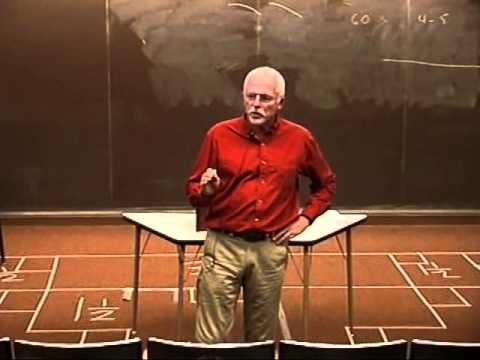
"Marty Lobdell - Study Less Study Smart" · Marty Lobdell · 59 min · 25.3M views · 2011
In short: Work in 25 to 30 minute blocks with short breaks, in a space used only for study, then sleep properly.
This is the lecture most study advice on YouTube is downstream of. Lobdell covers the mechanics that sit under everything else: session length, physical environment, active recitation, and sleep. It runs long, but it is the one video here that answers the whole setup question at once.
Key takeaways
The average college freshman holds effective focus for roughly twenty five to thirty minutes before attention drops and further study time stops paying off.
A dedicated study area, kept separate from recreational space, trains attention and improves how efficiently each session runs.
Understanding concepts matters more than memorizing facts, and active recitation such as teaching or explaining to others reinforces what you learned.
Adequate sleep consolidates and stores memories, so trading sleep for extra study hours works directly against retention.
Watch on YouTube · Read the summary and Q&A
3. How Do You Take Notes Worth Reviewing?
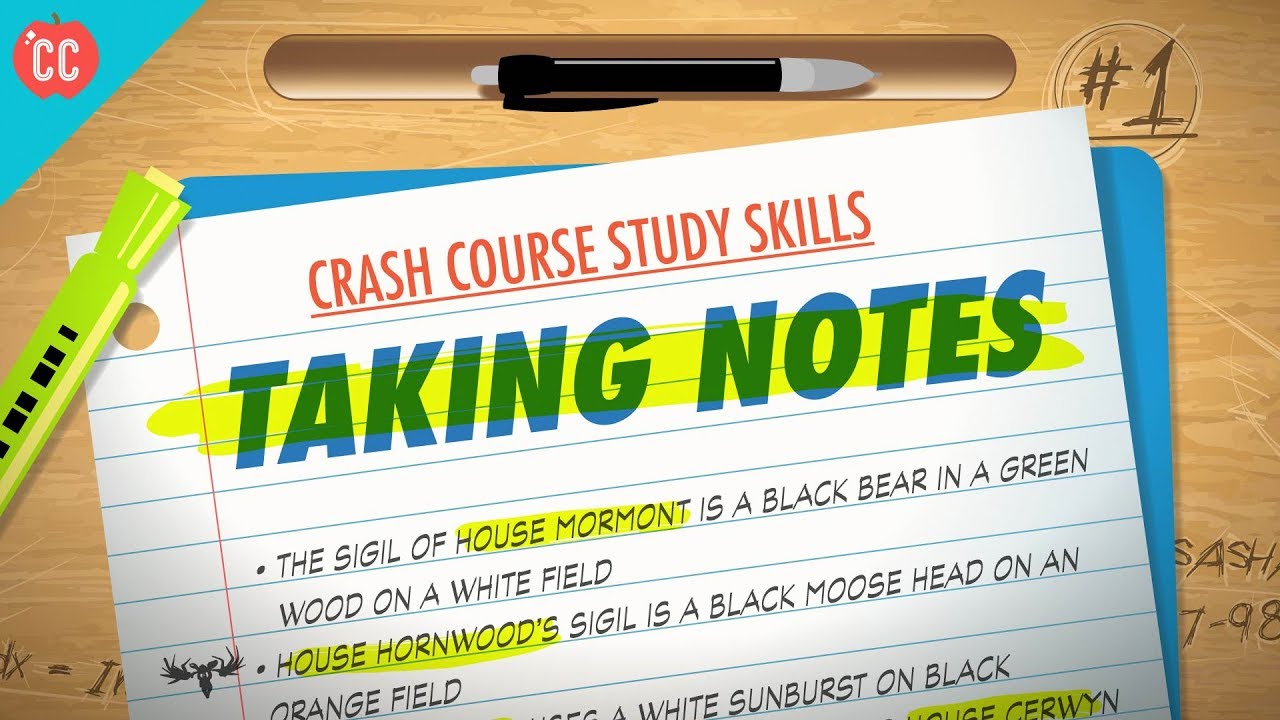
"Taking Notes: Crash Course Study Skills #1" · CrashCourse · 8 min · 3.8M views · 2017
In short: Capture big ideas, terms, definitions, and examples by hand, keeping a high signal to noise ratio instead of transcribing everything.
Most people never question their note format, then wonder why review feels useless. This video compares paper against laptop and lays out the Outline, Cornell, and Mind Mapping methods so you can pick per subject. It answers what belongs in notes and what does not.
Key takeaways
Handwritten notes lead to better retention than typed notes, because typing pulls attention toward syntax rather than the meaning of the message.
Notes should carry a high signal to noise ratio, holding only the information that will be useful for tests and later application.
The Outline method, the Cornell method, and Mind Mapping each suit different classes, so match the method to the material rather than defaulting to one.
Note taking is only the input step, and reviewing those notes during study sessions is what actually converts them into learning.
Watch on YouTube · Read the summary and Q&A
4. How Do You Read So You Retain It?

"Lecture #9: How to Read so that you Retain Information" · Jeffrey Kaplan · 23 min · 3.6M views · 2021
In short: Summarize every paragraph in one sentence in the margin, which forces active engagement and cuts the need for later rereading.
Reading is where most learning time goes and where most of it leaks. Kaplan gives one concrete mechanism, the marginalia method, and explains why condensing each paragraph produces understanding that passive reading never does. It applies to any text, not just academic ones.
Key takeaways
The marginalia method means writing a one sentence summary of each paragraph in the margin as you read through the text.
Passively reading without interaction produces weaker learning and retention than actively condensing what each paragraph is actually claiming.
Summarizing forces you to select the most important points and connect paragraphs, which results in deeper understanding of the material.
The method works on any reading material, from academic texts to novels, and outperforms speed reading on comprehension and retention.
Watch on YouTube · Read the summary and Q&A
5. How Do You Match Method to Material?

"How to Remember Everything You Read" · Justin Sung · 26 min · 9.9M views · 2024
In short: Sort what you read into procedural, analogous, conceptual, evidence, and reference information, then apply a different retention method to each type.
One technique applied to everything is why study systems break down. Sung's PACER framework splits information into five types and assigns each a different treatment, so flashcards go where flashcards belong and mind maps go where they belong. This is the video that makes the rest of the list selective rather than mechanical.
Key takeaways
The PACER system splits information into procedural, analogous, conceptual, evidence, and reference categories, each requiring a different learning approach.
Procedural information such as techniques and methods only sticks when practiced immediately, not when reviewed as written notes.
Conceptual information covering theories and relationships is best retained through mind mapping and network based note taking.
Overconsuming information without a digestion stage leads to forgetting, so balance how much you take in against how much you process.
Watch on YouTube · Read the summary and Q&A
6. What Is the Most Effective Study Method?
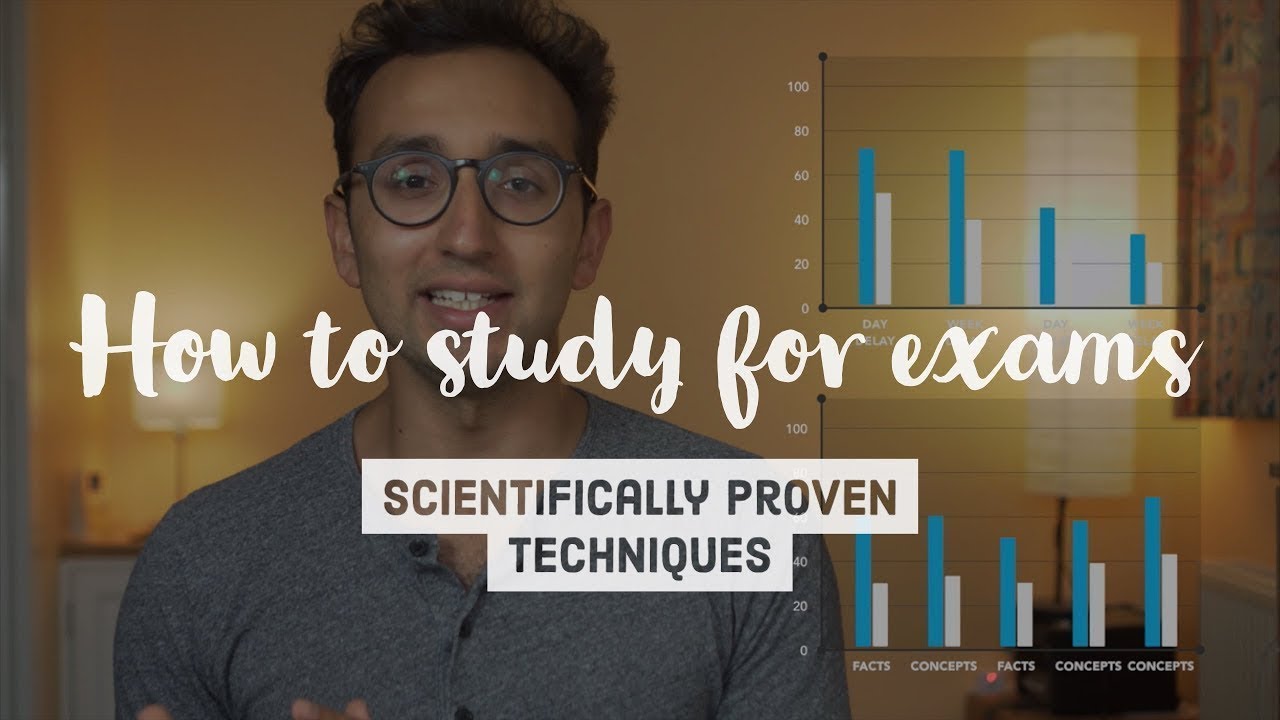
"How to study for exams - Evidence-based revision tips" · Ali Abdaal · 20 min · 5.5M views · 2018
In short: Active recall, meaning retrieving information from memory rather than rereading or highlighting, has the strongest research support of any study technique.
This is the video that moved active recall into mainstream study advice. Abdaal contrasts what students believe works against what the research shows, then gives specific ways to implement retrieval practice. If you watch only one technique video, this is it.
Key takeaways
Rereading, highlighting, and summarizing are the most commonly used study methods and have limited effectiveness compared with retrieval based methods.
Active recall strengthens connections in the brain and produces better long term retention and understanding of the material studied.
Anki flashcards, writing notes with the book closed, and self generated questions are three practical ways to implement active recall.
Students' intuitive beliefs about which study techniques work often fail to match what the scientific evidence actually demonstrates.
Watch on YouTube · Read the summary and Q&A
7. How Do You Space and Interleave Review?

"3 tips on how to study effectively" · TED-Ed · 5 min · 8.6M views · 2023
In short: Test yourself with flashcards, allow mistakes during retrieval, and spread review sessions across days instead of massing them together.
Active recall answers what to do; this answers when to do it. In five minutes TED-Ed covers self testing, the value of retrieval errors, interleaving, and spacing, and explains what each one does to memory. It is the fastest way to fix your review schedule.
Key takeaways
Medical residents who test themselves with flashcards and quizzes perform better in surgeries than those who study without self testing.
Making mistakes during retrieval improves long term memory, because correcting the error integrates the new information more firmly.
Interleaving subjects within a single study session improves retention and helps you make connections across topics.
Spacing review sessions across days gives the brain time to rest and integrate knowledge into long term storage.
Watch on YouTube · Read the summary and Q&A
8. How Do You Find Gaps in Understanding?
"How to Learn Faster with the Feynman Technique (Example Included)" · Thomas Frank · 5 min · 7.3M views · 2017
In short: Explain the concept in plain language as if teaching a child, and the points where you stall are your knowledge gaps.
Retrieval tells you whether you remember something. This tells you whether you understand it. Frank walks through the Feynman Technique with a worked example, showing how forced simplification surfaces the assumptions you did not know you were making.
Key takeaways
The Feynman Technique means explaining a concept in simple language as if you were teaching it to someone else from scratch.
Explaining a concept out loud exposes gaps in understanding and forces you to challenge assumptions you did not know you held.
The technique applies to any subject or purpose and is not limited to math or science material.
Breaking down technical terms into simplified language is the specific move that tests whether you genuinely understand something.
Watch on YouTube · Read the summary and Q&A
9. How Do You Run Active Recall in Practice?

"How to Study & Learn Using Active Recall | Dr. Cal Newport & Dr. Andrew Huberman" · Cal Newport and Andrew Huberman · 6 min · 1.1M views · 2024
In short: Step away from the material and reconstruct it from memory, then build a struggle pile of the concepts you could not recall.
Newport turns active recall from a principle into a protocol: when to do it, how to handle the concepts that resist, and why it feels harder than highlighting. Short, specific, and useful once you have already tried retrieval practice and found it uncomfortable.
Key takeaways
Active recall requires stepping away from the material and retrieving it, which contrasts sharply with passive methods such as highlighting.
The process is mentally taxing but produces a more robust understanding of the information and guards against forgetting it later.
Creating struggle piles of difficult concepts gives you a structured protocol for prioritizing what still needs work.
Timing matters, so schedule active recall during peak energy levels rather than at the end of an already long day.
Watch on YouTube · Read the summary and Q&A
10. How Do You Learn Fast Without Cramming?
"How To Learn So Fast It’s Almost Unfair" · Sandeep Swadia · 12 min · 5.3M views · 2025
In short: Compress material into its vital patterns, compile it through practice and teaching, then consolidate with rest before the next cycle.
The closer, because it assembles the individual techniques into one repeatable cycle. The 3C protocol covers selection, practice, and recovery, and explains why rest is part of the method rather than time off from it. Watch this after you have the pieces.
Key takeaways
The 3C protocol runs in three stages, compress, compile, and consolidate, replacing cramming with a structured and repeatable cycle.
Compressing means selecting the vital portion of the material, connecting it to prior knowledge, and forming memorable chunks.
Compiling uses slow practice, immersion, and teaching to turn compressed material into knowledge you can actually apply.
The prefrontal cortex consumes large amounts of energy, which is why cramming fails and why strategic breaks belong inside the method.
Watch on YouTube · Read the summary and Q&A
Frequently asked questions
What is the most effective study technique according to research?
Active recall, which means testing yourself by retrieving information from memory, has the strongest research support of any study technique. Rereading, highlighting, and summarizing are far more popular but considerably less effective.
What is active recall and how do I actually do it?
Active recall is retrieving information from memory instead of reviewing it passively. In practice that means using flashcards in an app like Anki, writing out notes with the book closed, or answering questions you wrote yourself.
How often should I review material to remember it long term?
Space your review sessions across multiple days rather than massing them into one block. Spacing gives the brain time to rest and integrate knowledge, which is what moves it into long term storage.
What is the Feynman Technique?
The Feynman Technique is explaining a concept in simple language as if you were teaching it to a child. The points where your explanation breaks down mark the gaps in your understanding.
How long should a study session be?
The average college freshman studies effectively for about twenty five to thirty minutes before focus drops off. Breaking sessions into blocks that length with short breaks between them keeps study time productive.
Is it better to take notes by hand or on a laptop?
Handwritten notes lead to better retention, because typing tends to pull attention toward recording syntax rather than understanding meaning. Typing can still work if you deliberately write less and focus on the ideas.
Why does rereading and highlighting not work?
Rereading and highlighting feel productive because the material becomes familiar, but familiarity is recognition, not recall. Neither method requires you to retrieve anything, so neither strengthens the memory connections that retrieval builds.
Does sleep really affect how much I remember?
Yes. Sleep is when memories are consolidated and stored, so cutting sleep to add study hours reduces how much of that studying you retain.
Should I use the same study method for everything?
No. The PACER framework sorts information into procedural, analogous, conceptual, evidence, and reference types, and each type retains best through a different approach, from immediate practice to mind mapping to spaced flashcards.
How to use this list
Watch these in the order listed. The sequence moves from attention, through capturing and reading material, into retrieval and spacing, and ends with a full cycle you can repeat, so each video assumes the one before it. If you only have fifteen minutes today, start with Chris Bailey at the top: fixing your stimulation level is what makes every technique after it usable. If you want the single highest leverage change, jump to Ali Abdaal on active recall, then come back and watch the list from the beginning.
Related lists
💡 Want summaries and transcripts for any YouTube video? Try YouTube Summary with ChatGPT & Claude.