How Can You Remember Everything You Read?
TL;DR
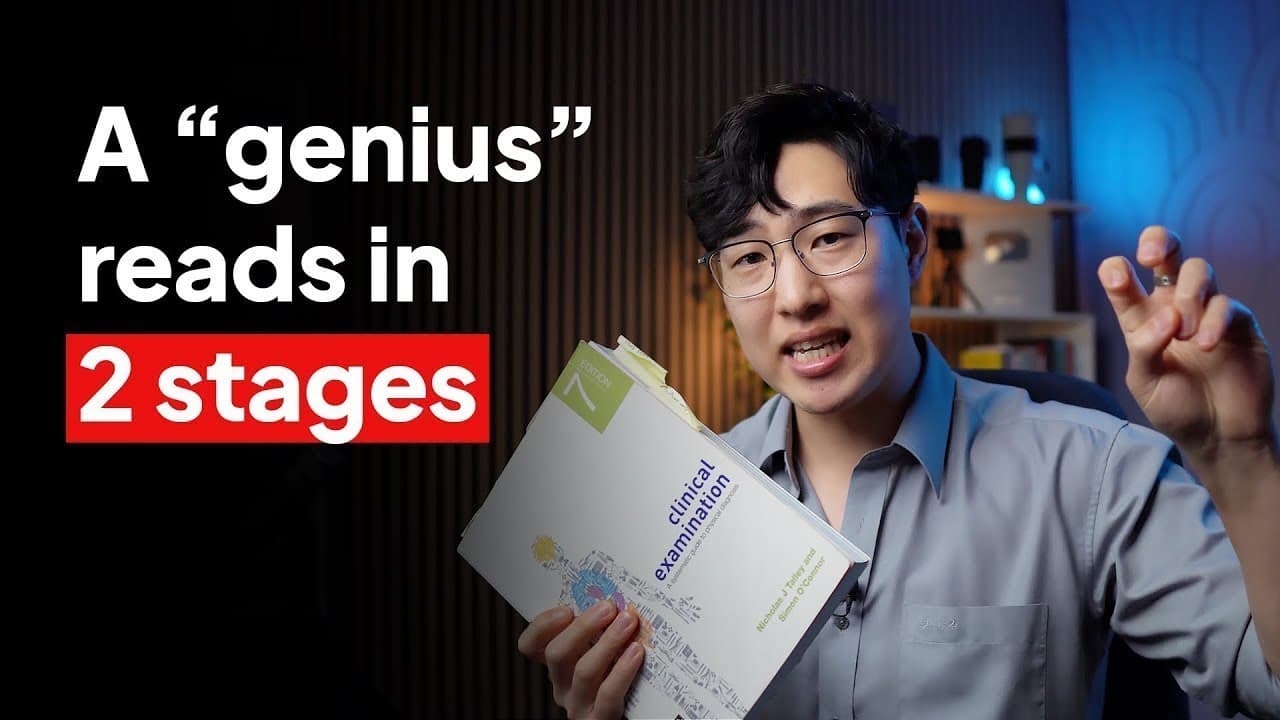
You can't remember everything you read, but you can improve retention with a system that categorizes information into five types: Procedural, Analogous, Conceptual, Evidence, and Reference. Each category requires a different approach, emphasizing the balance of consuming and digesting information for effective learning.
Transcript
in this video I'll teach you a system for remembering everything you read study or learn I've been using the system for the last 7 years starting from learning disease pathophysiology in medical school through to reading research articles and learning science or reading books on productivity or business and the reason the system wor... Read More
Key Insights
- The PACER system divides information into five categories: Procedural, Analogous, Conceptual, Evidence, and Reference, each requiring a targeted approach for effective learning.
- Balancing consumption and digestion stages is crucial for retaining information; overconsumption without digestion leads to forgetting.
- Procedural information, like techniques and methods, requires immediate practice to be retained effectively.
- Analogous information connects new concepts to prior knowledge, enhancing retention through the creation and critique of analogies.
- Conceptual information involves understanding theories and relationships, best retained through mind mapping and network-based note-taking.
- Evidence information provides concrete examples to support concepts and should be stored and rehearsed for effective recall.
- Reference information includes specific details that are less conceptually important and best learned through spaced repetition techniques like flashcards.
- Effective learning requires understanding and applying targeted processes for different types of information, beyond just memorization.
Install to Summarize YouTube Videos and Get Transcripts
Explore YouTube Video Summarizer or Get YouTube Transcript Extractor
Questions & Answers
Q: What is the PACER system?
The PACER system is a method for categorizing information into five types: Procedural, Analogous, Conceptual, Evidence, and Reference. Each category requires a specific process for effective learning and retention. This system helps balance the consumption and digestion of information, ensuring that what is learned is retained and can be applied effectively.
Q: Why is balancing consumption and digestion important in learning?
Balancing consumption and digestion is crucial because consuming information without proper digestion leads to forgetting. The digestion stage involves processing and encoding information into long-term memory. Without it, the brain is overwhelmed, similar to overeating without digestion, resulting in high rates of forgetting despite extensive study.
Q: How should procedural information be handled?
Procedural information, which includes methods and techniques, should be practiced immediately after consumption. This immediate application helps reinforce the learning and prevents forgetting. Delaying practice can result in forgetting much of the information, making initial efforts less effective and wasting time.
Q: What is analogous information and how is it used?
Analogous information is new information that relates to something you already know. It enhances learning by creating connections between new and existing knowledge. Critiquing these analogies helps deepen understanding by examining similarities and differences, which strengthens retention and comprehension.
Q: What role does conceptual information play in learning?
Conceptual information involves understanding theories, principles, and relationships between concepts. It is best retained through non-linear, network-based note-taking methods like mind mapping, which mimic the interconnected nature of expert knowledge. This approach helps learners see the bigger picture and understand how concepts interrelate.
Q: How should evidence information be processed?
Evidence information should be stored immediately upon identification and rehearsed later. Storing involves noting down facts, statistics, or cases that support conceptual points. Rehearsing involves applying this evidence in problem-solving, teaching, or writing, which reinforces retention and understanding by using the information in context.
Q: What is reference information and how is it learned?
Reference information consists of specific, detailed bits of information that are conceptually less important but may be needed later. It is best learned using spaced repetition techniques like flashcards, which facilitate direct recall. This method is efficient for memorizing details that don't require deep conceptual understanding.
Q: What additional resources are offered for improving learning?
The speaker offers a free weekly newsletter that distills effective learning strategies into bite-sized emails. There are also resources like a Learner Type Quiz, a Learning System Diagnostic, and a summary of research on efficient learning. These resources aim to help learners improve their memory, understanding, and application of knowledge.
Summary & Key Takeaways
-
The video introduces a system for remembering what you read by categorizing information into five types: Procedural, Analogous, Conceptual, Evidence, and Reference. Each type requires a specific approach for effective retention, emphasizing the importance of balancing information consumption and digestion.
-
Procedural information requires immediate practice, while analogous information benefits from creating and critiquing analogies. Conceptual information is best retained through mind mapping, and evidence information should be stored and rehearsed. Reference information is learned through spaced repetition.
-
The system aims to improve learning efficiency by focusing on processes that enhance memory retention and understanding, moving beyond simple memorization to applying knowledge effectively. The speaker also offers additional resources and a newsletter for further learning strategies.
Read in Other Languages (beta)
Share This Summary 📚
Summarize YouTube Videos and Get Video Transcripts with 1-Click
Try YouTube Summary with ChatGPT & Claude or YouTube Transcript Generator
Explore More Summaries from Justin Sung 📚

Summarize YouTube Videos and Get Video Transcripts with 1-Click
Try YouTube Summary with ChatGPT & Claude or YouTube Transcript Generator