How Does Site Reliability Engineering Work?
TL;DR
Site reliability engineering combines operations expertise with a development mindset to keep software services dependable while reducing manual work. SREs divide their attention between responding to incidents and customer problems, and automating repetitive tasks. Monitoring, logging, root cause analysis, redundancy, and continuous feedback help teams anticipate failures, recover effectively, and prevent recurring issues.
Transcript
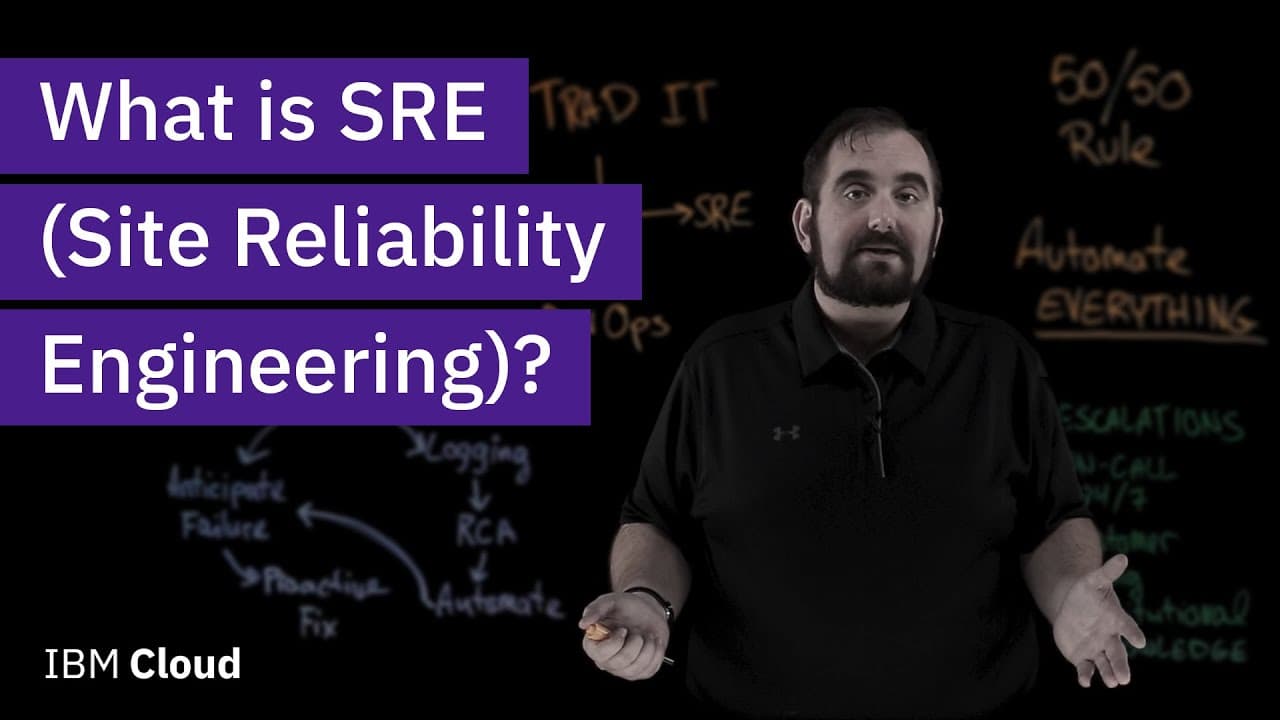
Thank you for joining us today! My name is Bradley Knapp, and I'm one of the product managers here at IBM Cloud and we've come to answer the question: what is Site Reliability Engineering, or SRE? And SRE is really the name for a new discipline that's actually an old discipline. It's a new name, it's only ... Read More
Key Insights
- Site reliability engineering is the intersection of traditional IT operations and DevOps, providing operational responsibility for software services after developers have engineered and released them. It connects software development with the practical work required to deliver a reliable service to customers.
- The SRE role is described as a 50/50 responsibility, with about half of an engineer's time devoted to incidents, escalations, on-call duties, and customer problems, and the other half devoted to automating work and improving the operational environment.
- Reducing toil is the process of eliminating repetitive manual work needed to keep hardware, middleware, software, and related services running. SREs reduce toil by creating programmatic solutions that prevent teams from applying the same manual correction repeatedly.
- Automation is a source of operational insight as well as efficiency. Each automated solution teaches the team something about system behavior, reveals additional tasks that could be automated, and creates opportunities to make future operations more reliable and less dependent on manual intervention.
- SREs are a source of cross-system knowledge because they work with hardware, software, monitoring, logging, automation, and customer-facing implementations. Developers know how software was designed to run, while SREs gain direct knowledge of how it actually behaves during daily operation.
- Failure is an expected property of software systems because a perfect system cannot be designed. SRE therefore focuses on predicting potential failures, solving foreseeable problems programmatically, building redundancy, and preparing effective tactical responses for incidents that cannot be anticipated.
- Monitoring is a real-time view of system activity that helps teams recognize warning signs and proactively address approaching failures. Logging is a historical record that allows teams to investigate unexpected incidents, reconstruct what happened, and perform root cause analysis afterward.
- An SRE mindset is useful even when a small company cannot fund a dedicated SRE organization. Developers who also operate the product can prioritize resilience, redundancy, monitoring, automation, and root cause analysis so that failures cause less disruption and recurring problems are eliminated.
Install to Summarize YouTube Videos and Get Transcripts
Explore YouTube Video Summarizer or Get YouTube Transcript Extractor
Questions & Answers
Q: What does site reliability engineering do?
Site reliability engineering combines the responsibilities of traditional IT operations with a DevOps-oriented development mindset. SREs help operate delivered software services, respond to incidents and customer escalations, monitor system behavior, investigate failures, and automate repetitive work. They also provide feedback to development teams based on how products actually behave during implementation and everyday customer use.
Q: How should an SRE divide time between operations and automation?
The role is described using a 50/50 model. About half of an SRE's time should address customer issues, escalations, incidents, on-call work, and other immediate operational problems. The remaining half should focus on automation and reducing toil. This balance lets the engineer support current service needs while systematically decreasing the manual effort required in the future.
Q: What is toil in site reliability engineering?
Toil is the manual work required to keep a software environment operating, including tasks involving hardware, middleware, software, and related services. SREs seek to reduce toil by creating programmatic solutions for recurring problems. The objective is to avoid making the same manual repair repeatedly and to make service operations more consistent, resilient, and manageable.
Q: Why is automation important for an SRE team?
Automation allows an SRE team to solve operational problems programmatically instead of repeating manual interventions. It also produces greater insight into the system because engineers learn from each process they automate. That knowledge can reveal additional automation opportunities, improve monitoring, reduce recurring work, and give the team more time to address new reliability challenges and customer needs.
Q: How do monitoring and logging differ in SRE?
Monitoring tracks what is happening in a system in real time, giving SREs an opportunity to identify warning signs, anticipate failures, and intervene proactively. Logging preserves an archive of events that have already occurred. When an unexpected failure happens, engineers can examine those records, determine what occurred, conduct root cause analysis, and design a lasting solution.
Q: How does root cause analysis prevent repeated failures?
Root cause analysis uses information from an unexpected failure, especially historical logs, to determine what happened and why it happened. Once the cause is understood, SREs can modify monitoring so that the same edge case is detected earlier and automate an appropriate response. The goal is to solve both the immediate problem and its future recurrence.
Q: Why does SRE assume that software systems will fail?
SRE assumes failure will happen because no system can be designed perfectly. Instead of treating every failure as avoidable, teams identify potential problems programmatically, create redundancy, improve resilience, and prepare ways to resolve immediate tactical issues. This approach aims to keep a failure from causing a major outage and turns actual incidents into opportunities for preventive improvement.
Q: How can a small company adopt SRE without a dedicated team?
A small company can adopt SRE practices even when its developers also serve as operators. The important step is applying an SRE mindset to engineering decisions. Teams should expect failures, add sufficient redundancy, design for resilience, monitor for warning signs, automate recurring corrections, and perform thorough root cause analysis so that previously encountered failures do not keep returning.
Summary & Key Takeaways
-
Site reliability engineering bridges traditional IT operations and DevOps. SREs operate delivered services, resolve incidents and customer escalations, and provide practical knowledge about how software behaves in production. Their daily experience helps reconcile how developers designed a system to work with what actually happens when customers use it.
-
Automation is central to SRE because repetitive manual work, called toil, consumes time without preventing recurrence. SREs approach operations with a development mindset, creating programmatic solutions across hardware, middleware, software, and related services. Each automated task can reveal more about the system and expose further opportunities for improvement.
-
SRE assumes that failures cannot be eliminated completely. Monitoring helps teams observe current conditions and anticipate problems, while logging preserves historical events for later investigation. Root cause analysis turns unexpected incidents into improved monitoring and automation. Organizations of any size can adopt this resilient, redundant, and prevention-focused mindset.
Read in Other Languages (beta)
Share This Summary 📚
Summarize YouTube Videos and Get Video Transcripts with 1-Click
Try YouTube Summary with ChatGPT & Claude or YouTube Transcript Generator
Explore More Summaries from IBM Technology 📚





Summarize YouTube Videos and Get Video Transcripts with 1-Click
Try YouTube Summary with ChatGPT & Claude or YouTube Transcript Generator