What AI trends define 2026 for agents and quantum computing
TL;DR
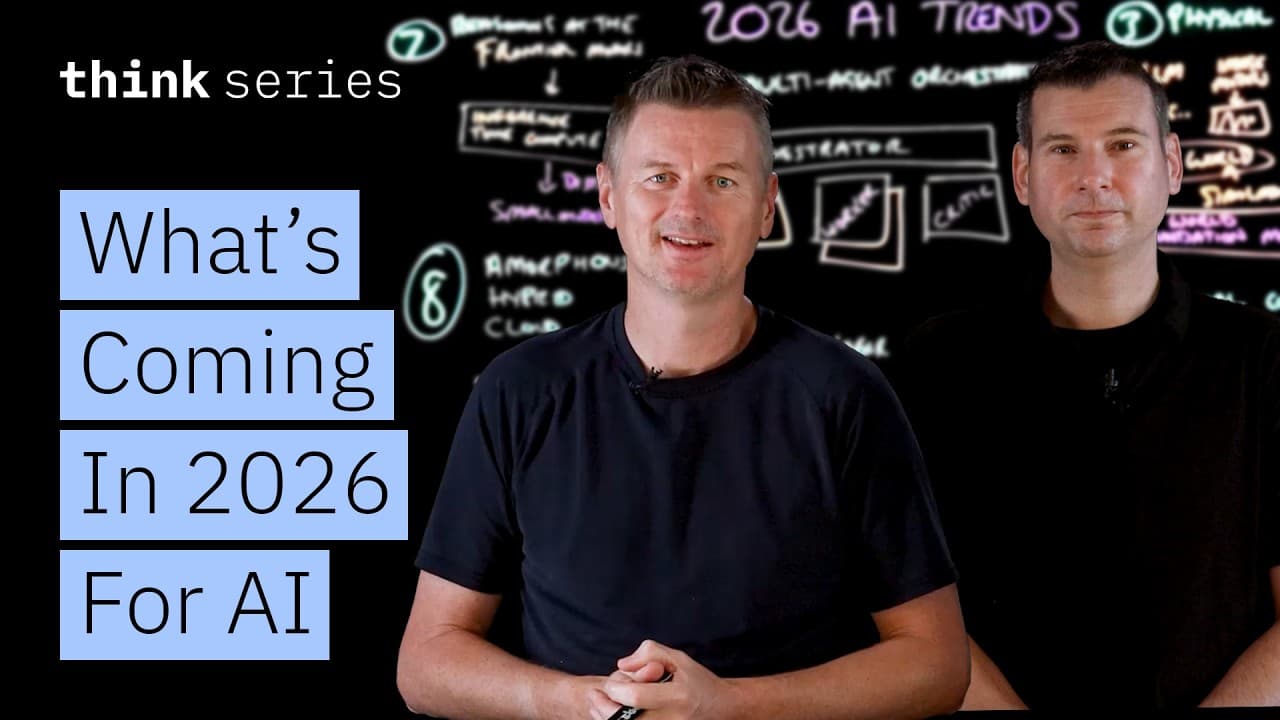
Agentic platforms for tasks will expand in 2026, enabling teams of agents that collaborate and orchestrate across workflows. Autonomous digital labor and human-in-the-loop quality control will grow, while governance, transparency, and auditable systems become essential. Quantum and hybrid computing will blend with smaller models to improve thinking and efficiency.
Transcript
What will be the most important trends in AI in with with some success, I would say. And this of my colleague, Aaron Baughman, to help us out. of infinite memory last year, I thought maybe that's that's fair. Well, how about we each take first? All right. Okay. So my number one trend year we said 2025 was the year of the agent. action on a task and... Read More
Key Insights
- Agentic platforms enable teams of planners and workers that collaborate to solve complex problems.
- Autonomous agents interpret multimodal inputs to complete workflows with human-in-the-loop oversight.
- Physical AI moves beyond virtual predictions to real world actions like robotics and 3D understanding.
- Systems will require auditable documentation and transparency to meet governance needs.
- Synthetic text and training opt-outs will be summarized to support compliance and accountability.
- Quantum computing will complement AI by solving problems more efficiently than classical methods.
- Frontier and small models will think step by step, generating reasoning to improve accuracy offline.
- Hybrid computing will merge transformers with diverse hardware to maximize performance across tasks.
Install to Summarize YouTube Videos and Get Transcripts
Explore YouTube Video Summarizer or Get YouTube Transcript Extractor
Questions & Answers
Q: What defines the rise of agentic AI in 2026 and how does it affect task workflows?
Agentic AI in 2026 refers to platforms that act as a team of agents, including a planner agent and multiple worker agents, that collaborate to break down tasks, coordinate actions, and flag issues. This approach enhances efficiency by distributing responsibilities, enabling more complex, multi step workflows, and it emphasizes collaboration between AI agents to manage tasks end to end.
Q: How does digital labor function as autonomous agents within AI systems?
Digital labor describes autonomous agents that can perform a series of tasks by interpreting multimodal inputs and workflows. They operate across downstream components and require incorporation of human oversight to ensure alignment and accuracy. The goal is to create scalable automation that can execute end-to end processes with minimal manual intervention while maintaining governance.
Q: What is meant by physical AI and why is it important?
Physical AI refers to models that understand and interact with the real world, including robotics and 3D world reasoning. It emphasizes learning about physical properties like gravity and how to grasp objects, enabling AI to perform real world actions rather than relying solely on digital predictions. This connects AI to tangible capabilities and real world impact.
Q: What role does human-in-the-loop play in AI systems described in the trends?
Human-in-the-loop provides oversight and correction to ensure agents perform correctly and safely. It introduces a feedback mechanism where humans interpret results, guide decisions, and ensure outputs meet objectives. This helps address reliability, safety, and governance concerns while enabling agents to act with informed judgment.
Q: How will governance and transparency shape AI systems in 2026?
Governance and transparency will require auditable systems, documentation, and clear training data opt outs. This framework ensures compliance with identified standards and enables users to understand how models are trained and deployed. The emphasis is on accountability, traceability, and the ability to inspect AI behavior.
Q: What is quantum computing expected to contribute to AI trends?
Quantum computing is expected to be used to reliably solve problems more efficiently than classical methods, enabling AI to run more complex simulations and decision making. It will be integrated into a unified compute environment alongside other AI trends, helping to accelerate optimization and provide practical value in everyday workflows.
Q: What is meant by frontier models thinking and how do smaller models relate?
Frontier models are large-scale, capable models that think through problems step by step. They may require more compute but can generate detailed reasoning and solutions. Smaller models, running locally, aim to distill this reasoning into efficient workflows, enabling offline operation with reduced latency and data exposure while still supporting advanced thinking.
Q: How does hybrid computing influence the future of AI infrastructure?
Hybrid computing combines transformers, various GPUs and TPUs, and emerging QPUs into a fluid architecture. This enables flexible mapping of tasks to optimal hardware, improves performance across diverse workloads, and supports the integration of different computing paradigms. The result is a more capable, adaptable AI infrastructure for complex, real world use cases.
Summary & Key Takeaways
-
In 2026, agentic AI platforms will expand to coordinate multiple agents that act as planners and workers, breaking problems into tasks and flagging issues. Collaboration among agents will resemble a team-based workflow that enhances productivity. The trend emphasizes practical, auditable workflows and governance alongside automation.
-
Autonomous digital labor will perform tasks by interpreting multimodal inputs and integrating across downstream components. Human-in-the-loop AI will provide oversight for correctness and alignment, creating a feedback loop that improves reliability and reduces risk in complex tasks.
-
Physical AI focuses on models that understand and interact with the real world, including robotics. It contrasts traditional rule-based programming by learning to grasp, move, and operate in physical environments, driving a shift toward real-world applicability and integration with other AI trends such as agents and simulation.
Read in Other Languages (beta)
Share This Summary 📚
Summarize YouTube Videos and Get Video Transcripts with 1-Click
Try YouTube Summary with ChatGPT & Claude or YouTube Transcript Generator
Explore More Summaries from IBM Technology 📚
Summarize YouTube Videos and Get Video Transcripts with 1-Click
Try YouTube Summary with ChatGPT & Claude or YouTube Transcript Generator