How Does the Liver Metabolize Drugs and Toxins?
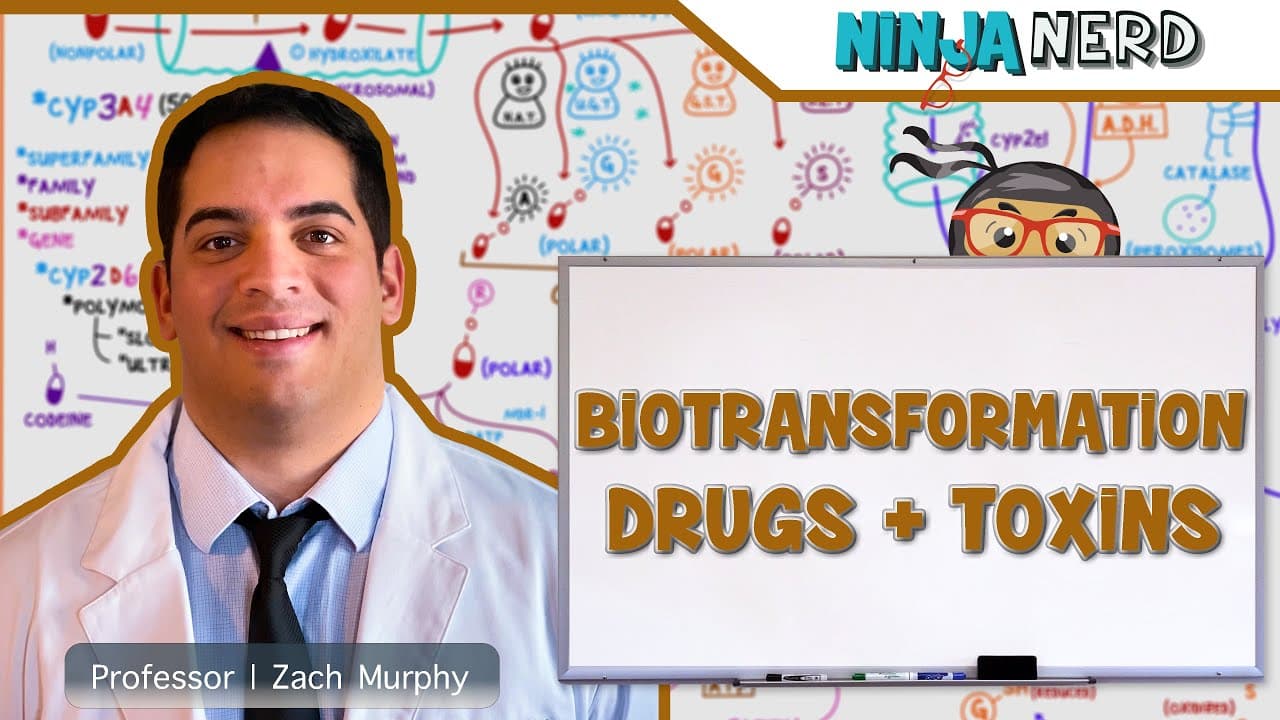
TL;DR
The liver converts hydrophobic drugs and toxins into more polar, water-soluble products that can be eliminated through urine or fecal matter. Phase I primarily uses cytochrome P450 enzymes for oxidation, reduction, or hydrolysis, while Phase II adds conjugated groups through processes such as glucuronidation, sulfation, acetylation, and glutathione conjugation.
Transcript
all right so it's going to get start on xenobiotic metabolism what is xenobiotics we should really get an understanding of that first before we start talking about all this other stuff so xenobiotics they are basically any particular substance that is not naturally present in the body or it's not produced by the body or it's in higher concentration... Read More
Key Insights
- Xenobiotics are substances that are foreign to the body, are not naturally produced by it, or are present at higher concentrations than usual. Drugs and toxins are the primary xenobiotics considered in hepatic biotransformation.
- The liver is a central detoxification organ because it metabolizes many drugs and toxins. Orally ingested drugs cross the digestive system, enter the hepatic portal circulation, and reach hepatocytes before undergoing biochemical modification.
- Drug biotransformation has two main phases. Phase I introduces or exposes polar groups through oxidation, reduction, or hydrolysis, while Phase II uses conjugation reactions to increase water solubility and support excretion.
- Cytochrome P450 enzymes are heme-containing proteins located in the smooth endoplasmic reticulum of hepatocytes. Their name reflects the approximately 450-nanometer maximum absorption wavelength observed when the heme pigment binds carbon monoxide.
- The purpose of Phase I metabolism is to make hydrophobic compounds more polar. Cytochrome P450 enzymes commonly accomplish this through hydroxylation, although oxidation, reduction, and hydrolysis reactions can also modify drug molecules.
- CYP3A4 metabolizes almost 50 percent of the available drugs discussed in the lecture. In its name, CYP identifies the superfamily, 3 identifies the family, A identifies the subfamily, and 4 identifies the gene producing the isozyme.
- CYP2D6 genetic polymorphisms can produce slow or ultra-rapid metabolizers. Because CYP2D6 converts codeine into morphine, slow metabolism can reduce the analgesic effect, while ultra-rapid metabolism can generate dangerously high morphine concentrations, especially in children.
- Phase II conjugation further increases the water solubility of modified compounds. The described pathways include glucuronidation, sulfation, acetylation, and glutathione conjugation, and UDP-glucuronosyltransferase is identified as a particularly common enzyme in this stage.
Install to Summarize YouTube Videos and Get Transcripts
Explore YouTube Video Summarizer or Get YouTube Transcript Extractor
Questions & Answers
Q: What are xenobiotics in drug metabolism?
Xenobiotics are substances that are not naturally present in the body, are not produced by the body, or occur at concentrations higher than usual. The lecture primarily uses the term for drugs and toxins. Because many of these compounds are hydrophobic, the body must modify them into more polar products that can dissolve in urine, fecal matter, or blood plasma.
Q: How does the liver metabolize drugs and toxins?
The liver metabolizes drugs and toxins through two main phases of biotransformation. Phase I uses reactions such as oxidation, reduction, and hydrolysis to introduce or expose a polar group, often a hydroxyl group. Phase II then conjugates the modified compound through processes such as glucuronidation, sulfation, acetylation, or glutathione conjugation, increasing water solubility and facilitating elimination.
Q: What happens during Phase I drug metabolism?
Phase I drug metabolism primarily occurs through cytochrome P450 enzymes in the smooth endoplasmic reticulum of hepatocytes. These enzymes modify hydrophobic drug molecules through oxidation, reduction, or hydrolysis. Hydroxylation is emphasized as a common reaction because adding an oxygen-containing hydroxyl group makes the compound slightly more polar and prepares it for further metabolism or eventual elimination.
Q: What happens during Phase II drug metabolism?
Phase II metabolism uses conjugation reactions to make a drug or its Phase I product more water-soluble. The pathways identified include glucuronidation, sulfation, acetylation, and glutathione conjugation. UDP-glucuronosyltransferase is highlighted as a common enzyme involved in this stage. Greater polarity helps the resulting products become soluble enough for excretion through urine or fecal matter.
Q: What is the cytochrome P450 enzyme system?
The cytochrome P450 system is a superfamily of heme-containing enzymes that plays a central role in xenobiotic metabolism. These enzymes are abundant in the smooth endoplasmic reticulum of liver cells and commonly introduce oxygen into drug compounds. The designation P450 comes from the approximately 450-nanometer maximum wavelength absorbed when the heme pigment is bound to carbon monoxide.
Q: Why is CYP3A4 important in drug metabolism?
CYP3A4 is important because the lecture identifies it as responsible for metabolizing almost 50 percent of available drugs. Its name also illustrates cytochrome P450 nomenclature: CYP indicates the enzyme superfamily, 3 represents the family, A represents the subfamily, and 4 identifies the gene that produces the particular protein isozyme involved in metabolism.
Q: How do CYP2D6 polymorphisms affect codeine?
CYP2D6 polymorphisms can cause people to metabolize codeine at very different rates. Slow metabolizers produce too little of the relevant enzyme and may convert insufficient codeine into morphine, reducing the analgesic effect. Ultra-rapid metabolizers can produce morphine at very high concentrations, creating serious and potentially fatal effects, particularly when codeine is given to children.
Q: What factors can alter drug biotransformation?
Drug biotransformation can be influenced by genetic variability, drug interactions, enzyme induction or inhibition, and liver disease. These factors can change how quickly or efficiently a compound is metabolized, thereby altering its half-life and effectiveness. Metabolism can also activate certain prodrugs, so changes in metabolic activity may influence whether those drugs produce their intended effects.
Summary & Key Takeaways
-
Xenobiotics are substances that are not naturally present in the body, are not produced by it, or occur at concentrations above normal. After an orally administered drug enters the hepatic portal system, it reaches the liver, where hepatocytes begin transforming the usually hydrophobic compound into forms that are easier to transport or eliminate.
-
Phase I metabolism occurs largely in the smooth endoplasmic reticulum of hepatocytes through the cytochrome P450 enzyme system. Oxidation, reduction, and hydrolysis reactions introduce or expose polar groups, often through hydroxylation. This initial modification makes a drug slightly more polar, preparing it for elimination or additional processing during Phase II metabolism.
-
Phase II metabolism uses conjugation reactions to make compounds more water-soluble. Processes described include glucuronidation, sulfation, acetylation, and glutathione conjugation, with UDP-glucuronosyltransferase identified as a common enzyme. Genetic variability, enzyme induction or inhibition, drug interactions, and liver disease can alter metabolism, drug half-life, effectiveness, and the risk of serious effects.
Read in Other Languages (beta)
Share This Summary 📚
Summarize YouTube Videos and Get Video Transcripts with 1-Click
Try YouTube Summary with ChatGPT & Claude or YouTube Transcript Generator
Explore More Summaries from Ninja Nerd 📚






Summarize YouTube Videos and Get Video Transcripts with 1-Click
Try YouTube Summary with ChatGPT & Claude or YouTube Transcript Generator