How Does Google's Personal Intelligence Work?
TL;DR
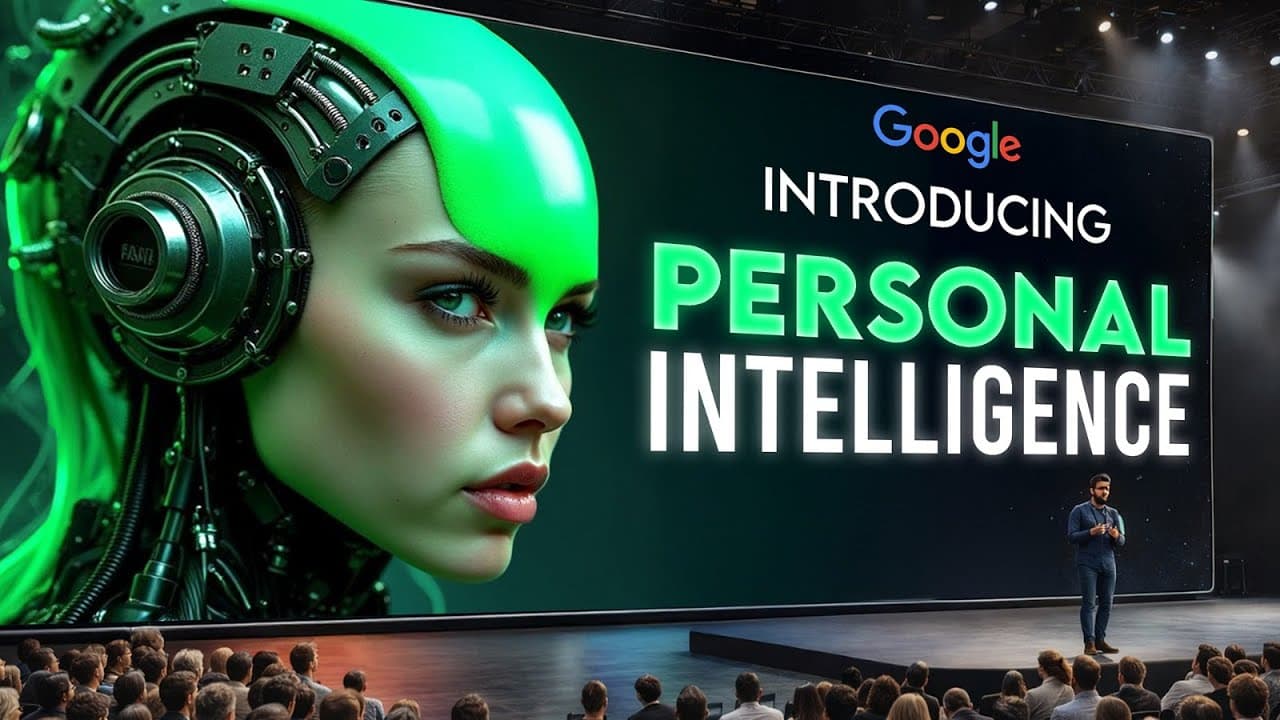
Google's Gemini now offers personal intelligence by using data from Gmail, Photos, and other apps to provide personalized recommendations. Users maintain control over privacy settings, ensuring data is not used for model training. This approach aims to create a more integrated and personalized assistant experience, enhancing user engagement within Google's ecosystem.
Transcript
Google just rolled out personal intelligence in Gemini, meaning your assistant can now pull context from your Gmail, photos, and connected apps. Open AAI is pushing global mass adoption with chat GPT go at 8 a month while preparing to test ads inside freeand go accounts. Meanwhile, Black Forest Labs just launched Flux Point.2 Klein, bringing sub0.5... Read More
Key Insights
- Google's Gemini uses personal data from Gmail, Photos, and connected apps to offer personalized suggestions.
- Unlike traditional assistants, Gemini retains long-term context and memory for personalized interactions.
- Users have control over which apps are connected and when personalization is active, emphasizing privacy.
- Google claims Gemini does not use personal data for model training, maintaining a boundary between personalization and data usage.
- OpenAI's ChatGPT Go offers a cheaper subscription tier at $8 per month, aiming for mass adoption.
- OpenAI plans to introduce ads in ChatGPT Free and Go, creating an ad-supported AI economy.
- Black Forest Labs' FLUX.2 Klein offers sub-0.5 second photorealistic image generation on consumer GPUs, enhancing creative workflows.
- Google plans to reintroduce smart glasses in 2026, focusing on normal designs and integrating features like navigation within the user's field of view.
Install to Summarize YouTube Videos and Get Transcripts
Explore YouTube Video Summarizer or Get YouTube Transcript Extractor
Questions & Answers
Q: How does Google's Gemini use personal data?
Google's Gemini utilizes personal data from Gmail, Photos, and connected apps to offer personalized recommendations. This system analyzes past interactions, emails, photos, and activities to tailor suggestions to individual preferences. Users can control which apps provide data and when personalization is active, ensuring privacy and user control over their personal information.
Q: What privacy features does Google's Gemini offer?
Google's Gemini emphasizes privacy by allowing users to control which apps are connected and when personalization is active. The system is designed to reference personal data in real time without using it for model training. Users can also adjust privacy settings, opt out of features, and correct any inaccuracies, ensuring transparency and user control over their data.
Q: What is OpenAI's ChatGPT Go?
OpenAI's ChatGPT Go is a subscription tier priced at $8 per month, aimed at expanding user access to advanced AI features. It provides more messages than the free tier, allows file uploads, and offers image generation capabilities. This tier is designed for heavy day-to-day use, with longer memory and a larger context window, making it suitable for regular tasks and workflows.
Q: How will ads be integrated into ChatGPT Free and Go?
OpenAI plans to introduce ads in ChatGPT Free and Go to support the lower subscription price. Ads will be labeled and separated from AI responses, ensuring they do not influence the answers provided. Sensitive topics like health and politics will be ad-free to maintain user trust and prevent any potential bias in the AI's responses.
Q: What is FLUX.2 Klein and why is it significant?
FLUX.2 Klein, launched by Black Forest Labs, is a model that enables sub-0.5 second photorealistic image generation on consumer GPUs. This capability allows for real-time image creation and editing, making it a valuable tool for developers, creators, and research teams. Its fast processing speed and compatibility with consumer hardware make it accessible and practical for various creative applications.
Q: What are Google's plans for smart glasses in 2026?
In 2026, Google plans to reintroduce smart glasses with a focus on normal, socially acceptable designs. The new models aim to integrate practical features like navigation displayed in the user's field of view. Google is working with popular brands to ensure the glasses are desirable accessories, leveraging its ecosystem for seamless integration with services like Maps and Gmail.
Q: How does Gemini differ from traditional assistants?
Gemini differs from traditional assistants by maintaining long-term context and memory, allowing it to offer personalized recommendations based on a user's past interactions and preferences. Unlike generic chatbots, Gemini can analyze emails, photos, and activities to provide tailored suggestions, creating a more integrated and personalized user experience within Google's ecosystem.
Q: Why is personalization important for Google's strategy?
Personalization is crucial for Google's strategy as it enhances user engagement and creates a lock-in effect within its ecosystem. By offering tailored recommendations through Gemini, Google ensures users rely on its services for organization, travel planning, and daily schedules. This personalized approach makes it difficult for users to switch to other platforms, strengthening Google's market position.
Summary & Key Takeaways
-
Google's Gemini introduces personal intelligence by integrating data from Gmail, Photos, and connected apps to deliver tailored recommendations. Users can control app connections and personalization settings, ensuring privacy protection. This feature aims to deepen user engagement within Google's ecosystem.
-
OpenAI's ChatGPT Go, priced at $8 per month, seeks to expand its user base by offering more features than the free tier. OpenAI is also testing ads in ChatGPT Free and Go, establishing an ad-supported model to sustain lower subscription costs.
-
Black Forest Labs' FLUX.2 Klein offers rapid photorealistic image generation on consumer GPUs, enhancing real-time creative processes. Meanwhile, Google plans a 2026 comeback for smart glasses, focusing on user-friendly designs and practical features like integrated navigation.
-
(Content reviewed on 2026-08-27.)
Read in Other Languages (beta)
Share This Summary 📚
Summarize YouTube Videos and Get Video Transcripts with 1-Click
Try YouTube Summary with ChatGPT & Claude or YouTube Transcript Generator
Explore More Summaries from AI Revolution 📚


Summarize YouTube Videos and Get Video Transcripts with 1-Click
Try YouTube Summary with ChatGPT & Claude or YouTube Transcript Generator