How Does DeepSeek OCR Compress Documents?
TL;DR
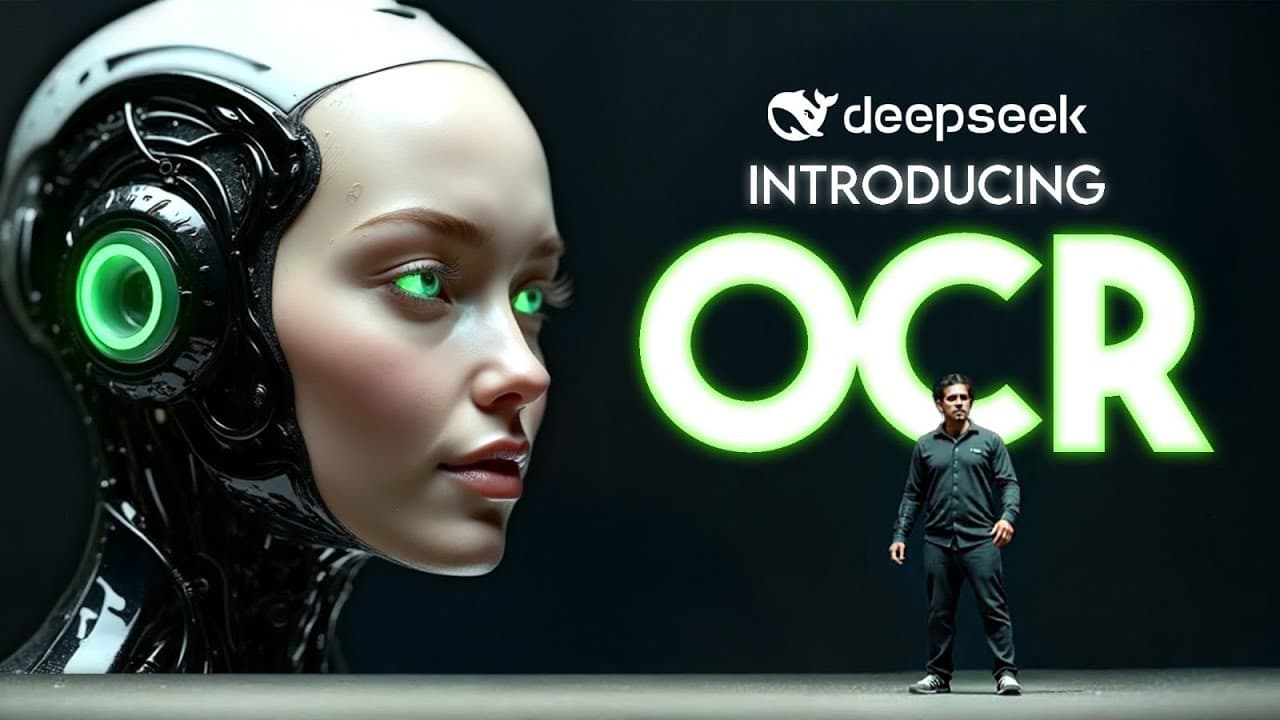
DeepSeek OCR compresses documents by rendering text as images, using a vision encoder to convert them into a compact stream of visual tokens for an LLM. It can reduce a 1,000-word article to roughly 100 visual tokens while retaining about 97% of the information, and one NVIDIA A100 can process around 200,000 pages daily. Read on for its architecture, benchmarks, training data, and outputs.
Transcript
DeepSeek just went viral on GitHub with a new open-source AI that can read massive documents and squeeze a thousand words down to a 100. Basically turning text into tiny visual snapshots. Shang Shu just dropped a new video model to rival Google's V3. It lets you stitch faces, props, and scenes into full cinematic clips in seconds. Google built an A... Read More
Key Insights
- DeepSeek OCR is an open-source document model that renders text as images, processes those images through a vision encoder, and supplies a compact sequence of visual tokens to a language model instead of relying on a large conventional text-token context.
- DeepSeek OCR reportedly compresses a 1,000-word article into roughly 100 visual tokens while preserving about 97% of its information. This approach can reduce the token burden associated with large document collections, long history windows, retrieval corpora, and compliance archives.
- DeepSeek OCR can process about 200,000 pages per day on one NVIDIA A100, according to the figures presented. Its roughly 3-billion-parameter design includes a 380-million-parameter encoder and a mixture-of-experts generator with about 570 million parameters active at a time.
- DeepSeek OCR uses fewer tokens than competing systems in the cited benchmarks. It matches Goo OCR 2.0 tasks at around 100 visual tokens instead of roughly 256, while remaining below 800 tokens on comparable dense-page scenarios where MinerU 2.0 can exceed 6,000.
- Vidu Q2 is a reference-to-video system that accepts up to seven images containing faces, props, or scenes. It combines those references with a prompt, maintains multiple entities across a clip, and can generate transitions using only the first and final frames.
- Vidu Q2 demonstrated consistent Chinese text, logos, referenced objects, facial expressions, and bilingual lip synchronization in the tests described. Its emotional audio delivery was judged flatter than Veo 3.1, but its multi-entity stability and support for production integration through an API were competitive.
- DeepSomatic is a cancer-genome analysis model that converts sequencing reads into images and uses a convolutional neural network to separate genuine mutations from noise. It works across Illumina, PacBio, and Oxford Nanopore sequencing data without platform-specific retraining, according to the transcript.
- Kohler's Dekoda is a $599 toilet-mounted camera that analyzes waste for hydration, gut-health patterns, and traces of blood. It supports separate profiles through fingerprint authentication, uses end-to-end encryption, and has a rechargeable battery that lasts about one week.
- "Take a thousandword article, compress it into roughly 100 visual tokens, and keep about 97% of the information." (0:49)
- "Instead of throwing piles of text at a tokenizer and paying the token tax, they render text as images, run it through a vision encoder, and hand the LLM a compact stream of vision tokens." (1:00)
- "A single NVIDIA A100 can process on the order of 200,000 pages per day with this pipeline." (1:17)
- "You can preserve formatting, dump plain text, or emit general image descriptions." (3:22)
Install to Summarize YouTube Videos and Get Transcripts
Explore YouTube Video Summarizer or Get YouTube Transcript Extractor
Questions & Answers
Q: How does DeepSeek OCR compress documents?
DeepSeek OCR renders text as images and processes those images through a vision encoder. The encoder gives the language model a compact stream of visual tokens instead of sending piles of text through a conventional tokenizer.
Q: How much can DeepSeek OCR compress a 1,000-word article?
The presented example compresses a 1,000-word article into roughly 100 visual tokens. It retains about 97% of the information.
Q: How many pages can DeepSeek OCR process per day?
A single NVIDIA A100 can process on the order of 200,000 pages per day with the pipeline. The transcript connects this throughput to building pre-training sets, RAG corpora, and compliance archives.
Q: What is the architecture of DeepSeek OCR?
The overall model has around 3 billion parameters. It combines a deep encoder of about 380 million parameters with a mixture-of-experts language model containing roughly 3 billion total parameters and around 570 million active at a time.
Q: How does DeepSeek OCR compare with Goo OCR 2.0 and Minor U 2.0?
On OmniDoc Bench, Goo OCR 2.0 needs roughly 256 tokens per page while DeepSeek reaches the same task at around 100 vision tokens. For comparable dense-page complexity, Minor U 2.0 often exceeds 6,000 tokens per page while DeepSeek remains under 800.
Q: What data was DeepSeek OCR trained on?
Its training data includes roughly 30 million PDF pages spanning about 100 languages, with around 25 million pages in Chinese and English. It also includes about 10 million synthetic diagrams, 5 million chemical formulas, and 1 million geometric figures.
Q: What output formats does DeepSeek OCR support?
DeepSeek OCR can preserve formatting, produce plain text, or emit general image descriptions. The transcript says this flexibility makes it easier to connect the model to downstream tools without replacing existing pipelines.
Q: Where is DeepSeek OCR available, and what tools are included?
The project is available through HuggingFace and GitHub under the name stated in the transcript as DeepSeek AAI/deseek OCR. It includes runnable code for NVIDIA GPUs, PDF helpers, and acceleration tips via VLM.
Summary & Key Takeaways
-
DeepSeek OCR treats document text as visual information instead of feeding conventional text tokens directly into a language model. Its vision encoder creates a compact token stream, reportedly preserving about 97% of the information when compressing a 1,000-word article into roughly 100 visual tokens. The open-source release includes runnable code and PDF tools.
-
ShengShu's Vidu Q2 creates 5-second and 8-second, 1,080-pixel clips using text or reference images. Users can provide up to seven images covering faces, scenes, and props. Tests described in the transcript found strong consistency for multiple entities, Chinese text, logos, facial expressions, and bilingual lip synchronization, although voice emotion remained comparatively flat.
-
DeepSomatic converts stacked genetic sequencing reads into images so a convolutional neural network can distinguish mutations from noise across Illumina, PacBio, and Oxford Nanopore data. Kohler's Dekoda applies a similar visual-analysis trend to home health, using a toilet-mounted camera to track hydration, gut-health patterns, and possible traces of blood.
Read in Other Languages (beta)
Share This Summary 📚
Summarize YouTube Videos and Get Video Transcripts with 1-Click
Try YouTube Summary with ChatGPT & Claude or YouTube Transcript Generator
Explore More Summaries from AI Revolution 📚





Summarize YouTube Videos and Get Video Transcripts with 1-Click
Try YouTube Summary with ChatGPT & Claude or YouTube Transcript Generator