How Does Gemini 3 Advance Google's AGI Plan?
TL;DR
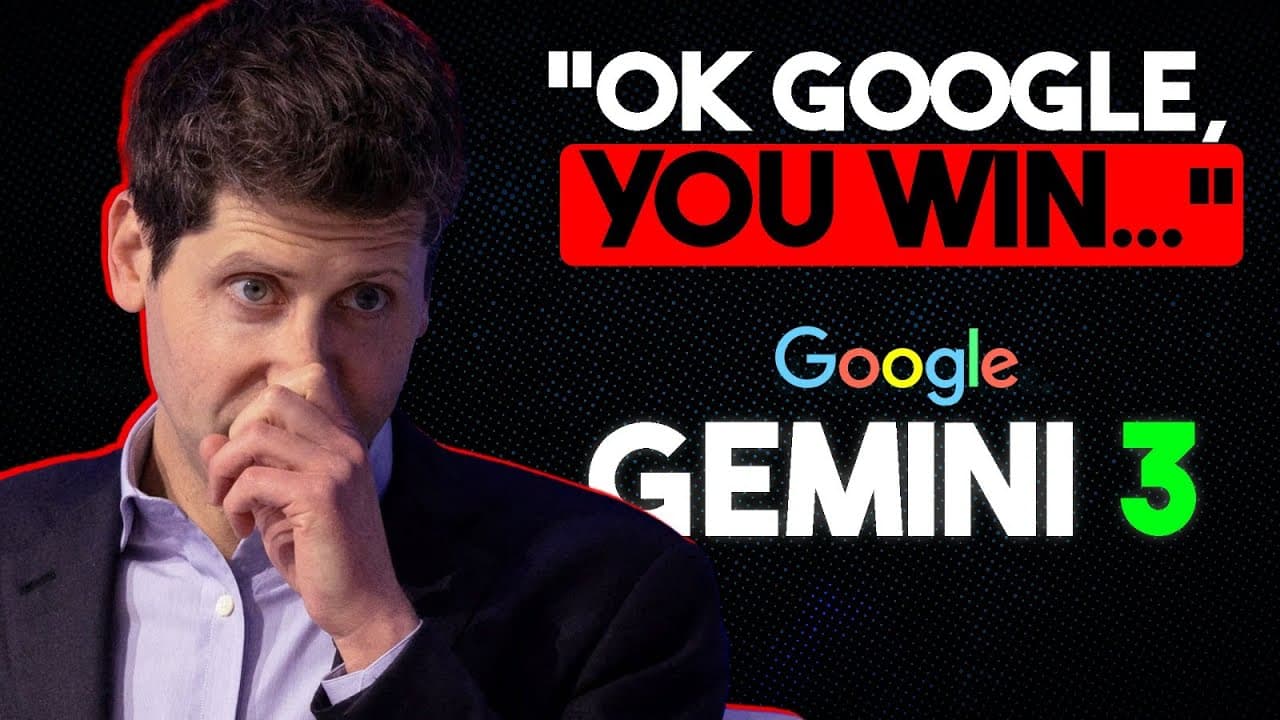
Gemini 3 is presented as a reasoning engine embedded across Google's products, with structured problem solving, unified multimodal processing, stable long-context handling, and stronger agentic coding. The central argument is that Google's advantage comes from combining the model with Search, Antigravity, Android, Chrome, Cloud, and other services, creating an ecosystem where agents can plan, use tools, and complete extended tasks.
Transcript
So, Google dropped Gemini 3, and honestly, the rollout did not feel like a normal model release at all. Everyone expected the usual stuff, benchmarks, a couple of polished demos, maybe a blog post, and that's it. Instead, the whole timeline flipped in minutes. Gemini 3 showed up, and once you connect the dots, the whole thing starts to look less li... Read More
Key Insights
- Gemini 3 is presented as a reasoning engine that identifies deeper intent, follows extended logic, and maps out steps before answering. Its responses are described as cleaner, more grounded, and less robotic because the model works with surrounding context instead of reacting mainly to isolated keywords.
- Deep Think works by constructing structured task trees and dividing a problem into smaller steps before generating an answer. The transcript contrasts this layered organization with sprawling chains of thought and credits the method for more consistent performance on demanding reasoning tests.
- Gemini 3's multimodal system processes text, images, video, spatial reasoning, and diagrams as parts of one coherent context. This unified treatment lets the model connect mixed inputs rather than treating each medium as a separate mode with limited continuity between them.
- The 1 million token context window is valuable because Gemini 3 reportedly uses it reliably, not merely because the window is large. The model is described as maintaining coherence across long documents, codebases, videos, and mixed inputs without the drift that can undermine nominally large context windows.
- Gemini 3's video reasoning maintains object tracking and temporal consistency across fast or chaotic footage. It can connect earlier segments with later events, which the transcript identifies as important for robotics, autonomous driving, surveillance, sports analysis, and other tasks requiring continuous understanding.
- Google's full-stack advantage is its control of research, silicon, cloud infrastructure, data centers, Search, Android, Chrome, devices, advertising, and widely used applications. The transcript argues that this ownership lets Google distribute Gemini across existing products without depending primarily on outside platforms or partnerships.
- Antigravity is described as an agent-first developer environment rather than a conventional coding assistant. It lets Gemini work across the editor, terminal, browser, logs, and errors, creating a controlled setting for planning, tool switching, troubleshooting, self-correction, and extended project execution.
- Google's proposed AGI strategy is a distributed ecosystem of agents operating across products rather than a single model confined to a chat interface. Search, Android, Chrome, Gmail, Docs, YouTube, Maps, Photos, consumer agents, and developer tools are portrayed as connected parts of that environment.
Install to Summarize YouTube Videos and Get Transcripts
Explore YouTube Video Summarizer or Get YouTube Transcript Extractor
Questions & Answers
Q: What makes Gemini 3 different from a normal model release?
Gemini 3 is portrayed as a full-stack release because Google combined a frontier-level reasoning model with immediate product distribution and agent-oriented tooling. The model reportedly entered Search on its first day while also demonstrating stronger reasoning, multimodal processing, long-context stability, video understanding, and coding. The transcript argues that these elements reveal a coordinated platform strategy rather than an isolated model upgrade.
Q: How does Deep Think reason through difficult problems?
Deep Think is described as building structured task trees internally. It breaks a difficult problem into smaller steps before it begins answering, producing a layered reasoning process instead of an uncontrolled sequence of thoughts. According to the transcript, this organization helps it approach demanding reasoning tests consistently because it first creates a structure for the task rather than simply guessing at an answer.
Q: How does Gemini 3 handle multimodal information?
Gemini 3 reportedly processes text, images, video, diagrams, and spatial information within one coherent context structure. Rather than treating each input type as an isolated mode, it connects them as pieces of the same situation. This approach is presented as useful when a task requires relationships across media, such as interpreting written instructions alongside visual evidence, motion, or spatial layouts.
Q: Why does Gemini 3's 1 million token window matter?
The 1 million token window matters because Gemini 3 is described as using large contexts with greater reliability, not because a large window is itself new. The model reportedly keeps long documents, codebases, videos, and combinations of different inputs coherent without drifting. That stability can be more useful than nominal capacity when a task depends on details spread across extensive source material.
Q: What video reasoning capabilities does Gemini 3 provide?
Gemini 3 is described as tracking objects through fast motion, maintaining temporal consistency, and remembering earlier video segments while interpreting later ones. It reportedly remains coherent even when footage becomes chaotic instead of analyzing every frame in isolation. The transcript connects these capabilities to robotics, autonomous driving, surveillance, sports analysis, and other applications that need continuous understanding over time.
Q: What is Google Antigravity designed to do?
Antigravity is presented as an agent-first operating environment for developers. It gives Gemini access to the editor, terminal, browser, logs, errors, and other parts of a development workflow. Within that environment, the model can plan multiple steps, switch tools, identify problems, correct itself, and continue toward a larger objective, rather than limiting its work to isolated code suggestions.
Q: Why is Google's product ecosystem important for Gemini 3?
Google controls many layers named in the transcript, including silicon, research, cloud infrastructure, data centers, Search, Android, Chrome, devices, advertising, and widely used applications. This structure gives Gemini extensive distribution and potential access to connected workflows. The video's central argument is that integrating a capable model throughout this stack may be more strategically important than winning individual benchmark comparisons.
Q: How could Gemini 3 support a distributed AGI ecosystem?
The proposed ecosystem places reasoning and agents throughout Google's products instead of keeping Gemini inside one chat interface. Search can reason for users, Android can provide a device layer, Chrome can serve as a working environment, and services such as Gmail, Docs, YouTube, Maps, and Photos can become connected workflow components. Antigravity adds a developer environment for extended planning and tool use.
Summary & Key Takeaways
-
Gemini 3 is characterized as more than a model update because Google reportedly introduced it directly within Search and paired it with capabilities spanning reasoning, multimodal understanding, long context, video analysis, and coding. The release is interpreted as an activation of a broader system rather than a conventional collection of benchmarks and demonstrations.
-
Deep Think is described as organizing difficult problems into structured task trees and smaller steps before producing answers. Gemini 3 also processes text, images, video, diagrams, and spatial information as parts of one context. Its 1 million token window is considered valuable because the model reportedly maintains coherence across large, mixed inputs.
-
Antigravity is portrayed as an agent-oriented developer environment that gives Gemini access to an editor, terminal, browser, logs, and errors. Combined with Google's ownership of research, silicon, infrastructure, software, and distribution, it could support agents that plan, use tools, troubleshoot, and execute long projects across both developer and consumer products.
Read in Other Languages (beta)
Share This Summary 📚
Summarize YouTube Videos and Get Video Transcripts with 1-Click
Try YouTube Summary with ChatGPT & Claude or YouTube Transcript Generator
Explore More Summaries from AI Revolution 📚




Summarize YouTube Videos and Get Video Transcripts with 1-Click
Try YouTube Summary with ChatGPT & Claude or YouTube Transcript Generator