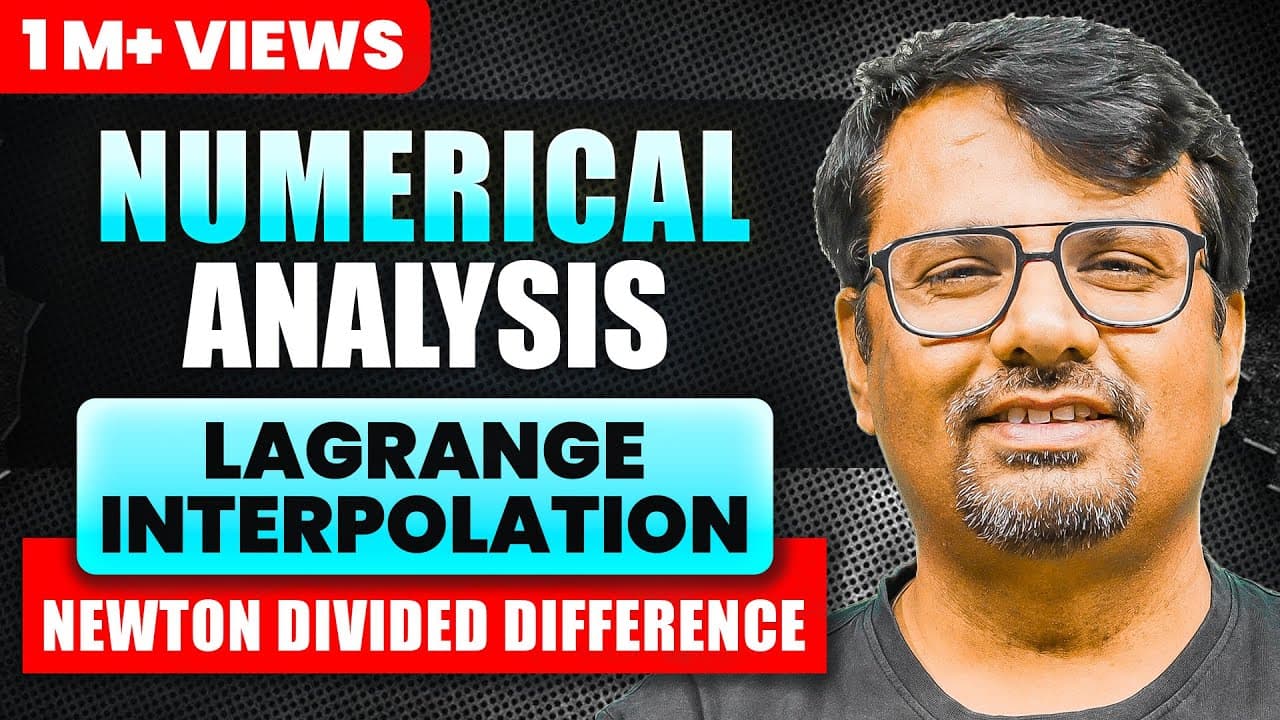
How to apply Lagrange Interpolation for unequal intervals?
TL;DR
Lagrange interpolation for unequal intervals is explained with tricks to avoid memorizing the formula. The video presents solving multiple example problems and comparing Lagrange and Newton divided difference approaches. It also covers inverse interpolation and emphasizes practice through questions and recaps for engineering mathematics and basic sciences.
Transcript
Hello students, myself Dr. Gajendra Purohit today we will discuss Lagranges Interpolation formula for the for the unequal interval, students before this here is the high tab you can go there and watch all the videos plus for engeering mathematics and bsc students I've made lots of videos those are in the playlist so students see here Lagrang... Read More
Key Insights
- Lagrange interpolation is used for unequal intervals, not just equal spacing.
- The method can be taught with a quick trick to avoid memorizing the full formula.
- Newton divided difference is discussed as an alternative approach for uneven data.
- Polynomial calculation can be performed with either Lagrange or Newton methods.
- Inverse interpolation is covered as a separate topic within the same lesson.
- The video includes multiple example problems to illustrate concepts clearly.
- The instructor emphasizes practice by presenting exam style questions and solutions.
- The content is aimed at engineering mathematics and basic science students, including GATE and IIT JAM aspirants.
Install to Summarize YouTube Videos and Get Transcripts
Explore YouTube Video Summarizer or Get YouTube Transcript Extractor
Questions & Answers
Q: How to apply Lagrange interpolation for unequal intervals in practice?
Lagrange interpolation for unequal intervals is demonstrated by selecting known data points and constructing the interpolation polynomial using the Lagrange basis polynomials. The approach stays focused on nonuniform spacing, showing how to form each basis polynomial and combine them to obtain the interpolating polynomial that fits all given points.
Q: What is the quick trick to learn the Lagrange formula without memorizing it?
The video presents a trick that helps students derive the interpolation polynomial from first principles rather than memorizing a fixed formula. By understanding the construction of basis polynomials and how they weight function values, learners can reproduce the result for unequal intervals in two minutes or fewer, given the data.
Q: How does Newton divided difference relate to unequal interval interpolation?
Newton divided difference provides an alternative formulation for interpolation with unevenly spaced data. The method computes successive divided differences and builds the interpolating polynomial in a progressive, recursive manner. The video shows how this approach can yield the same polynomial as Lagrange for the same data set.
Q: What kinds of examples are used to illustrate the method?
Several example problems are used to demonstrate both Lagrange and Newton methods. Each example walks through data points with unequal intervals, constructs the appropriate polynomial, and verifies that the polynomial passes through all given points, reinforcing understanding through concrete calculations and step by step reasoning.
Q: Is inverse interpolation discussed in this lesson?
Yes, inverse interpolation is addressed as a separate topic within the same video. The instructor explains how to interpolate to invert the dependent and independent variables, showing scenarios where one might estimate the input value corresponding to a given output, using the same interpolation principles.
Q: What is the target audience for this video?
The content is aimed at engineering mathematics and basic science students, including those preparing for competitive exams such as GATE and IIT JAM. The material is designed to be accessible to BSc and BTech students and focuses on practical problem solving rather than memorization.
Q: Do the videos include almost any support material besides the lecture?
The description mentions a playlist with related topics in engineering mathematics and a second channel for additional content. Viewers are encouraged to watch related topics and subscribe to stay updated, suggesting a broader set of materials to reinforce learning across topics in numerical analysis.
Q: What is the structure and pacing of the lesson according to the video?
The video is structured with an introduction, several example sections with time stamps, and a concluding recap. This pacing allows learners to follow along gradually, see the application of theory to problems, and revisit any section as needed, ensuring clarity and retention of key interpolation concepts.
Summary & Key Takeaways
-
The video introduces Lagrange interpolation for unequal intervals and shows a practical trick to learn the formula quickly while solving exam style questions. It demonstrates how to work with both Lagrange and Newton divided difference methods and applies them to several examples.
-
Several example problems are solved to reinforce the method, including how to compute interpolation polynomials and how to use inverse interpolation. The instructor combines theory with step by step calculations to help viewers grasp the concepts and apply them in exams.
-
Towards the end the presenter recaps the key ideas and invites viewers to subscribe and watch related videos in the engineering mathematics playlist. The description encourages sharing with classmates and highlights that the content targets engineering and basic science students preparing for exams.
Read in Other Languages (beta)
Share This Summary 📚
Summarize YouTube Videos and Get Video Transcripts with 1-Click
Try YouTube Summary with ChatGPT & Claude or YouTube Transcript Generator
Explore More Summaries from Dr.Gajendra Purohit 📚


Summarize YouTube Videos and Get Video Transcripts with 1-Click
Try YouTube Summary with ChatGPT & Claude or YouTube Transcript Generator