How to Build No-Code AI Agents That Work
TL;DR
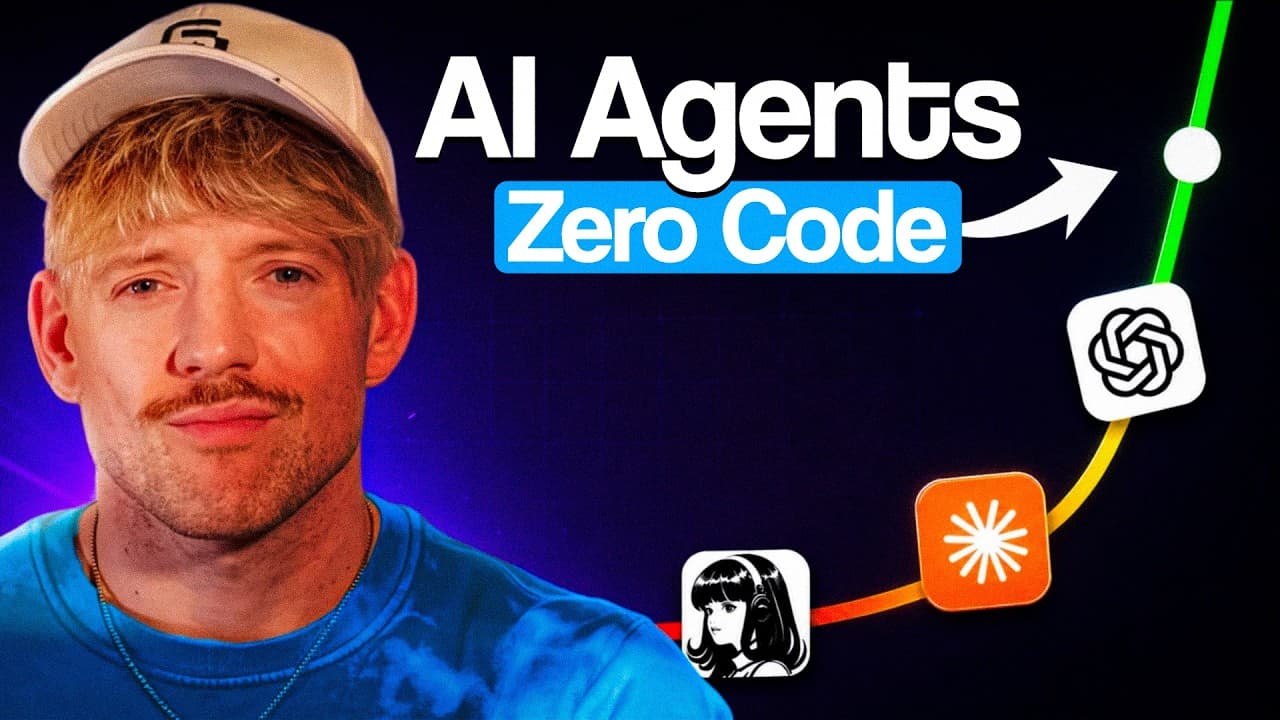
Effective AI agents require three capabilities: access where work happens, knowledge about the user or organization, and proactivity. Start with a repeatable task, turn it into a persistent agent, connect it to a shared channel such as Slack or Telegram, and add relevant memories, policies, strategy, and business context so the agent can produce useful results for individuals or teams.
Transcript
I'm going to show you exactly how to build AI agents that actually work. AI can be very confusing and there are so many different concepts to understand. And after spending literally hundreds of hours building AI agents, I'm going to show you exactly no fluff. How to build AI agents easily with no code across three levels that you need to master so... Read More
Key Insights
- Access is the first level of an effective AI agent because the agent should live where work already happens. Connecting it to Slack or Telegram reduces the need to introduce additional platforms and allows individuals or entire teams to reach the same reusable capability.
- A reusable agent is more valuable than a one-time prompt because its task definition can be preserved and invoked repeatedly. The demonstrated brand agent extracts a website's brand characteristics and creates a navigable, two-slide HTML presentation whenever a user submits another website.
- Shared agent access is a practical way to distribute specialized capabilities across a team. A thumbnail designer, video editor, or other colleague can message the same bot, allowing the organization to reuse an established workflow instead of having each person recreate it independently.
- Planning and approval are part of the demonstrated agent workflow. The user first requests a plan, answers follow-up questions about presentation length, format, and focus, reviews the proposed approach, and approves it before the agent executes the task and produces the deliverable.
- Knowledge is the second level because an agent needs relevant context about the person or organization it serves. Useful context can include identity, strategy, company policies, personal preferences, connected services, emails, and calendars, depending on the agent's responsibilities.
- Memory importance is configurable in the demonstrated system, allowing a user to indicate how strongly a stored fact should influence the agent. Memories can also be categorized, such as a user fact, so persistent context is organized rather than buried inside repeated prompts.
- Proactivity is the third level in the framework and distinguishes a responsive chatbot from an agent that can initiate useful work. Hyper Agent's live-agent option is presented as a way for an agent to reach out proactively instead of waiting for every request.
- The three-level framework is designed to apply beyond Hyper Agent. The presenter uses that platform for the walkthrough, but explicitly states that access, knowledge, and proactivity are general principles that can guide work in any AI agent system.
- More videos from this channel:
- More from this channel: Jack Roberts
Install to Summarize YouTube Videos and Get Transcripts
Explore YouTube Video Summarizer or Get YouTube Transcript Extractor
Questions & Answers
Q: How do you build a no-code AI agent for a team?
Begin with a specific, repeatable business or personal problem, then create and test the task in an agent platform. Turn the successful task into a persistent agent and connect it to the channel where the team already works, such as Slack or Telegram. Give the agent relevant organizational knowledge, then add proactive behavior after its shared access and context are working reliably.
Q: What are the three levels of an effective AI agent?
The three levels are access, knowledge, and proactivity. Access means placing the agent where users already communicate and work. Knowledge means supplying the personal or organizational context required for relevant output. Proactivity means enabling the agent to initiate useful activity rather than responding only after someone sends a request. Together, these levels form the video's framework for digital employees.
Q: Why should an AI agent connect to Slack or Telegram?
An agent should connect to Slack or Telegram because work and team communication may already happen there. This arrangement lets people call the agent without repeatedly switching to another platform. It also provides shared access, so several colleagues can use the same specialized workflow, including designers and editors, through a familiar communication channel and a single persistent bot.
Q: How can a one-time AI task become a reusable agent?
First, test the task with a concrete request and review the generated result. In the demonstration, the request is to extract a website's brand guidelines and create a two-slide HTML presentation. After the output succeeds, ask the platform to convert that workflow into a persistent agent, save it, and configure an invocation channel so future users can repeat it with new websites.
Q: How do you connect a Hyper Agent to Telegram?
Choose Telegram from the agent's invocation options, create a Telegram bot through BotFather, and copy the resulting token into Hyper Agent. After the connection is created, open Telegram through the pairing flow and complete the pairing. The connected bot can then receive requests, and team members can message it to invoke the persistent agent's established workflow.
Q: What knowledge should an AI agent be given?
An agent should receive knowledge that directly supports its assigned role. Personal agents may need facts about the user, preferences, strategy, connections, emails, or calendars. Business agents may need company policies and information about how organizational systems connect. The demonstrated platform also supports universal memories and importance settings, helping users preserve facts that should consistently influence agent behavior.
Q: Why is agent memory important for no-code automation?
Agent memory preserves useful context so users do not need to restate the same facts in every request. The demonstration shows a memory containing a personal interest and current training focus, assigns it a high importance level, and categorizes it as a user fact. This approach helps an agent tailor future responses while keeping important information available across interactions.
Q: What makes an AI agent proactive instead of reactive?
A reactive agent waits for a person to send a message before it begins work. A proactive agent can reach out or initiate activity, which is presented as the third level after access and knowledge. The video's live-agent option is introduced as the mechanism for proactive contact, while the description also identifies agent-to-agent communication as part of the broader automation topic.
Summary & Key Takeaways
-
The access level places an AI agent inside the communication tools where people already work. The demonstration turns a one-time brand-analysis task into a persistent agent, connects it to Telegram, and lets multiple team members request two-page HTML presentations without repeatedly opening or configuring a separate agent platform.
-
The knowledge level gives an agent the context needed to provide relevant answers and actions. Depending on its role, that context can include personal preferences, company strategy, organizational policies, connections, emails, and calendars. Hyper Agent supports agent-specific context and universal memories with adjustable importance and fact categories.
-
The proactivity level completes the three-part framework by moving beyond agents that only respond when contacted. The description presents proactive operation and agent-to-agent communication as capabilities to master after access and knowledge, creating digital employees that can contribute while the user is unavailable and support repeatable business workflows.
Read in Other Languages (beta)
Share This Summary 📚
Summarize YouTube Videos and Get Video Transcripts with 1-Click
Try YouTube Summary with ChatGPT & Claude or YouTube Transcript Generator
Explore More Summaries from Jack Roberts 📚




Summarize YouTube Videos and Get Video Transcripts with 1-Click
Try YouTube Summary with ChatGPT & Claude or YouTube Transcript Generator