How to unlearn habits to learn faster and better
TL;DR
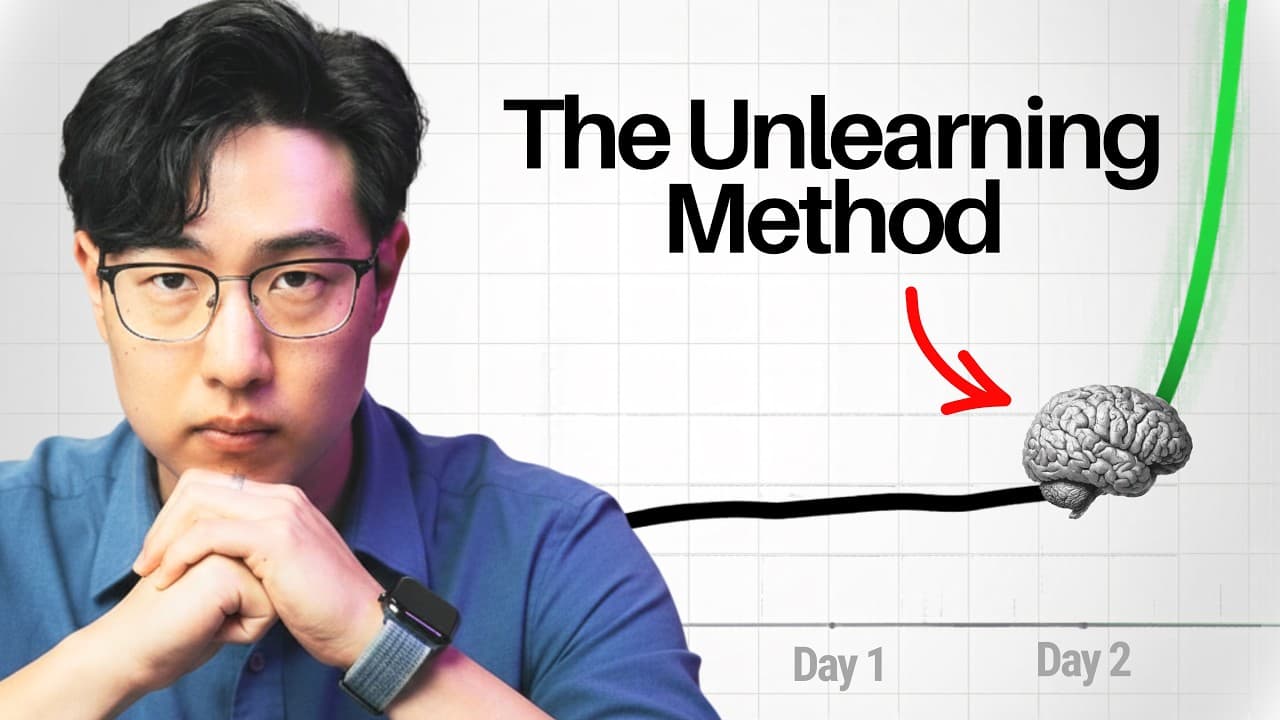
Unlearning is the key to faster skill acquisition because it replaces old, inefficient habits with new ones. The process relies on destabilizing existing memories and rewiring neural pathways from the prefrontal cortex to the basal ganglia, turning deliberate practice into automatic habits. Expect a challenging path that requires sustained mental effort to overcome entrenched patterns.
Transcript
Learning a new skill can take a lot of time and effort, but most of that time and effort is because we don't focus enough on unlearning. Unlearning is the process of replacing an old habit with a new habit or the skill that you're trying to develop. And as a learning coach who spent the past 14 years teaching thousands of people how to learn new sk... Read More
Key Insights
- Unlearning is an active rewrite of old habits, not forgetting, and it is essential for acquiring new skills.
- The journey from learning to habit formation relies on a brain model that moves from the prefrontal cortex to the basal ganglia.
- A habit is fast, energy efficient, and hard to override, which is why unlearning is necessary for better learning results.
- Memory destabilization is the mechanism that allows rewriting neural pathways during the unlearning process.
- Old habits are reinforced by low-effort basal ganglia processes, making them hard to change.
- High cognitive effort from the prefrontal cortex can fatigue over time, allowing old habits to reassert themselves.
- Effective unlearning requires deliberate practice that continually challenges automatic behavior rather than relying on passive repetition.
- Supportive strategies like structured learning approaches help sustain destabilization opportunities and promote lasting change.
- More videos from this channel:
- More from this channel: Justin Sung
Install to Summarize YouTube Videos and Get Transcripts
Explore YouTube Video Summarizer or Get YouTube Transcript Extractor
Questions & Answers
Q: What is unlearning and why is it different from forgetting?
Unlearning is the active process of rewriting old habits to replace them with new skills, whereas forgetting is a passive pruning of information from memory. Unlearning involves destabilizing existing neural connections to create room for new patterns, enabling you to implement better strategies and form new habits that support faster skill acquisition.
Q: How do the prefrontal cortex and basal ganglia contribute to learning?
The prefrontal cortex handles problem solving, executive thinking, and planning the steps of a new skill, while the basal ganglia execute habitual actions automatically. Learning starts in the prefrontal cortex and, with practice, transfers control to the basal ganglia so the skill becomes fast, efficient, and autopilot.
Q: What role does memory destabilization play in unlearning?
Memory destabilization is the moment when existing neural connections become more plastic, allowing you to rewrite the pathway with a new habit. This process is essential for replacing ineffective habits with new ones, enabling progress even when old patterns keep reappearing.
Q: Why is unlearning often harder than learning a new skill?
Unlearning fights against efficient, energy-saving habits produced by the basal ganglia. The prefrontal cortex must expend significant mental energy to counter these ingrained patterns, and fatigue can cause old habits to resurface, making progress feel slow and discouraging despite continuous effort.
Q: What is the importance of turning a skill into a habit?
Turning a skill into a habit makes it fast, reliable, and automatic, allowing you to perform it with minimal cognitive load. This shift from conscious effort to autopilot enables consistent performance and frees mental resources for higher-level tasks.
Q: How can someone improve their unlearning success rate?
Improve unlearning by creating consistent, repeated practice that targets the old habit, forces the brain to destabilize existing pathways, and substitutes new patterns. Sustained effort over time helps the basal ganglia adopt the new habit while the prefrontal cortex guides the correction.
Q: What is the consequence of not addressing unlearning when learning a new method?
If unlearning is neglected, the old, inefficient habits persist and interfere with the new method whenever the trigger for the old pattern appears. This leads to poor performance, repeated mistakes, and a feeling that progress is stalled despite attempts to learn a new approach.
Q: What practical steps can learners take to start unlearning today?
Begin by identifying the old habit to replace, design a clear new pattern to adopt, and create triggers that prompt the new behavior. Engage in focused, repeated practice while monitoring for moments of destabilization, then reinforce the new pathway with consistent effort until it becomes automatic.
Summary & Key Takeaways
-
Unlearning replaces old habits with new ones to speed up skill acquisition, turning deliberate practice into habits.
-
The brain shifts control from the prefrontal cortex to the basal ganglia as habits form, which makes skills more automatic over time.
-
Destabilization of memories creates opportunities to rewrite neural pathways, enabling progress despite initial difficulty.
Read in Other Languages (beta)
Share This Summary 📚
Summarize YouTube Videos and Get Video Transcripts with 1-Click
Try YouTube Summary with ChatGPT & Claude or YouTube Transcript Generator
Explore More Summaries from Justin Sung 📚


Summarize YouTube Videos and Get Video Transcripts with 1-Click
Try YouTube Summary with ChatGPT & Claude or YouTube Transcript Generator