How to Build an AI Social Media Content Team
TL;DR
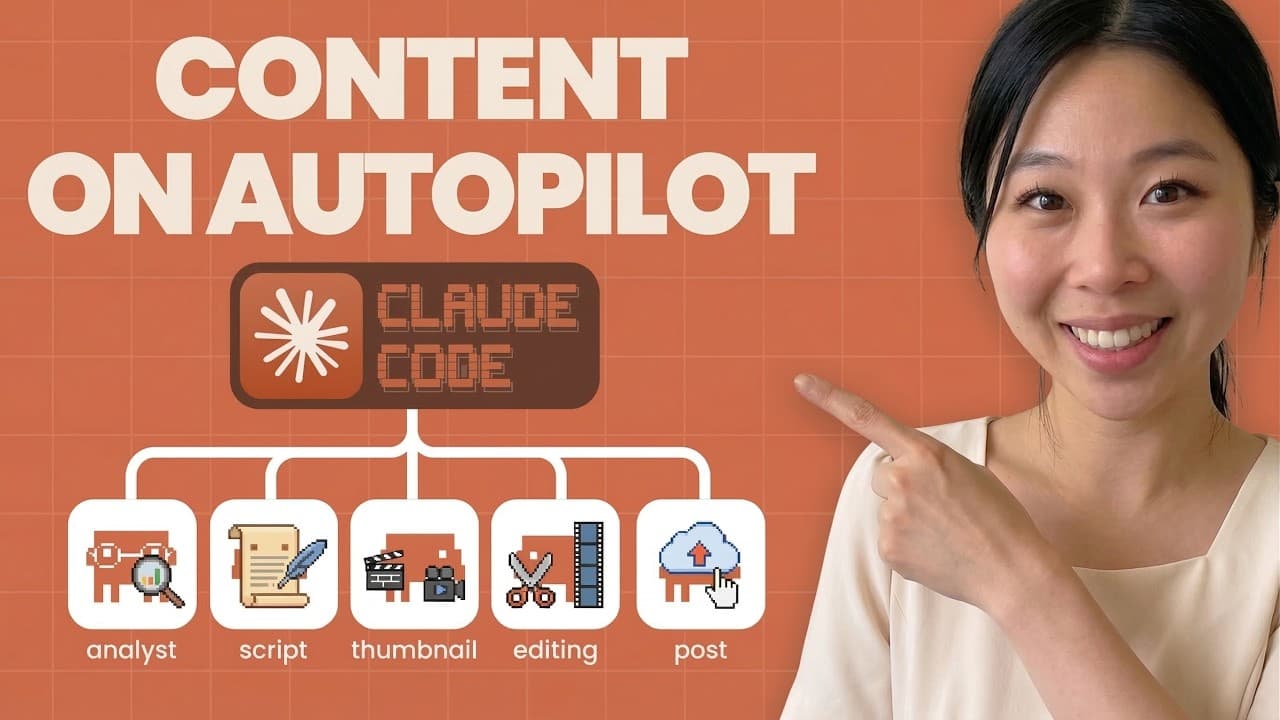
Build a personalized AI content team by dividing the workflow into specialized agents for channel analysis, trend research, scripting, thumbnails, reporting, and video editing. Claude Code is favored for deeper customization and API connections, but the system still requires human input, brand guidance, testing, and approval before publishing.
Transcript
Are you wanting to build your personal brand or grow your business? I talked to many different people and one of the struggles that they have often is creating content. [music] After working a long day, they finally come home, then they have to turn on [music] the camera and often times they don't exactly know what to say. So, they have to go back ... Read More
Key Insights
- Content consistency is difficult when creators must research, script, record, and edit after handling work and family responsibilities. The creator repeatedly stopped publishing because the workload became overwhelming, despite building an organic audience across YouTube, Instagram, and TikTok.
- The proposed AI team is a group of specialized agents rather than a single general assistant. Separate responsibilities include analyzing the channel, researching influencers, finding trends, writing scripts, generating thumbnail concepts, preparing reports, and supporting video editing and eventual uploading.
- Claude Code is the preferred platform for a workflow that needs deeper customization and several API connections. The creator contrasts it with Claude Co-work's simpler interface and values Claude Code's ability to store sensitive API keys in an environment file and perform more detailed work.
- Brand voice analysis is the foundation for personalized recommendations. The system is asked to study every available channel video, understand Sandy's voice and teaching style, and use that profile when adapting ideas, scripts, titles, thumbnails, colors, images, and editing choices.
- Outlier research is focused on unusually successful content, especially videos from smaller creators. The system examines YouTube, Instagram, and X, captures titles, thumbnails, and the first 30 seconds of relevant videos, and identifies their underlying formulas without copying them directly.
- The content report separates source material from personalized recommendations. One section preserves the creators' original titles, thumbnails, and introductions for review, while another proposes transformed versions that fit Sandy's brand voice, recording style, audience, and broader content strategy.
- A strong introduction is designed to identify the ideal viewer immediately, present a missed opportunity, and promise clear value for continuing. The creator also plans to include a preview lasting less than 10 seconds so viewers can quickly understand what the full content will cover.
- Human oversight remains necessary throughout AI-assisted production. The creator intends to review research, modify spreadsheet entries, provide brand assets, approve edited videos before publication, and gradually grant more autonomy only after the workflow consistently reflects her standards and earns her trust.
Install to Summarize YouTube Videos and Get Transcripts
Explore YouTube Video Summarizer or Get YouTube Transcript Extractor
Questions & Answers
Q: How can Claude Code automate a social media content workflow?
Claude Code can coordinate specialized agents that analyze an existing channel, research relevant influencers, identify trending and outlier content, draft scripts, propose titles, develop thumbnail concepts, prepare reports, and support editing. The creator plans to connect several APIs and tools, collect results in Google Sheets, receive email reporting, and approve finished work before anything is published.
Q: Why is Claude Code preferred over Claude Co-work for this system?
Claude Code is preferred because the planned content system needs deeper customization, multiple tool connections, and secure handling of API keys through an environment file. Claude Co-work has an easier interface and can perform useful tasks, but the creator believes it cannot yet go as deeply as Claude Code for this particular multi-agent workflow.
Q: What AI agents are included in the proposed content team?
The proposed team includes agents for channel and brand analysis, influencer research, trend and outlier detection, scriptwriting, title development, thumbnail creation, reporting, and video editing. These agents are expected to work together, with the creator supplying ideas, brand rules, photographs, colors, recorded footage, API access, feedback, and final approval before publication.
Q: How does the system find useful content ideas?
The system searches YouTube, Instagram, and X for relevant topics, trends, and unusually successful posts or videos. It studies creators working in areas such as AI agencies, AI news, AI business, and practical AI use. The creator specifically wants attention placed on smaller channels whose individual videos perform unusually well, rather than only tracking consistently large creators.
Q: How are successful videos adapted without copying them?
The workflow records the original title, thumbnail, and first 30 seconds of an outlier video's script for analysis. It then extracts the format and formula behind those elements instead of reproducing them directly. A separate recommendation uses Sandy's brand voice, audience, recording style, and visual identity to create a distinct title, introduction, script, and thumbnail concept.
Q: What should a strong video introduction contain?
A strong introduction should quickly show the intended viewer that the content addresses their situation. It should identify an important opportunity they may miss, communicate the value or satisfaction they can expect from continuing, and include a preview lasting less than 10 seconds that demonstrates what the rest of the content will deliver.
Q: How does human review fit into AI content automation?
Human input remains central because the creator does not believe businesses should rely on AI completely. She plans to review research, revise spreadsheet entries, guide brand voice, provide images and visual standards, and confirm edited videos before they are posted. Greater publishing autonomy would come only after the system proves that it can follow her preferences reliably.
Q: What tools and data support the automated content system?
The workflow uses Claude Code, APIs, Google Sheets, email reporting, brand voice training, outlier video research, script generation, thumbnail ideation, and AI editing. The creator also mentions Whisper Flow for spoken prompts, Descript and its API for editing and uploading, OpenRouter API access, and Nano Banana Pro for thumbnail generation using her photographs.
Summary & Key Takeaways
-
The creator wants to reduce the exhaustion of producing content while managing a full-time job and caring for children. Her solution is a personalized AI content team that supports research, ideation, scripting, thumbnails, editing, reporting, and publishing while preserving her judgment and creative input throughout the workflow.
-
The proposed research system studies the creator's existing channel and brand voice, monitors relevant influencers across YouTube, Instagram, and X, and identifies outlier content. It records successful titles, thumbnails, and opening scripts, then recommends original variations aligned with Sandy's audience, recording style, messaging, and brand identity.
-
Claude Code is preferred over Claude Co-work because the planned system requires deeper capabilities, sensitive API configuration, and connections with several tools. The completed workflow uses APIs, Google Sheets, email reporting, brand voice training, thumbnail ideation, script generation, and AI editing, although it requires substantial customization, testing, and refinement.
Read in Other Languages (beta)
Share This Summary 📚
Summarize YouTube Videos and Get Video Transcripts with 1-Click
Try YouTube Summary with ChatGPT & Claude or YouTube Transcript Generator
Explore More Summaries from Sandy Lee AI 📚


Summarize YouTube Videos and Get Video Transcripts with 1-Click
Try YouTube Summary with ChatGPT & Claude or YouTube Transcript Generator