Why Do the Best AI Tools Look Nothing Like ChatGPT?
TL;DR
The best AI tools look unlike ChatGPT because they operate where work already lives and deliver the exact artifact users need to ship. Dreamlit creates transactional emails from Supabase data, Stricks verifies vulnerabilities through attempted exploits, MEM 2.0 surfaces notes before meetings, and Caesar completes tasks across interfaces without APIs. Read on to see how proximity, proof, proactive recall, and last-mile execution make these tools useful.
Transcript
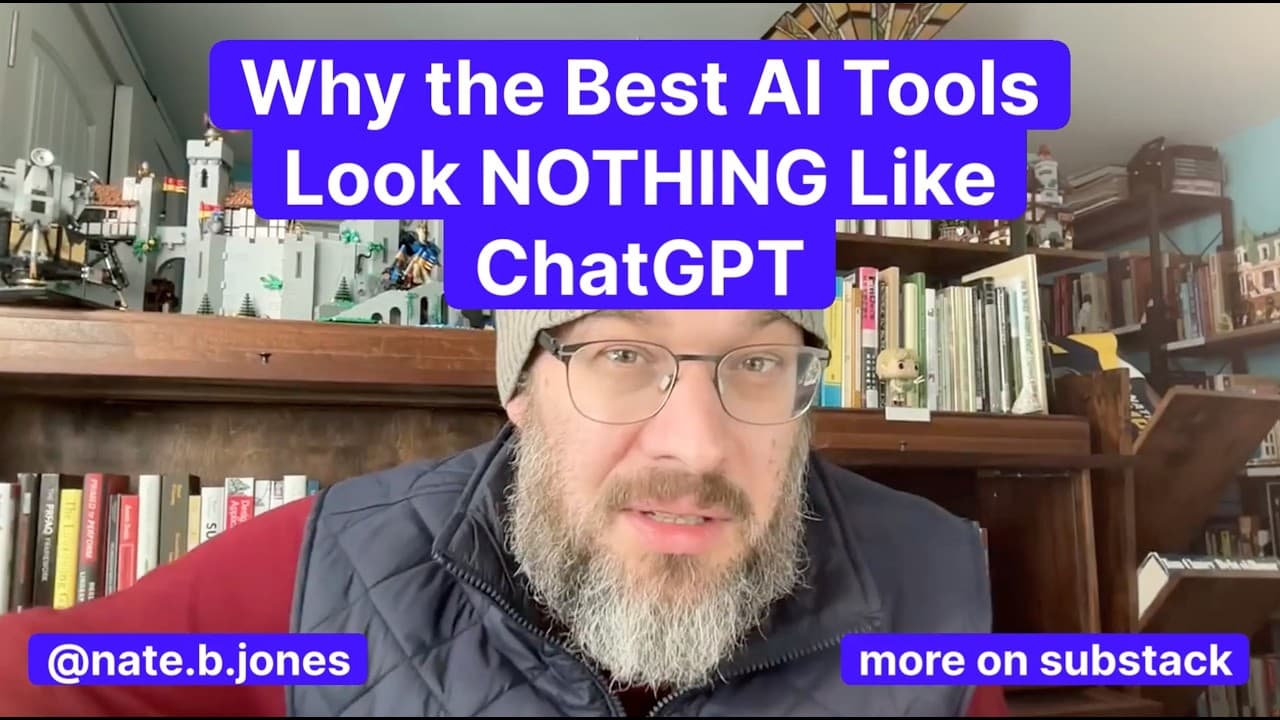
I did a survey of hundreds of AI tools and the best AI tools out there today do not look like chat GPT and I wanted to do a whole video breaking down the patterns I learned digging into these new tool launches because everybody's building AI chat interfaces it seems like and the companies actually starting to drive adoption, print money, and grow f... Read More
Key Insights
- The winning AI pattern is reducing the distance between intelligence and the artifact that must be shipped. A tool becomes more useful when it produces the email, verified report, timely reminder, or completed task directly, without requiring a separate copying and finishing workflow.
- The conventional chatbot workflow creates a productivity gap by making users leave their work surface, explain the task elsewhere, copy the response back, and manually complete the last mile. AI adoption improves when the system works inside the database, editor, communication channel, or application already being used.
- Dreamlit brings AI email creation into Supabase, where operational data already flows. Users can describe a transactional email, preview it with live database rows, and send it, avoiding the need to move query results into a separate email campaign platform.
- Stricks makes security findings more trustworthy by attempting to exploit vulnerabilities, capturing proof, and filing validated findings. Its value comes from deterministic verification: security professionals can inspect the exploit log instead of relying on an AI-generated claim or confidence score.
- MEM 2.0 acts as a memory aid by monitoring calendar and Slack context and proactively surfacing relevant notes before meetings. Its primary function is accurate, useful, and timely recall of existing knowledge, rather than generating additional content that users did not previously possess.
- Caesar automates tasks by clicking through web, desktop, and mobile interfaces when APIs are unavailable. This interface-level approach can cover long-tail applications that lack data integrations or MCP servers, trading the speed of a dedicated integration for the ability to operate across more environments.
- Data proximity is a competitive advantage because AI tools require less effort when they operate where work already flows. Keeping intelligence close to operational data removes unnecessary portals and reduces the friction involved in transporting information between disconnected systems.
- The practical buying question is whether an AI product owns the last mile to the needed work artifact. Tools that deliver finished outputs, verifiable evidence, or completed cross-application actions have clearer utility and greater potential to replace an existing item in the software budget.
Install to Summarize YouTube Videos and Get Transcripts
Explore YouTube Video Summarizer or Get YouTube Transcript Extractor
Questions & Answers
Q: Why do the best AI tools look nothing like ChatGPT?
The strongest AI tools operate where work and data already live, then produce the exact artifact a user needs to ship. This avoids leaving a database, editor, or chat, prompting an external AI, copying its response back, and manually completing the last mile.
Q: What pattern emerged from surveying hundreds of AI tools?
The winning pattern was collapsing the distance between AI and the artifact that needs to be shipped. The speaker selected roughly 12 to 15 tools that illustrate this approach and discusses four examples: Dreamlit, Stricks, MEM 2.0, and Caesar.
Q: How should companies evaluate a new AI tool?
Companies should ask whether the tool owns the last mile to the artifact they actually need. A strong product should work near existing data, deliver a finished output, provide inspectable proof when accuracy matters, and have the potential to replace something already in the software budget.
Q: How does Dreamlit improve transactional email creation?
Dreamlit builds transactional emails inside Supabase through natural chat. Users describe an email, preview it with live database rows, and send it where their operational data already flows, instead of copying query or SQL results into another tool such as Mailchimp.
Q: Why does Stricks exploit vulnerabilities before reporting them?
Stricks attempts to exploit vulnerabilities, captures proof, and then files validated findings. Security professionals can inspect the exploit log instead of trusting an AI claim or confidence score, and Stricks does not report a finding if it cannot prove it.
Q: What does MEM 2.0 do before meetings?
MEM 2.0 monitors calendar and Slack context and proactively surfaces relevant notes before the next meeting. Users do not have to ask for the information; the tool retrieves useful knowledge that may otherwise remain forgotten in a large collection of notes.
Q: How does Caesar automate applications without APIs?
Caesar creates agents that click through web, desktop, and mobile interfaces when direct APIs or data integrations are unavailable. This lets it operate across long-tail applications that lack MCP servers or dedicated integrations, although it may be slower than a deep integration.
Q: What does it mean for an AI tool to own the artifact?
Owning the artifact means delivering the usable result that completes the workflow rather than producing a draft that still needs manual transfer and revision. Examples include a sent transactional email, an exploit-validated security finding, a timely meeting reminder, or a completed task across applications.
Summary & Key Takeaways
-
Successful AI products bring intelligence directly into the environment where work and data already live. This eliminates the conventional cycle of leaving a work surface, describing the task in a separate chat interface, copying the response back, and manually completing the final steps required to produce a usable artifact.
-
Dreamlit creates transactional emails from Supabase data, Stricks validates security findings through attempted exploits, MEM 2.0 retrieves relevant notes before meetings, and Caesar controls interfaces across web, desktop, and mobile. Each tool demonstrates a different method for connecting AI capabilities directly to completed work rather than isolated content generation.
-
The proposed evaluation standard is whether an AI tool owns the last mile to the required artifact. Strong products should operate near existing data, provide proof instead of relying on confidence scores, produce finished outputs instead of drafts, and replace an existing software expense rather than simply expanding the technology budget.
Read in Other Languages (beta)
Share This Summary 📚
Summarize YouTube Videos and Get Video Transcripts with 1-Click
Try YouTube Summary with ChatGPT & Claude or YouTube Transcript Generator
Explore More Summaries from AI News & Strategy Daily | Nate B Jones 📚






Summarize YouTube Videos and Get Video Transcripts with 1-Click
Try YouTube Summary with ChatGPT & Claude or YouTube Transcript Generator