How to apply regular expression identities in theory
TL;DR
Union with empty set leaves a regex unchanged, while concatenation with empty set yields empty set. Epsilon acts as a neutral element for concatenation, and many identities relate star and plus forms. Understanding these rules helps simplify regex problems and exam questions in theory of computation.
Transcript
in this lecture we will be seeing some of the identities of regular expressions so this identities of the Glitter expressions are important when you solve some problems related to regular expressions and also if you are giving some exams like gait these identities are important because sometimes you get direct questions based on these identities al... Read More
Key Insights
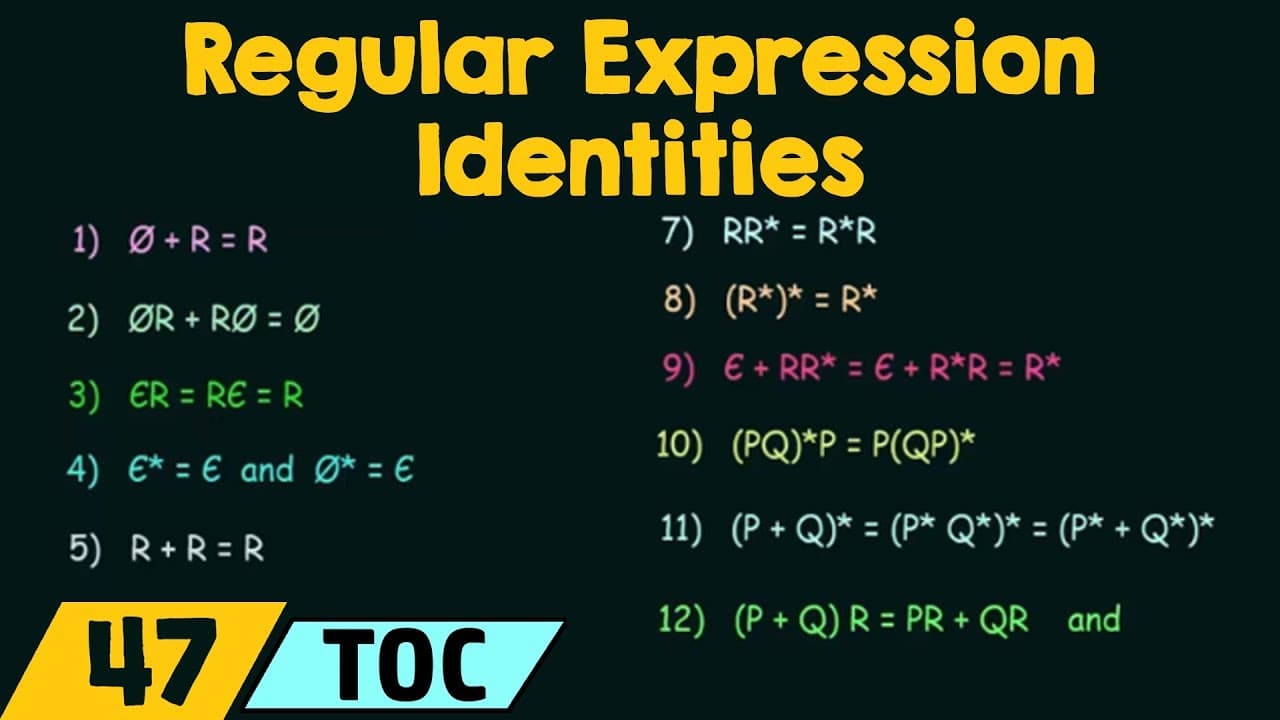
- Phi plus R equals R, meaning the union with an empty set yields the original expression.
- Concatenating with Phi on either side and then taking a union results in Phi, showing emptiness propagates through concatenation and union.
- Epsilon concatenation with R yields R, and R concatenation with epsilon yields R, highlighting epsilon as a neutral element for concatenation.
- Epsilon closure equals Epsilon, indicating the closure of epsilon remains epsilon and that Phi closure is epsilon, not Phi.
- R star concatenated with R star equals R star, demonstrating idempotence of the Kleene star under concatenation.
- R star equals R star R, and R star equals R R star, illustrating commutativity between a regex and its star.
- R star plus epsilon equals R star plus R, clarifying how plus with epsilon relates to R plus, and how it reduces to R star depending on context.
- P concatenation Q with its closure P is equal to P and Q or the concatenation of P's closure with Q's closure shows distribution of closure over concatenation.
- P plus Q closure equals P closure Q closure and equals P closure Q closure and also equals P closure union Q closure demonstrates how closure distributes over union and concatenation.
Install to Summarize YouTube Videos and Get Transcripts
Explore YouTube Video Summarizer or Get YouTube Transcript Extractor
Questions & Answers
Q: How to interpret Phi plus R in regular expressions
Phi plus R means the union of the empty set with R, which results in R. This identity is useful because it lets you drop the empty component when simplifying expressions during problem solving and proofs in theory of computation. The rule is simple: add Phi to any expression and you get the expression back unchanged.
Q: What happens when you concatenate with Phi
Concatenating Phi with R on the left or on the right, followed by a union that includes Phi, yields Phi itself. This shows that the empty set acts as a multiplicative zero under concatenation and that combining such a zero with another expression and then uniting with it preserves emptiness in the specific construction described.
Q: Why epsilon is a neutral element for concatenation
Epsilon behaves as a neutral element for concatenation because epsilon R equals R and R epsilon equals R. This means inserting epsilon does not change the structure or outcome of the regular expression, which is a key simplifying principle when reducing expressions in automata theory problems.
Q: What is the epsilon closure of Phi
The epsilon closure of Phi is epsilon, not Phi. This distinction matters when applying closure operations because it shows that the closure operation on the empty set yields the epsilon symbol, reinforcing that epsilon represents a minimal element in certain regex algebraic rules.
Q: What does R star equal in concatenations
R star concatenated with R star equals R star, which shows the idempotent property of the Kleene star under concatenation. This means repeating the repetition operator does not change the overall closure, a fact used to simplify expressions in proofs and problem solving.
Q: How does R star relate to R star R
R star equals R star R, and also equals R R star, illustrating that the star of R distributes over concatenation in a way that allows the star to commute with the original expression. This helps in transforming and simplifying regex formalisms during computation theory tasks.
Q: What does R plus R star equal
R plus R star equates to R star, since R star already includes all zero or more occurrences of R, including the empty sequence. Therefore adding R on top of R star does not extend the language, an insight useful for quick simplifications in exam questions.
Q: How is R plus Q closure represented
P plus Q closure can be expressed as P closure Q closure or as the union of their closures followed by a closure operation. This rule demonstrates how closure distributes over union and concatenation, providing a toolkit for rewriting complex expressions into simpler, equivalent forms.
Summary & Key Takeaways
-
This lecture covers key identities of regular expressions, focusing on how empty set, epsilon, and star operations interact with union and concatenation. The identities are presented as simple rules to memorize and apply when solving problems and exams in automata theory.
-
The material explains several fundamental properties, such as Phi plus R equals R, epsilon R equals R, and that R star R star equals R star, showing how closure and repetition behave under concatenation and union.
-
Students are guided on remembering and applying complex identities like P plus Q closure equals P closure Q closure, and P plus Q concatenation equals PR plus QR, which helps in simplifying expressions and proving properties in theory courses.
Read in Other Languages (beta)
Share This Summary 📚
Summarize YouTube Videos and Get Video Transcripts with 1-Click
Try YouTube Summary with ChatGPT & Claude or YouTube Transcript Generator
Explore More Summaries from Neso Academy 📚



Summarize YouTube Videos and Get Video Transcripts with 1-Click
Try YouTube Summary with ChatGPT & Claude or YouTube Transcript Generator