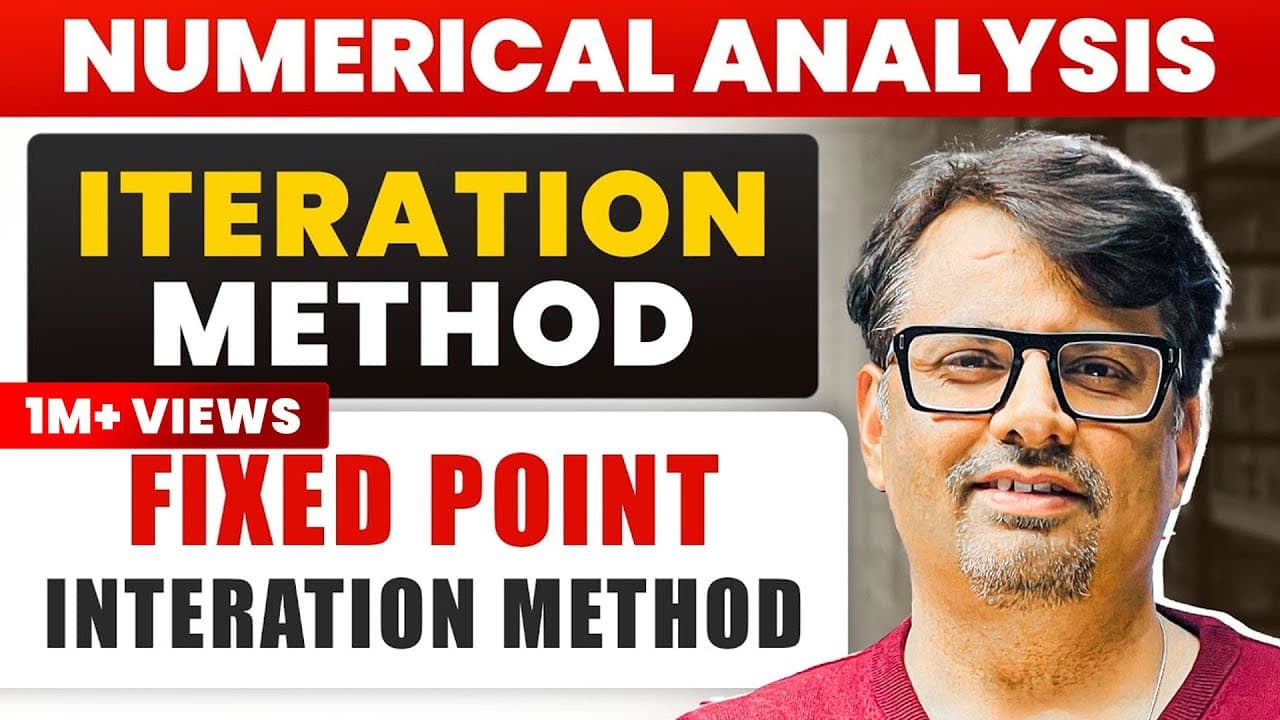
How to Solve Equations with Fixed Point Iteration
TL;DR
Fixed point iteration is used to find solutions of algebraic and transcendental equations through a repeatable numerical procedure. The lecture introduces the formula and procedure, applies the method to two questions, and notes that its rate of convergence is lower than that of the Newton-Raphson method, which can solve comparable questions in three to four steps.
Transcript
Students you can go to the playlist and watch all my videos as the complete playlist is arranged topic wise so you won't face any problem as many students complain that sir we are not getting this topic that topic so here topic wise the complete playlist is arranged so you can go and watch all my videos. Hello students myself Dr. Gajendra Purohi... Read More
Key Insights
- • Fixed point iteration is a numerical method used to obtain solutions of algebraic and transcendental equations.
- • The iteration method is also called the fixed point iteration method in the lecture and its accompanying description.
- • The working procedure begins with a formula, followed by repeated application of the iteration method to find a solution.
- • The lecture uses two questions to demonstrate how fixed point iteration is applied after the formula and procedure are introduced.
- • The first worked question begins at 1:58, following the formula and procedural explanation that starts at 1:25.
- • The second worked question begins at 10:48, providing another application of the same numerical method.
- • The rate of convergence for the previously taught methods is described as lower than the rate for the Newton-Raphson method.
- • The Newton-Raphson method is described as capable of solving a question in three to four steps, while the other methods produce longer solutions.
Install to Summarize YouTube Videos and Get Transcripts
Explore YouTube Video Summarizer or Get YouTube Transcript Extractor
Questions & Answers
Q: What is the fixed point iteration method used for?
The fixed point iteration method is used to find solutions of algebraic and transcendental equations. The lecture presents it within numerical analysis and introduces both its formula and working procedure. It then applies the method to two questions so students can see how the numerical process is used to obtain solutions in practice.
Q: Is the iteration method the same as fixed point iteration?
Yes. The instructor explicitly identifies the iteration method as the fixed point iteration method while introducing the topic. Both names refer to the method presented for solving algebraic and transcendental equations. The lesson subsequently explains its formula and procedure and applies that procedure to two worked questions included in the lecture.
Q: How is fixed point iteration taught in the lecture?
The lecture starts with an introduction and then presents the formula and procedure of the iteration method at 1:25. The instructor follows this explanation with two worked questions. The first begins at 1:58, and the second begins at 10:48, creating a sequence that moves from the stated procedure to example-based application.
Q: What types of equations can fixed point iteration solve?
Fixed point iteration is presented as a method for finding solutions of both algebraic equations and transcendental equations. These two equation categories define the stated scope of the lesson. The instructor explains the method’s formula and working procedure before using questions to demonstrate how the approach is applied when seeking numerical solutions.
Q: How many fixed point iteration examples are included?
The instructor states that the topic will include one or two more questions, and the description provides timestamps for two questions. The first question starts at 1:58, while the second starts at 10:48. These questions follow the formula and procedure section, which begins at 1:25 in the lecture.
Q: How does fixed point iteration compare with Newton-Raphson?
The instructor states that the rate of convergence for the previously taught methods is lower than that of the Newton-Raphson method. Fixed point iteration and the other methods are described as producing longer solutions, whereas Newton-Raphson is said to solve a question in only three to four steps. Newton-Raphson is scheduled as the next topic.
Q: When does the fixed point iteration procedure begin?
The formula and procedure of the iteration method begin at 1:25, according to the timestamps in the description. The first worked question follows at 1:58, and a second begins at 10:48. This organization places the procedural introduction immediately before the examples that demonstrate the method’s application to equation solving.
Q: Who is the fixed point iteration lesson intended for?
The lesson is described as useful for engineering and basic science students, including B.Sc. and B.Tech students. It is also presented for learners preparing for mathematics-related competitive examinations such as CSIR-NET, GATE, and IIT-JAM. The stated focus is understanding fixed point iteration through its procedure and example-based questions.
Summary & Key Takeaways
-
Fixed point iteration is presented as a numerical method for solving algebraic and transcendental equations. The lecture introduces the method, identifies its alternative name, and then moves from the formula and working procedure to examples intended to demonstrate how the process is applied when finding solutions.
-
The lesson includes two worked questions after introducing the formula and procedure. According to the timestamps, the procedural explanation begins at 1:25, the first question begins at 1:58, and the second begins at 10:48, giving students a progression from the method’s setup to its practical application.
-
Fixed point iteration is compared with the Newton-Raphson method near the conclusion. The instructor states that the previously discussed methods have lower convergence rates and require longer solutions, while Newton-Raphson can solve a question in three to four steps. Newton-Raphson is identified as the next method to be taught.
Read in Other Languages (beta)
Share This Summary 📚
Summarize YouTube Videos and Get Video Transcripts with 1-Click
Try YouTube Summary with ChatGPT & Claude or YouTube Transcript Generator
Explore More Summaries from Dr.Gajendra Purohit 📚

Summarize YouTube Videos and Get Video Transcripts with 1-Click
Try YouTube Summary with ChatGPT & Claude or YouTube Transcript Generator