How to Audit a Broken Facebook and Google Ad Account
TL;DR
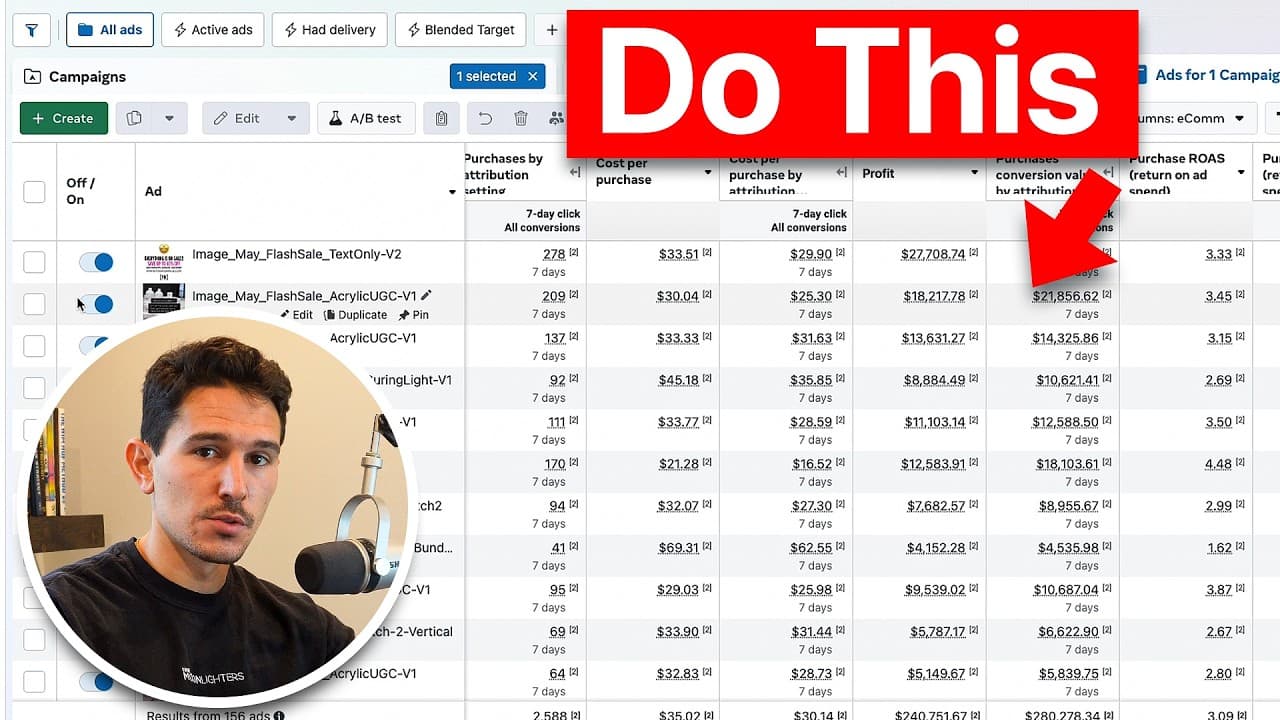
Start an ad account audit by asking where the money should go, not by tweaking settings. Sort campaigns by spend, confirm the campaign-level setup, then compare both platforms against a third-party attribution tool. In this account the platform dashboards each claimed similar revenue, but first-click data showed Google carrying nearly all of it while Facebook was the broken piece.
Transcript
if you want to successfully run Facebook and Google ads one of the number one things you need to understand is how to actually optimize your ads how to set up the ads properly and most important you need to see the full picture between both platforms at the same time so that you know you're spending the right amount of money in the right place agai... Read More
Key Insights
- Running Facebook and Google ads well requires seeing both platforms at the same time, because the point of the exercise is knowing that the right amount of money is going to the right place at the right time, which no single dashboard can answer alone.
- Sorting campaigns by spend is the first move in an audit, because it immediately answers where the money went before any judgment is made about whether that money produced net new revenue for the business.
- A well-configured Advantage Plus campaign shows website and shop placements, maximize number of conversions, the correct Commerce account, the correct data set, and the correct conversion event firing, all checked at the campaign level before drilling into individual ads.
- A missing existing-customer budget cap is a flag worth holding rather than condemning immediately, since whether it is a problem depends on what the rest of the account and the attribution data eventually reveal.
- Campaigns named with catalog at the end usually signal a brand that lacks either the budget or the creative width to build heavier custom creative, which is itself a lever for improving the account.
- Retargeting people who viewed or added to cart but did not purchase, while excluding recent purchasers, is high-intent targeting that generally works, and a low retargeting budget is acceptable for a small brand.
- Third-party attribution tools like Hyros are valuable precisely because they have no influence over what Facebook and Google report, giving a click-based reading that can contradict both platform dashboards for the same period.
- The first question in advertising is where the money should go, ahead of any complicated setup: which platform to fund, whether to spend more in different places, or whether to aggregate spend into a single platform.
Install to Summarize YouTube Videos and Get Transcripts
Explore YouTube Video Summarizer or Get YouTube Transcript Extractor
Questions & Answers
Q: How do you audit a Facebook ad account?
Open the account over a recent window, such as the last thirty days, and sort campaigns by spend so you can see immediately where the money went and whether it drove net new revenue. Review the top-spending campaign at the campaign level first: placements, the optimization goal, the Commerce account, the data set, and the conversion event. Then check audience location inclusions, reporting segments such as add-to-cart and site visitors, existing-customer settings, and the daily budget. Only after the structure checks out should you move down into the ad sets and the ads themselves.
Q: Why should you look at Google Ads and Facebook Ads together?
Because neither platform can tell you whether money is going to the right place. Each reports on its own conversions, so a channel can look acceptable in isolation while the combined picture shows something different. In the account audited here, the Meta dashboard and the Google dashboard each reported similar revenue for the same period, which suggested both were pulling their weight. Reviewing them side by side, and then against neutral attribution data, revealed that one channel was carrying nearly all the real revenue and the other needed to be fixed rather than funded further.
Q: What makes an Advantage Plus campaign correctly set up?
The correct configuration includes website and shop as destinations, maximize number of conversions as the optimization goal, the correct Commerce account attached, the correct data set selected, and the correct conversion event firing. Beyond that, audience location inclusions should match the intended market, and reporting breakdowns such as add-to-cart, site visitors, and existing customers should be configured so performance can be segmented later. One item to watch is whether an existing-customer budget cap has been set, since its absence can allow spend to concentrate on people who would have bought anyway.
Q: What is a good retargeting campaign structure for a small brand?
Target people who viewed products or added to cart but did not purchase, since that is very high intent and generally converts well. Exclude recent purchasers so budget is not wasted on customers who just bought. Use maximize conversions with a cost per result goal, set the product set to the brand's top-performing products, and confirm the attribution setting. A low daily budget is completely acceptable for retargeting, especially for a small brand, because the addressable audience is limited and spending beyond it produces diminishing returns.
Q: Why use a third-party attribution tool like Hyros?
Because it has no influence over what Facebook and Google report, and it measures on pure click-based data. Ad platforms each attribute conversions to themselves, so two dashboards can both claim credit for overlapping revenue and together overstate what the business actually earned. In this audit, the platform numbers suggested both channels were performing acceptably, but the neutral first-click report showed Google's figure landing reasonably close to what Google claimed while Facebook's real contribution was a fraction of what Meta reported. That gap is what identified Facebook as the broken piece.
Q: What is the difference between first-click and last-click attribution reports?
Last-click attribution assigns the entire conversion to the final ad click before the purchase, so if someone clicks many Google ads and then one Meta ad last, Meta receives all the credit. First-click attribution assigns everything to the first ad click that brought the customer to the site, and nothing after that matters. First click tells you what is driving top of funnel, and last click tells you what is closing at the bottom of the funnel. Together these two reports are usually all you need.
Q: When should you use scientific deprecation or linear fractional attribution?
These models distribute credit across the customer journey rather than concentrating it at a single touchpoint, giving different weightings depending on where the customer sat in that journey. They paint a somewhat better picture, but only when you already know your brand and your customer journey precisely. Without that understanding, the added complexity does not improve decisions. For most accounts, focusing on the first-click and last-click reports is enough, because those two answer the practical questions of what opens the journey and what closes it.
Q: How do you decide where to put your ad budget?
Start with the top-level question before any complicated setup work: where should the money go. Decide whether it belongs in Facebook ads, in Google ads, whether you should spend more in different places, or whether you should aggregate spend into a single platform. Answer that using attribution data that is independent of the ad platforms, not the platform dashboards alone. In this audit the neutral data showed Google was the winner and deserved more spend, while Facebook was the piece that needed fixing before it earned additional budget.
Summary & Key Takeaways
-
The audit begins in the Meta account over the last thirty days, sorted by spend, to see where budget actually went and whether it drove net new revenue. The top spender is an Advantage Plus campaign, and the reviewer checks placement settings, the Commerce account, the data set, and the conversion event before looking at any single ad.
-
Campaign structure alone is not the diagnosis. The Advantage Plus campaign, the audience inclusions, the reporting segments, and the retargeting campaign built on viewers and add-to-cart users who did not purchase all look correct, with recent purchasers excluded. When the setup checks out, the problem lives deeper in the details rather than in the build.
-
The Google account holds three primary campaigns with a target return on ad spend set slightly above the brand's own target, and it produces more revenue than Meta on less spend. Both accounts are reviewed together because judging one platform in isolation hides which channel is actually carrying the business.
-
A third-party attribution tool, Hyros, is used as a neutral reading because it has no stake in what Facebook or Google report. Its click-based first-click report shows Google's revenue landing reasonably close to the platform figure while Facebook's collapses to a fraction of what Meta claimed for the same window.
-
First-click and last-click reports answer different questions: first click shows what opens the customer journey, last click shows what closes it. Scientific deprecation and linear fractional spread credit across the journey, which helps only when the brand already knows its customer path well. The practical conclusion is to fix Facebook and push more spend into Google.
Read in Other Languages (beta)
Share This Summary 📚
Summarize YouTube Videos and Get Video Transcripts with 1-Click
Try YouTube Summary with ChatGPT & Claude or YouTube Transcript Generator
Explore More Summaries from Sam Piliero 📚


Summarize YouTube Videos and Get Video Transcripts with 1-Click
Try YouTube Summary with ChatGPT & Claude or YouTube Transcript Generator