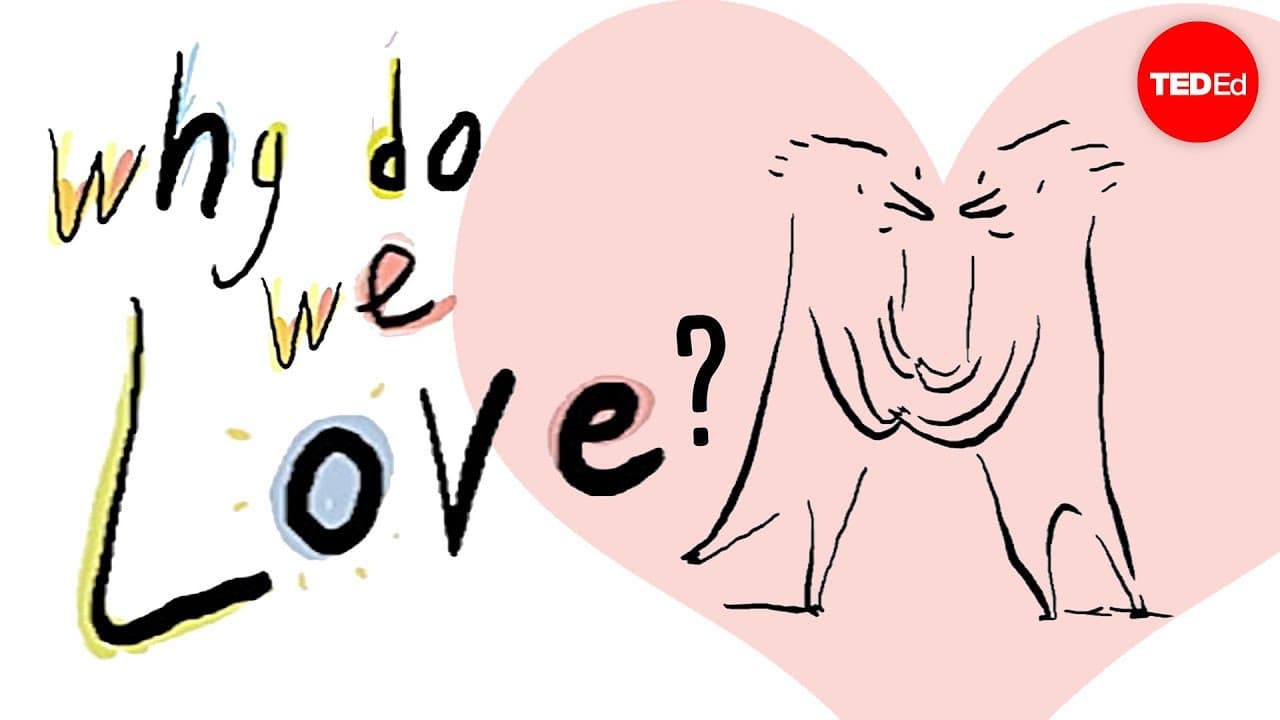
Why do we love? A philosophical inquiry - Skye C. Cleary
TL;DR
Philosophers propose various reasons for why we love: Plato believed it fulfills our longing for wholeness, Schopenhauer suggested it's a biological trick for procreation, while Bertrand Russell viewed it as a remedy for loneliness. In contrast, Buddha argued that love often leads to suffering, and Simone de Beauvoir emphasized authentic love as a means of mutual enrichment and self-discovery.
Transcript
Ah, romantic love - beautiful and intoxicating, heartbreaking and soul-crushing, often all at the same time. Why do we choose to put ourselves through its emotional wringer? Does love make our lives meaningful, or is it an escape from our loneliness and suffering? Is love a disguise for our sexual desire, or a trick of biology to make us procreate?... Read More
Key Insights
- 🥰 Plato's theory of love as the search for wholeness.
- 🥰 Schopenhauer's perspective on love as a biological trick for procreation.
- 🥰 Russell's belief in love as a tool to overcome loneliness.
- 🥰 Buddha's view of love as a source of suffering due to attachments.
- 🥰 Cao Xueqin's tragic illustration of the folly of romantic love in "Dream of the Red Chamber."
- 🥰 Beauvoir's concept of authentic love as a means of self-discovery and enrichment.
- 🥰 Debate on whether love is an escape or a fulfillment of human existence.
Install to Summarize YouTube Videos and Get Transcripts
Explore YouTube Video Summarizer or Get YouTube Transcript Extractor
Questions & Answers
Q: Why did Plato believe in the concept of finding a soulmate in love?
Plato believed that love is the search for a soulmate who completes the missing half of ourselves, as illustrated in his "Symposium."
Q: How did Schopenhauer view the role of love in procreation?
Schopenhauer believed love was a way for nature to trick us into procreating, leading to momentary happiness but ultimately perpetuating human suffering.
Q: What did Bertrand Russell suggest is the purpose of love?
Russell thought that love serves as a means to overcome our fears and loneliness, facilitating a deeper engagement with life and human connection.
Q: How did Simone de Beauvoir redefine the concept of love?
Beauvoir proposed that authentic love entails supporting each other in self-discovery and personal growth, transcending dependency and power dynamics.
Summary
This video explores different theories and philosophies about romantic love. It discusses ideas from ancient Greek philosopher Plato, who believed that love is the longing to find a soulmate who will make us feel whole again. German philosopher Arthur Schopenhauer suggested that love is a trick of nature to make us procreate, and Nobel Prize-winning philosopher Bertrand Russell argued that love is an escape from loneliness. The video also touches on Buddhist beliefs that attachments, including romantic love, can lead to suffering, and concludes with the idea that love is the desire to integrate with another and infuses our lives with meaning, as proposed by French philosopher Simone de Beauvoir.
Questions & Answers
Q: What did Plato believe about love?
Plato believed that love is the longing to find a soulmate who will make us feel complete. According to him, humans were once creatures with four arms, four legs, and two faces. When they angered the gods, they were split in two, resulting in every person feeling incomplete. Love, for Plato, is the search for the other half that will make us feel whole again.
Q: What theory did Arthur Schopenhauer propose about love?
Schopenhauer suggested that love based on sexual desire is a voluptuous illusion. He believed that we love because our desires lead us to believe that another person will make us happy. However, he argued that this is a misconception. Nature tricks us into procreating, and the sense of fusion we seek in love is ultimately found in our children. Once our sexual desires are satisfied, we are left with the reality of our tormented existence.
Q: According to Bertrand Russell, why do we love?
Russell proposed that we love in order to quench our physical and psychological desires. He believed that without the ecstasy of passionate love, sex would be unsatisfying. Humans have a natural fear of the world, leading us to build hard shells to protect and isolate ourselves. Love, with its delight, intimacy, and warmth, helps us overcome this fear and engage more fully in life.
Q: How did Buddha view romantic love?
Buddha considered romantic love to be a source of suffering. He believed that our passionate cravings and attachments, even in the context of romantic love, are defects. Buddha discovered the eight-fold path, a program for extinguishing desire, with the goal of reaching Nirvana, a state of peace, wisdom, and compassion. While not all Buddhists share this view, the story of "Dream of the Red Chamber" illustrates the sentiment that attachments can lead to tragedy.
Q: What did Simone de Beauvoir propose about love?
Beauvoir saw love as the desire to integrate with another and believed that it infuses our lives with meaning. She cautioned against becoming dependent on the other person to justify our existence, as it can lead to boredom and power games. Instead, Beauvoir advised loving authentically, fostering a relationship more akin to a great friendship. True lovers support each other in discovering themselves, reaching beyond themselves, and enriching their lives and the world together.
Q: What is the conclusion of the video?
The video concludes by acknowledging that falling in love is an emotional rollercoaster ride. It can be scary and exhilarating, making us suffer and soar. While we may never fully understand why we fall in love, it remains a unique and transformative experience. It may lead us to lose ourselves or find ourselves, and it has the potential to be both heartbreaking and the best thing in life. The video challenges viewers to dare to find out for themselves.
Takeaways
Romantic love is a complex and multifaceted experience that has been contemplated by philosophers throughout history. The theories discussed in the video provide different perspectives on the purpose and nature of love. From Plato's belief in finding completeness through a soulmate to Russell's idea of love as an escape from loneliness, each theory offers a distinct way of understanding love's role in our lives. Ultimately, the video suggests that while we may never discover a definitive answer, love remains a powerful force that can transform and enrich our existence.
Summary & Key Takeaways
-
Plato believed love is the longing to find a soulmate who makes us feel whole again.
-
Schopenhauer suggested love is a trick of nature to ensure procreation.
-
Simone de Beauvoir proposed love is about integrating with another to enrich our lives authentically.
-
(Content reviewed on 2026-08-27.)
Read in Other Languages (beta)
Share This Summary 📚
Summarize YouTube Videos and Get Video Transcripts with 1-Click
Try YouTube Summary with ChatGPT & Claude or YouTube Transcript Generator
Explore More Summaries from TED-Ed 📚
Summarize YouTube Videos and Get Video Transcripts with 1-Click
Try YouTube Summary with ChatGPT & Claude or YouTube Transcript Generator