What makes something "Kafkaesque"? - Noah Tavlin
TL;DR
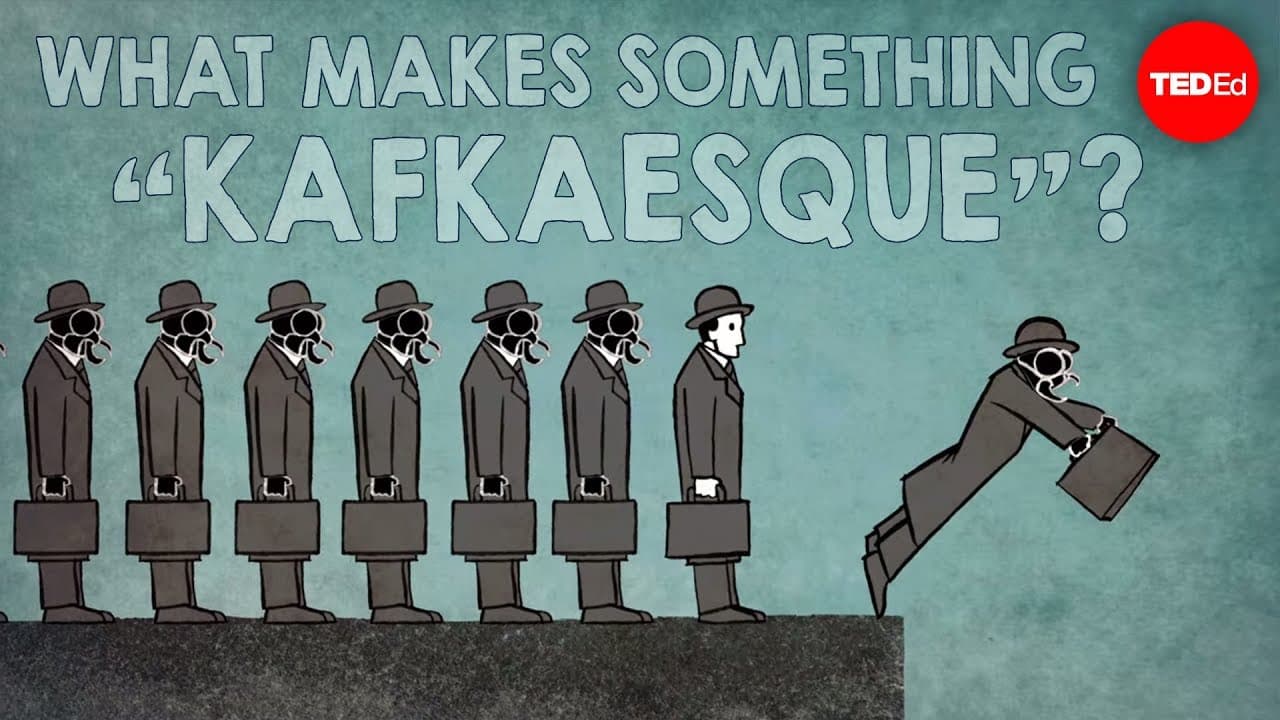
Kafkaesque refers to experiences that are absurd, frustrating, and highlight the complexity of bureaucracy, much like the bewildering scenarios found in Kafka's stories. His work illustrates how characters navigate arbitrary power systems, showcasing the irony in their struggles against nonsensical rules and procedures that often lead to existential crises.
Transcript
"Someone must have been telling lies about Josef K. He knew he had done nothing wrong, but one morning, he was arrested." Thus begins "The Trial," one of author Franz Kafka's most well-known novels. K, the protagonist, is arrested out of nowhere and made to go through a bewildering process where neither the cause of his arrest, nor the nature of ... Read More
Key Insights
- ❓ Kafkaesque scenarios extend beyond the absurdity of bureaucracy and capture the ironic circular reasoning and internal struggles of the characters.
- 🤕 Kafka's stories function as myths for the modern industrial age, employing dream logic to explore the power dynamics between individuals and arbitrary systems.
- 💦 The story "Metamorphosis" reflects Kafka's critique of the authoritarian realm of the workplace, where the transformed protagonist's primary concern is still getting to work on time.
- 🧑🎨 The short story "A Hunger Artist" reveals the self-imposed struggles of an artist whose act of extended fasting loses popularity, ultimately leading to his realization that his art was fraudulent.
- 👨⚖️ "The Trial" highlights the sinister nature of the legal system, which perpetuates itself rather than serving justice, aligning with the concept of "tyranny without a tyrant" described by Hannah Arendt.
- 🫚 Kafka's stories carry a blend of bleakness and humor, rooted in the nonsensical logic of the situations presented.
- 🛟 Modern society reflects the Kafkaesque through convoluted administrative systems that impact various aspects of life while subjecting individuals to unknown rules and anonymous judgment.
Install to Summarize YouTube Videos and Get Transcripts
Explore YouTube Video Summarizer or Get YouTube Transcript Extractor
Questions & Answers
Q: What does the term "Kafkaesque" mean?
"Kafkaesque" describes unnecessarily complicated and frustrating experiences, particularly in navigating through labyrinths of bureaucracy inspired by Franz Kafka's work.
Q: How does Kafka's personal experience influence his stories?
Kafka's experience as an insurance clerk in Prague influences his portrayal of protagonists who are office workers struggling through various obstacles and facing disorienting and illogical situations within bureaucratic systems.
Q: How does Kafka use irony in his stories?
Kafka infuses irony into his stories by showcasing the circular reasoning and internal struggles of his characters as they react to the absurdity of bureaucracy, ultimately making success futile.
Q: What themes does Kafka explore in his stories?
Kafka's stories delve into the relationships between systems of arbitrary power and individuals, highlighting the impact of external bureaucracies and internal struggles on the protagonists.
Summary
Franz Kafka's work is often described as Kafkaesque, referring to the intricate and frustrating experiences of navigating complex bureaucracies. Kafka's stories explore the mundane and absurd aspects of modern bureaucracy, with characters struggling through illogical and disorienting obstacles. His writing delves into the relationships between arbitrary power systems and the individuals caught up in them. Kafka's stories also contain elements of humor and reflect our own shortcomings, reminding us of our ability to create and change the world we live in.
Questions & Answers
Q: What is considered Kafkaesque?
Kafkaesque refers to experiences that are unnecessarily complicated and frustrating, often involving navigating labyrinths of bureaucracy. It captures the essence of Kafka's work, which revolves around characters facing bewildering processes where the cause of their struggle is unclear, and the chances of success seem pointless.
Q: How did Kafka's personal experiences influence his writing?
Kafka's personal experiences working as an insurance clerk in early 20th century Prague heavily influenced his writing. Many of his protagonists are office workers grappling with obstacles within bureaucratic systems. Kafka drew from his own encounters with mundane and absurd aspects of modern bureaucracy and incorporated them into his stories.
Q: Can you provide an example of a Kafkaesque scenario?
In Kafka's short story "Poseidon," the Ancient Greek god is portrayed as an executive burdened with excessive paperwork, preventing him from focusing on his underwater domain. The irony lies in the fact that even a god struggles to handle the demands of modern bureaucracy. The story encompasses the circular reasoning and irony often found in Kafka's work, making it truly Kafkaesque.
Q: How does Kafka use dream logic in his writing?
Kafka's stories employ dream logic to explore the relationships between systems of arbitrary power and the individuals affected by them. He uses surreal and irrational elements to convey deeper meanings and emotions. This dreamlike quality adds to the richness of his storytelling and allows readers to delve into the psychological depths of his characters' experiences.
Q: What is the significance of Gregor Samsa's transformation in "Metamorphosis"?
In "Metamorphosis," Gregor Samsa wakes up one morning to find himself transformed into a giant insect. However, his primary concern remains getting to work on time, emphasizing the authoritarian realm of the workplace. This highlights the oppressive nature of society and the constant pressure to conform and meet societal expectations, even when faced with extraordinary circumstances.
Q: Besides bureaucracy, what other struggles do Kafka's protagonists face?
Kafka's protagonists also face internal struggles. In the short story "A Hunger Artist," the protagonist is a circus performer who fasts for extended periods to showcase his art. His frustration arises from the circus master limiting his fasts to 40 days, hindering his perceived ability to achieve greatness. However, when his act loses popularity, he realizes that his art was a fraud, leading to his demise.
Q: What does "The Trial" reveal about the legal system?
"The Trial" highlights the sinister aspect of the legal system. The vague laws and bewildering procedures symbolize the terrible momentum of the legal system, which serves to perpetuate itself rather than deliver justice. Kafka exposes the notion of a system that operates without a clear tyrant, showcasing a form of tyranny without a single authoritative figure.
Q: What does Hannah Arendt mean by "tyranny without a tyrant"?
Hannah Arendt, a political theorist, referred to Kafka's portrayal of the legal system as "tyranny without a tyrant." It signifies a system driven by its own momentum, where the force of bureaucracy itself becomes the oppressive force, detached from any specific person in power. The power lies within the system, and its machinery perpetuates its own existence.
Q: How does Kafka incorporate humor into his stories?
Alongside the bleakness of Kafka's stories, there is a great deal of humor rooted in the nonsensical logic of the situations described. This humor serves to reflect our absurdities and shortcomings as individuals and society. Kafka uses irony and satire to shed light on the illogical aspects of bureaucracy and human behavior, making his stories both thought-provoking and amusing.
Q: How does Kafka's writing suggest the power to create change?
Kafka's writing not only portrays the complexities of bureaucracy but also reflects our own shortcomings back at ourselves. By highlighting the absurdity of our systems and behaviors, Kafka reminds us that the world we live in is one we have the power to change for the better. His stories serve as a call to action, urging individuals to recognize their ability to shape and transform society.
Takeaways
Franz Kafka's work, often described as Kafkaesque, explores the frustrating experiences of navigating complex bureaucracies and the relationships between power systems and individuals. Drawing from his personal experiences and using dream logic, Kafka delves into the absurd and mundane aspects of modern bureaucracy. Through his storytelling, Kafka reflects our own shortcomings and reminds us of our power to create change. His work serves as a call to action, urging us to challenge and transform existing systems for the better.
Summary & Key Takeaways
-
Franz Kafka's works, such as "The Trial," highlight the bewildering experiences of individuals like protagonist K, who is arrested without knowing the cause or nature of the proceedings against him.
-
Kafka's stories center around mundane and absurd aspects of modern bureaucracy, reflecting his own experience as an insurance clerk in early 20th century Prague.
-
The author's tragicomic stories employ dream logic to explore the relationships between systems of power and the individuals trapped within them, encompassing external and internal struggles.
Read in Other Languages (beta)
Share This Summary 📚
Summarize YouTube Videos and Get Video Transcripts with 1-Click
Try YouTube Summary with ChatGPT & Claude or YouTube Transcript Generator
Explore More Summaries from TED-Ed 📚
Summarize YouTube Videos and Get Video Transcripts with 1-Click
Try YouTube Summary with ChatGPT & Claude or YouTube Transcript Generator