How close are we to automating scientific discovery?
TL;DR
AI progress is moving toward automating scientific discovery, with milestones in math problem solving and reasoning improvements. The discussion highlights the goal of general intelligence, the role of automated research, and the potential impact on fields like medicine and safety, while noting ongoing debate about AGI timelines and measurement.
Transcript
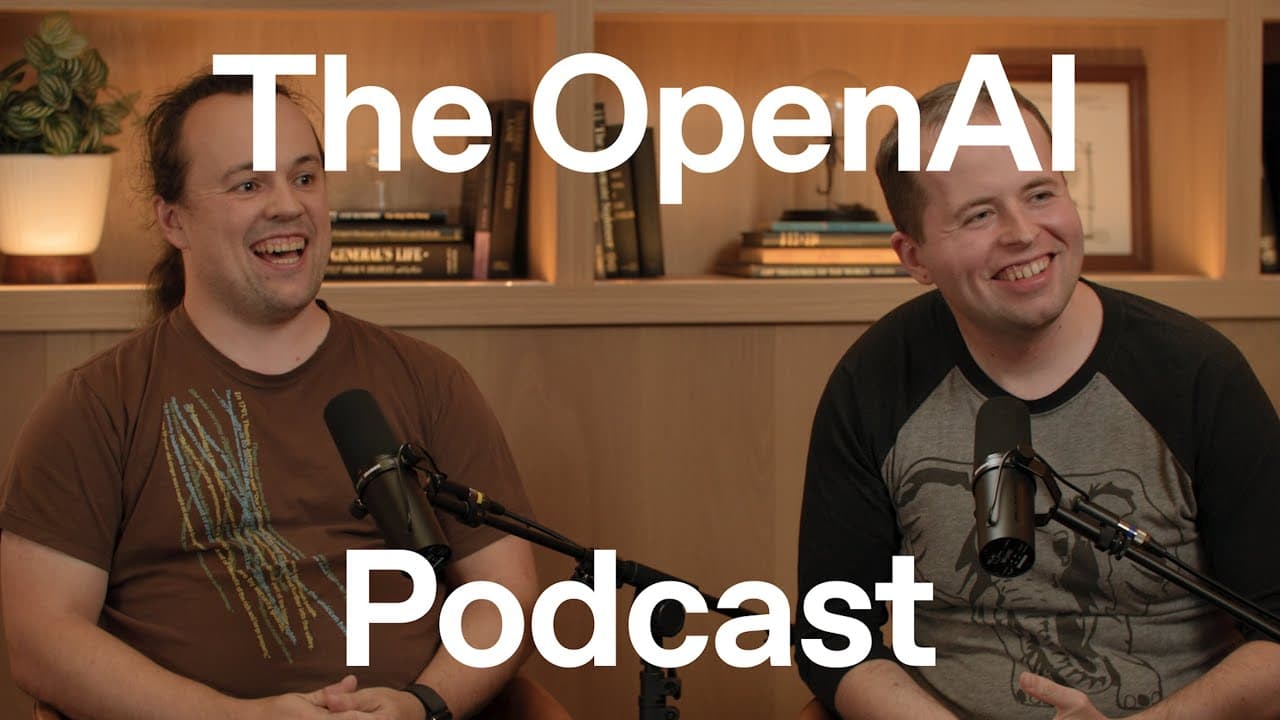
Hello, I'm Andrew Maine and this is the OpenAI podcast. Today our guests are OpenAI's chief scientist Yakob Pahhatzki and Simone Sedor. We're going to talk about measuring AI progress, how you determine AGI, and where the next breakthrough might come from. The model was able to correctly identify that didn't make progress on the problem. We started... Read More
Key Insights
- AGI is defined as general intelligence with broad capabilities, not just task-specific skill, and requires considering real world impact rather than isolated benchmarks.
- OpenAI prioritizes an automated researcher as a core research direction, aiming to accelerate discovery and technology development through general reasoning and scalable AI systems.
- The speakers describe a shift from simple problem solving to evaluating models on meaningful world tasks and the ability to reason across domains.
- Medicine, safety, and alignment are highlighted as areas where AI progress is both promising and challenging, requiring careful integration with human oversight.
- The conversation reflects a belief that breakthroughs may come from combining reasoning with domain knowledge and intuition, not just raw computational power.
- They recount the importance of math competitions and structured reasoning as indicators of future AI capabilities, illustrating how foundational skills translate into broader problem solving.
- There is an emphasis on scaling and long-horizon reasoning as essential for moving toward more capable AI systems, rather than focusing solely on immediate, narrow tasks.
- The dialogue notes that progress in NLP over the past decade exemplifies how gradual improvements can culminate in significant breakthroughs over time.
- More videos from this channel:
- More from this channel: OpenAI
Install to Summarize YouTube Videos and Get Transcripts
Explore YouTube Video Summarizer or Get YouTube Transcript Extractor
Questions & Answers
Q: How do the OpenAI guests define AGI for a lay audience?
The guests describe AGI as a form of intelligence with broad, general capabilities that go beyond narrow tasks. They emphasize moving from specific skill benchmarks to assessing meaningful real-world impact, such as the ability to converse naturally, solve complex problems, and contribute to discoveries in science and technology. They caution that definitions evolve as technology progresses and that safety and alignment remain critical concerns alongside capabilities.
Q: What role does automating scientific discovery play in OpenAI’s roadmap?
Automating scientific discovery is described as a priority that could accelerate progress by enabling AI to generate ideas, test hypotheses, and iterate on research more quickly than humans alone. The speakers discuss the potential for AI to contribute across disciplines, with particular interest in domains that combine reasoning with domain knowledge, and in automating research on AI alignment and safety.
Q: Which domains show promising AI progress according to the podcast?
Medicine is highlighted as a domain where AI progress is particularly encouraging, with the potential to apply advanced reasoning and domain knowledge to real-world health challenges. The speakers also reference safety and alignment as important areas requiring careful AI-driven research and governance to ensure beneficial outcomes.
Q: How has progress in AI been characterized over the last decade?
The discussion recalls a decade of progress from early NLP limitations to modern systems that can reason, solve math problems, and engage in broader conversations. It notes substantial improvements in tasks like sentiment analysis and problem solving, illustrating how iterative advancements accumulate into meaningful capabilities.
Q: What does the podcast say about benchmarks and their limits?
The speakers note that benchmark saturation can limit progress by focusing attention on narrow tasks. They argue for evaluating real world impact and generalizable reasoning, rather than chasing improvements on fixed tests, to better gauge how AI affects broader domains and longer time horizons.
Q: Why are math competitions mentioned in the context of AI progress?
Math competitions are cited as historical indicators of potential future AI capabilities, because strong mathematical reasoning signals broader problem solving ability. The discussion suggests such foundations can translate into improved AI reasoning across domains and contribute to breakthroughs in automated discovery.
Q: What is said about the relationship between AI progress and safety?
Safety and alignment are presented as essential considerations alongside capability gains. The guests discuss the need to study how AI can be governed and aligned with human values, and to automate safety research to ensure that advances in AI do not outpace our ability to manage them responsibly.
Q: How do the speakers view the future of AI and long horizon reasoning?
They express optimism that scaling and long horizon reasoning will unlock more capable AI systems, capable of sustained, multi-step problem solving. The expectation is that such progress could enable breakthroughs in science and technology while requiring robust governance, transparency, and safeguards to manage risk and ensure beneficial outcomes.
Summary & Key Takeaways
-
OpenAI aims for general intelligence and automated researchers, prioritizing long term research and scalable reasoning. The conversation emphasizes moving beyond task-specific benchmarks to measure real world impact, including how AI could automate parts of science and discovery.
-
Breakthroughs in medicine and alignment show progress, but the team warns that true AGI requires careful handling of safety, scope, and governance while exploring how to scale long-horizon reasoning.
-
The dialogue reflects a decade of progress from early NLP limits to modern capabilities, suggesting that progress is accelerating but remains gradual, with benchmarks saturating and new methods continuing to emerge.
Read in Other Languages (beta)
Share This Summary 📚
Summarize YouTube Videos and Get Video Transcripts with 1-Click
Try YouTube Summary with ChatGPT & Claude or YouTube Transcript Generator
Explore More Summaries from OpenAI 📚





Summarize YouTube Videos and Get Video Transcripts with 1-Click
Try YouTube Summary with ChatGPT & Claude or YouTube Transcript Generator