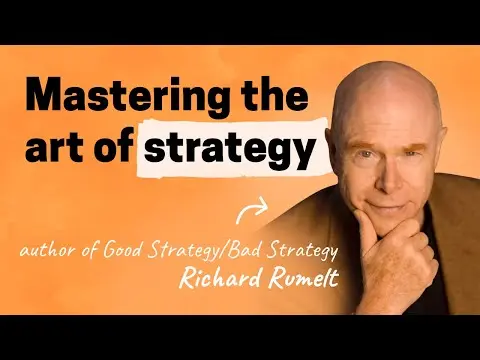
How to craft a winning strategy with five key questions

TL;DR
The five questions define where you play, how you win, and the required capabilities and enabling systems. Strategy is hard because it is integrative and emotionally intimidating, and current education often fails to teach practical methods. Start by clearly answering the five questions and then connect them to execution and governance.
Transcript
Why are so many people bad at strategy? What's taught now in business schools generally sucks. People aren't prepared educationally, and they sure don't get prepared for it in companies. It's intellectually challenging and it's emotionally intimidating. You have something you call the strategy choice cascade. You have to have answers to five q... Read More
Key Insights
- Strategy is a five question framework that ties together where you play, how you win, and the capabilities and systems needed to win.
- The winning aspiration is the anchor that guides all other choices and helps maintain focus during tradeoffs and execution.
- Where to play determines the market scope and offers a lens for prioritizing opportunities and resource allocation.
- How you win defines the competitive approach, whether through differentiation or cost leadership, and informs the required product and process choices.
- Capabilities are the unique strengths or assets you must develop or acquire to sustain advantage over competitors.
- Enabling management systems include the organization, processes, metrics, and governance needed to support strategic choices.
- Strategy is both intellectually challenging and emotionally intimidating because it requires making and owning hard tradeoffs.
- Many business schools and firms misteach strategy by overemphasizing theory and underemphasizing practical, on the ground decision making.
- More videos from this channel:
- More from this channel: Lenny's Podcast
Install to Summarize YouTube Videos and Get Transcripts
Explore YouTube Video Summarizer or Get YouTube Transcript Extractor
Questions & Answers
Q: How to apply the five questions in a real project
Apply the five questions by starting with a clear winning aspiration that sets a long term direction, then define the specific playing field including product lines and customer segments. Next, determine a winning approach whether through differentiation or cost leadership. Identify core capabilities and map the enabling management systems that support coordinated actions, then audit and adjust as conditions change. This structured sequence encourages consistent decisions and helps track progress against strategic goals.
Q: What makes strategy hard to execute effectively
Strategy is hard because it requires integrating diverse decisions to form a coherent plan that all parts of the organization must follow. It is emotionally intimidating since it involves choosing to cut activities and accept accountability for those choices. It also demands training that connects theory to practical, on the ground decision making, which is often missing in traditional curricula.
Q: Why current business education is seen as inadequate for strategy
Current education is deemed inadequate because it leans toward theory such as certain resource based models or mischaracterized positioning ideas, while failing to teach practical ways to connect where to play with how to win and with the required capabilities. Graduates therefore enter companies underprepared to make strategic choices with real impact.
Q: What is the resource based view and why is it criticized
The resource based view claims strategy centers on building assets and capabilities, but it falls short because valuable resources in one context may be useless in another. It does not provide clear methods for deciding what to invest in or where to deploy capabilities, and it is often seen as disconnected from practical market realities and execution needs.
Q: How do you differentiate between differentiation and low cost
Differentiation and low cost are two routes to winning that guide the kind of capabilities you build and the way you operate. Differentiation focuses on unique value that competitors cannot easily replicate, while low cost emphasizes efficiency and price leadership. The choice determines product design, process choices, and the enabling systems you must implement.
Q: What role do frontline managers play in strategy
Frontline managers play a crucial role by making strategic choices within their domains of influence and ensuring these choices align with the overall strategy. Their decisions impact brand performance and outcomes across functional lines, so training and empowerment at all levels are essential for sustainable strategic success.
Q: What is meant by the term playing to win versus playing to play
Playing to win means making strategic choices that lead to competitive advantage and sustained performance, not just engaging in activity for its own sake. Playing to play describes pursuing actions without a clear link to winning outcomes, which risks misalignment and inefficiency. The distinction matters for focus and accountability.
Q: What simple starting trick helps thinking through strategy
A simple starting trick is to map the five questions to a single, shared narrative that links aspiration, playing field, winning approach, capabilities, and governance. By telling a concise story that connects these elements, teams can quickly identify gaps, test tradeoffs, and begin aligning actions across functions.
Summary & Key Takeaways
-
The five questions you must answer to build strategy are winning aspiration, where to play, how to win, what capabilities you have, and what enabling management systems to implement. These questions force coherent choices that reinforce one another and guide action across the organization.
-
Strategy is hard because it requires integrating multiple decisions to fit together, and because it involves conscious tradeoffs that people must own and defend. It also involves emotional challenges, not just intellectual ones, when committing to do some things and not others.
-
Educational and consulting practices often fail to prepare practitioners for real strategic work, focusing on theory and unrelated models rather than actionable frameworks and frontline decision making. A practical approach links playing to win with the right capabilities and governance mechanisms.
Read in Other Languages (beta)
Share This Summary 📚
Summarize YouTube Videos and Get Video Transcripts with 1-Click
Try YouTube Summary with ChatGPT & Claude or YouTube Transcript Generator
Explore More Summaries from Lenny's Podcast 📚


Summarize YouTube Videos and Get Video Transcripts with 1-Click
Try YouTube Summary with ChatGPT & Claude or YouTube Transcript Generator