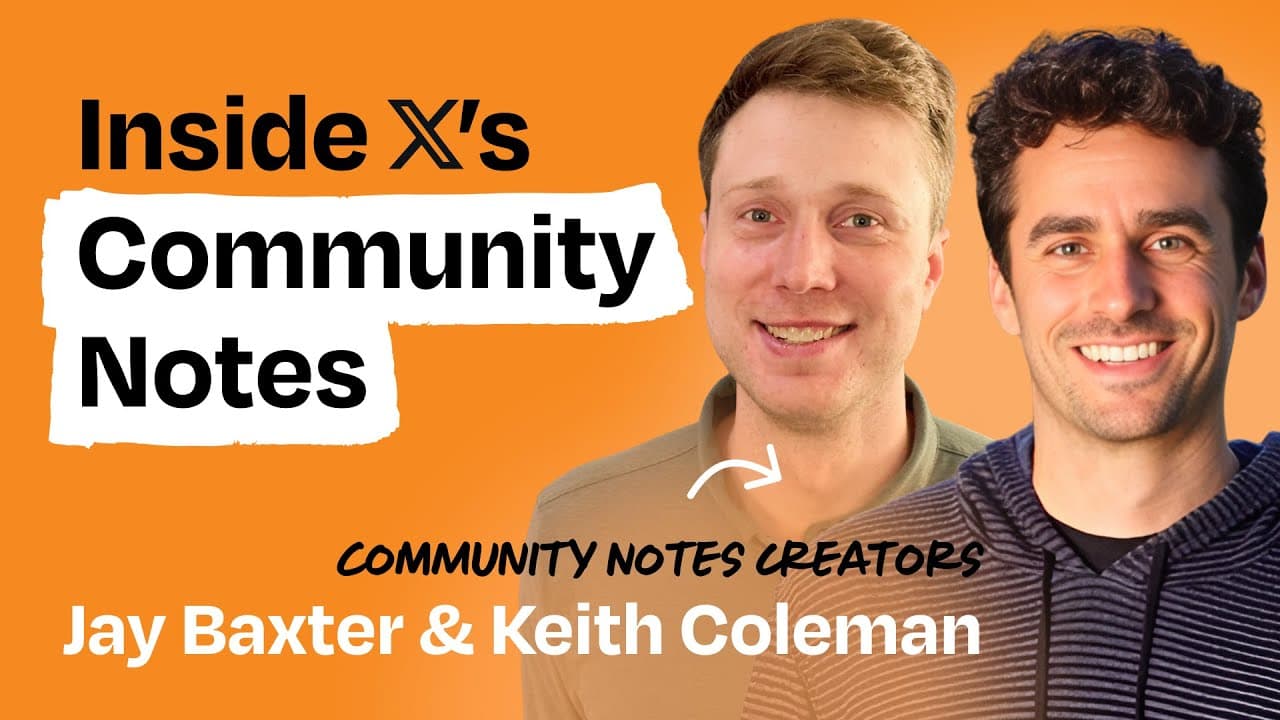
How Community Notes on X works to fight misinformation
TL;DR
Community Notes lets the public add context to misleading posts and uses a bridging agreement algorithm to surface notes that are informative and neutral. Regular contributors with verified phones participate, and notes are shown only when there is agreement among people who normally disagree. The system has persisted through leadership changes and is spreading to other platforms.
Transcript
The work that you guys do has had such a tremendous impact on the way the world works. I want to start with just giving people a brief understanding of what is Community Notes. Someone on X can see a post. If they think it's misleading, they can propose a note that they think other people might find informative. Other people can then rate t... Read More
Key Insights
- X users can propose notes to posts they see as misleading.
- Notes are shown when agreed upon by users who usually disagree, boosting neutrality.
- The system uses a bridging agreement algorithm to reduce bias.
- Contributors must verify their identity with a phone number.
- The approach emphasizes open participation over curated editors.
- History includes surviving four leadership changes at the company.
- External studies suggest notes influence audience agreement with core claims.
- Meta has adopted Community Notes as a key tool for fact checking.
- More videos from this channel:
- More from this channel: Lenny's Podcast
Install to Summarize YouTube Videos and Get Transcripts
Explore YouTube Video Summarizer or Get YouTube Transcript Extractor
Questions & Answers
Q: What is Community Notes and how does it work on X
Community Notes is a public context tool for posts that may be misleading. A user can propose a note, and others rate it. If the note is found helpful by people who typically disagree, it becomes visible to everyone. The goal is to provide informative, neutrally worded context to help users decide what they see.
Q: How does the bridging agreement concept improve accuracy
Bridging agreement looks for consensus between users who usually disagree rather than relying on a simple majority. This helps identify notes that are accurate and neutrally written, reducing the risk of bias from a homogeneous group. It creates a more robust signal for when a note should be shown.
Q: Who can contribute notes and what checks exist
Contributors are regular people who sign up and verify their phone number. They are not required to be professional fact checkers. The verification step and the open participant model are designed to maintain accessibility while adding a layer of trust to the process.
Q: What challenges did the team face during development
The team faced skepticism about whether regular people could perform this task effectively and concerns about manipulation. They chose an open model and a bridging algorithm to counter concerns, aiming to move away from curated editorial decisions toward distributed crowd input.
Q: How did leadership changes impact Community Notes
Community Notes survived four leadership changes, including leaders like Elon and Jack. The core principles and flexible, lightweight team structure contributed to its resilience, showing that the concept could endure shifts in vision while maintaining its approach to crowd-sourced context.
Q: What is the role of open participation in the system
Open participation allows a wide range of people to contribute notes, including adversarial inputs, which helps test the accuracy and neutrality of notes. The design relies on diverse perspectives to improve the quality of information presented to users.
Q: What does Meta’s adoption mean for Community Notes
Meta adopting Community Notes as a main fact checking tool signals broader acceptance of open, crowdsourced context. It suggests the approach could become a standard method for handling online information, emphasizing transparency, neutral language, and rapid coverage across platforms.
Q: What is the practical impact of Community Notes on users
Users benefit from added context that clarifies potentially misleading posts, helping them form better judgments. The notes influence how core claims are perceived and can change audience agreement with a post when presented with additional information from the community.
Summary & Key Takeaways
-
Community Notes enables public context on posts that may be misleading, with notes shown when trusted by people who typically disagree. This creates more neutral and informative content. The process relies on verified contributors and a specialized agreement algorithm rather than traditional editors.
-
The design emphasizes openness and broad participation to reduce manipulation, aiming for accurate, balanced notes that help users make informed decisions. It has endured leadership transitions and expanded beyond its origin to other platforms.
-
The future of Community Notes involves wider adoption and continued emphasis on transparency, neutral phrasing, and speed, supported by a lightweight, scalable operational model that relies on crowd input and bridging agreement.
Read in Other Languages (beta)
Share This Summary 📚
Summarize YouTube Videos and Get Video Transcripts with 1-Click
Try YouTube Summary with ChatGPT & Claude or YouTube Transcript Generator
Explore More Summaries from Lenny's Podcast 📚





Summarize YouTube Videos and Get Video Transcripts with 1-Click
Try YouTube Summary with ChatGPT & Claude or YouTube Transcript Generator