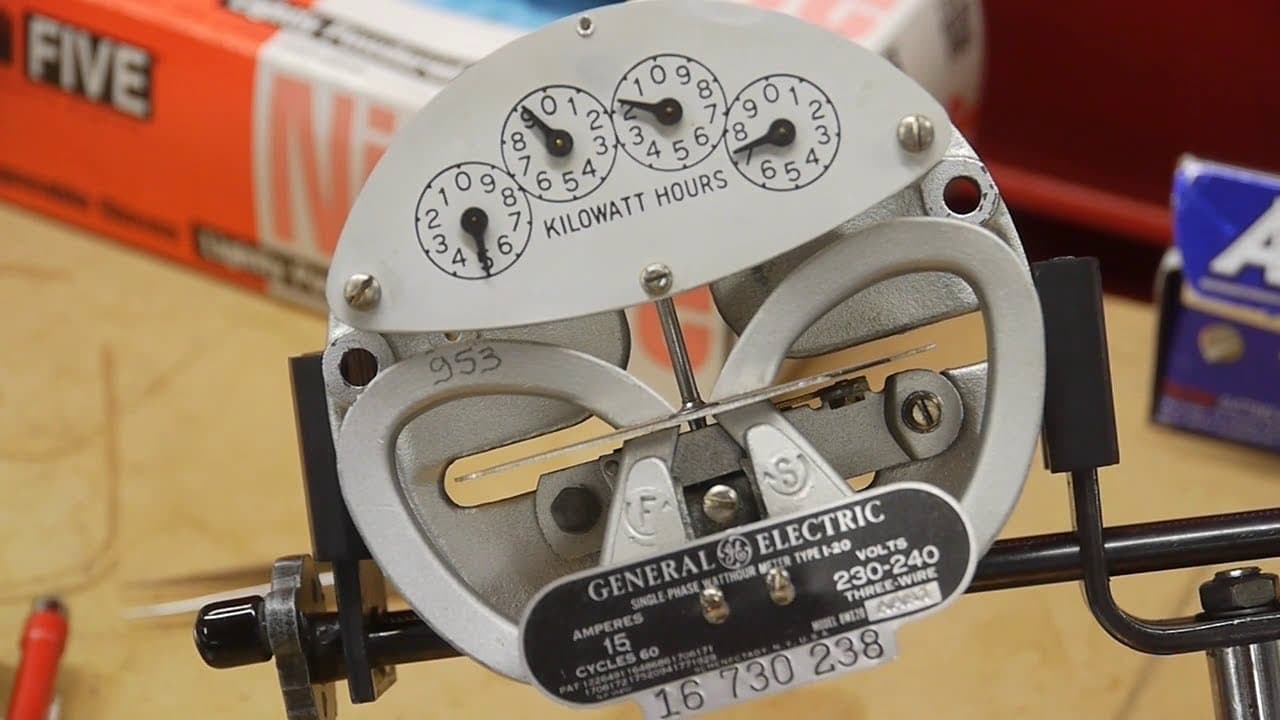
Explanation of how kilowatt-hour meters work (electromechanical)
TL;DR
Exploring the intricate workings of traditional power meters enhanced by phase-shift technology.
Transcript
hey everyone these electromechanical watt-hour meters are being replaced nowadays with digital counterparts but there's actually quite a lot of interesting stuff going on inside there to make those work so I thought we'd take a look today so I have this set up with a digital watt meter in line and then I have a heater over here so if I turn the hea... Read More
Key Insights
- 🤒 Traditional watt-hour meters combine voltage and current coils for power measurement.
- 🦻 Introducing a phase shift with a copper ring aids in creating a net torque for disc movement.
- ✊ Eddy current brakes help control disc speed in proportion to power consumption.
- 🤒 The anti-creep hole prevents overcharging by stopping meter rotation when no power is drawn.
- 🚄 High ratio reduction gear trains divide disc rotations for precise meter readings.
- 🤒 The stippling pattern on the disc aids in visibility and rigidity, not related to meter operation.
- 🛟 Asymmetric current coil configurations may serve unique operational purposes.
Install to Summarize YouTube Videos and Get Transcripts
Explore YouTube Video Summarizer or Get YouTube Transcript Extractor
Questions & Answers
Q: How do traditional electromechanical watt-hour meters work?
Traditional meters utilize two separate coils for voltage and current to create a magnetic force proportional to power consumption. Phase shift from a copper ring induces disc movement for accurate measurement.
Q: What role does the copper ring play in the meter's operation?
The copper ring in the meter introduces a 90-degree phase shift, essential for creating a moving magnetic field that drives the disc rotation, similar to a shaded pole motor.
Q: How do eddy current brakes contribute to the meter's functionality?
Eddy current brakes in the meter oppose disc motion as power consumption increases, ensuring a linear relationship between consumed power and disc speed.
Q: What is the purpose of the anti-creep hole in the meter design?
The anti-creep hole stops meter rotation when no power is consumed, preventing overcharging customers and compensating for mechanical drag.
Summary & Key Takeaways
-
Traditional watt-hour meters use a combination of voltage and current coils to measure power consumption.
-
Introducing phase shift with a copper ring aids in creating a net torque for disc movement.
-
The meter includes features like eddy current brakes, an anti-creep hole, and a high ratio reduction gear train for precise power measurement.
Read in Other Languages (beta)
Share This Summary 📚
Summarize YouTube Videos and Get Video Transcripts with 1-Click
Try YouTube Summary with ChatGPT & Claude or YouTube Transcript Generator
Explore More Summaries from Applied Science 📚



Summarize YouTube Videos and Get Video Transcripts with 1-Click
Try YouTube Summary with ChatGPT & Claude or YouTube Transcript Generator