How Do AI Agents Improve Cybersecurity?
TL;DR
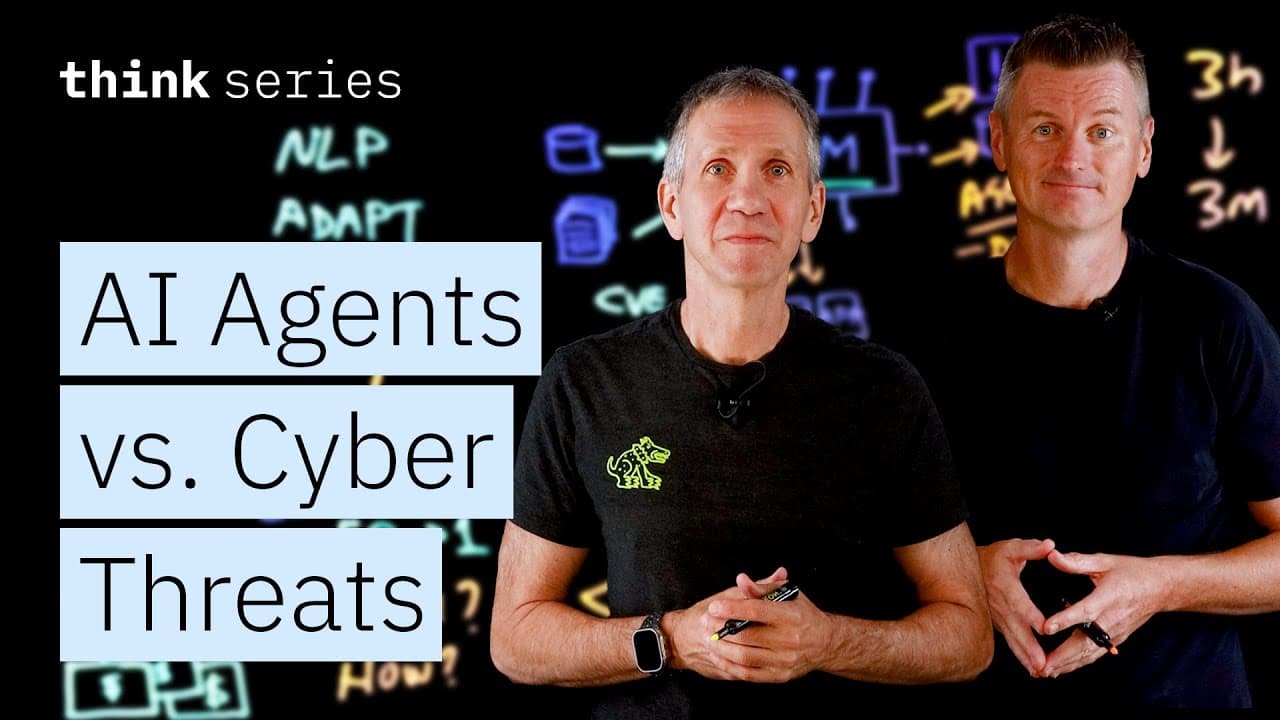
AI agents improve cybersecurity by gathering and correlating security data, interpreting context, triaging alerts, and recommending responses while adapting workflows to live information. They can accelerate investigations and reduce analyst workload, but hallucinations, prompt injection, false positives, and unsafe actions require limited permissions, extensive testing, human approval for high-risk steps, and continuous verification.
Transcript
Cybersecurity threats increase as data volumes grow, and finding real threats hidden among the noise of all that data is a challenge. And there's a chronic shortage of cybersecurity professionals like yourself, Jeff. Yes. In fact, there's an estimated 500,000 open cybersecurity jobs in the US alone. Half a million more Jeff Crumes is a bit of a ter... Read More
Key Insights
- AI agents are LLM-based systems that autonomously choose actions and interact with their environments within defined boundaries. Unlike static rules or narrow machine learning models, they can interpret intent, understand context, select appropriate tools, and adapt their next steps using live results.
- Traditional cybersecurity workflows are built around predefined rules, known signatures, and human-authored playbooks. A typical incident process follows a fixed sequence in which an analyst gathers data, checks known threat indicators, and follows documented procedures that must be manually updated when conditions change.
- Agentic investigations can reduce work that once took three hours to as little as three minutes without sacrificing accuracy, according to the reported comparison in the discussion. Agents also avoid the fatigue and experience-related variability that can affect overworked human analysts handling large alert volumes.
- Security alert triage is a practical role for AI agents because they can gather related cloud logs, identity logs, and EDR telemetry after an alert triggers. They can group connected signals and recognize that many alerts may represent one coordinated event rather than numerous separate incidents.
- Phishing analysis is strengthened by semantic context because agents can examine writing style, urgency, fear, deviations from a sender's normal communication, and social engineering cues. This approach goes beyond traditional spam filters, blacklisted URLs, and heuristic rules that rely primarily on predefined indicators.
- Malware analysis is supported when an LLM reads suspicious code, explains its sections in natural language, and identifies potentially suspicious API calls. In this role, the agent functions like a junior reverse engineer who helps analysts understand code rather than independently making every security decision.
- AI security agents are vulnerable to hallucinations and adversarial manipulation. They may incorrectly declare a system clean, recommend disruptive remediation, or follow indirect prompt injections hidden in logs or emails, which makes validation and tightly controlled permissions necessary for high-stakes environments.
- Safe agent deployment is a gradual trust process that starts with limited permissions, extensive testing, output reviews, and human confirmation for high-risk actions. Agents should assist human reasoning rather than replace it, while analyst feedback can improve precision and reduce false positives over time.
Install to Summarize YouTube Videos and Get Transcripts
Explore YouTube Video Summarizer or Get YouTube Transcript Extractor
Questions & Answers
Q: How do AI agents improve cybersecurity operations?
AI agents improve cybersecurity operations by collecting information from multiple security sources, enriching it with threat intelligence, correlating signals across systems, and ranking incidents according to assigned risk priorities. They can reference frameworks such as MITRE ATT&CK, recommend a response, and document the findings in a ticket or case, automating much of the research analysts previously performed manually.
Q: How are AI security agents different from traditional security tools?
Traditional security tools commonly rely on predefined rules, threat signatures, and fixed human-authored playbooks. Narrow machine learning models also tend to perform one task under fixed patterns. An LLM-powered agent can instead interpret natural language and context, choose which database, API, search, or script to use, examine the result, and dynamically decide what action should follow.
Q: How do AI agents help triage cybersecurity alerts?
When an alert triggers, an AI agent can automatically retrieve related cloud logs, identity logs, and EDR telemetry to determine whether the event represents a real threat. It can summarize and group connected alerts, reducing noise by identifying when many notifications describe one incident, such as 50 alerts that collectively indicate a single port scan attempt.
Q: How can AI agents detect phishing emails?
AI agents can analyze the meaning and context of an email rather than relying only on spam filters, blacklisted URLs, or heuristic rules. They can examine whether the writing creates urgency or fear, whether the sender normally communicates in that style, and whether the message includes social engineering cues, such as a request to purchase gift cards.
Q: How can AI agents assist with malware analysis?
An analyst can provide suspicious code to an AI agent powered by an LLM. The agent can break down the code, explain each section in natural language, and identify suspicious API calls. This allows it to operate like a junior reverse engineer who supports human analysis, alongside other uses in vulnerability management, risk management, and threat hunting.
Q: What risks come with using AI agents in cybersecurity?
AI security agents can hallucinate, make confident but incorrect claims, generate false positives, and recommend remediation that disrupts systems. Attackers may also place indirect prompt injections inside logs or email content to influence the agent. These risks mean an agent's output must be validated, especially before it is allowed to perform autonomous actions on high-stakes production systems.
Q: What guardrails should cybersecurity AI agents have?
Cybersecurity AI agents should initially have read-only access or permission to perform only low-risk actions. High-risk steps, such as shutting down a server, should require human confirmation. Organizations should test agents extensively, review their outputs, add validation layers against adversarial inputs, maintain healthy skepticism, and gradually increase permissions only after consistent performance has been demonstrated.
Q: What role should human analysts have when using AI agents?
Human analysts should remain in the loop, verify agent conclusions, approve high-risk actions, and provide feedback when outputs are inaccurate. Continuous analyst feedback can improve precision for a specific environment and reduce false positives over time. The intended balance is for AI to assist human thinking and automate research, not to replace judgment or encourage blind trust in automated recommendations.
Summary & Key Takeaways
-
LLM-powered security agents differ from traditional tools because they can interpret natural language, reason about context, select tools, and adjust workflows in real time. They process structured logs and unstructured reports, query databases or threat intelligence services, run scripts, and use each result to determine the most appropriate next investigative step.
-
Security operations centers use agents to gather cloud logs, identity records, and endpoint telemetry, then summarize and group related alerts. Agents can also evaluate phishing language, explain suspicious code, research likely incident causes, assess exposure to advisories, support threat hunting, and help with vulnerability, risk, and incident management activities.
-
Safe deployment requires guardrails because agents may hallucinate, produce false positives, recommend disruptive remediation, or be manipulated by malicious inputs. Organizations should begin with read-only or low-risk permissions, test extensively, review outputs, require confirmation for high-risk actions, incorporate analyst feedback, and expand trust only after the agent demonstrates consistent performance.
Read in Other Languages (beta)
Share This Summary 📚
Summarize YouTube Videos and Get Video Transcripts with 1-Click
Try YouTube Summary with ChatGPT & Claude or YouTube Transcript Generator
Explore More Summaries from IBM Technology 📚

Summarize YouTube Videos and Get Video Transcripts with 1-Click
Try YouTube Summary with ChatGPT & Claude or YouTube Transcript Generator