How to Turn Personal Problems Into Profitable Apps
TL;DR
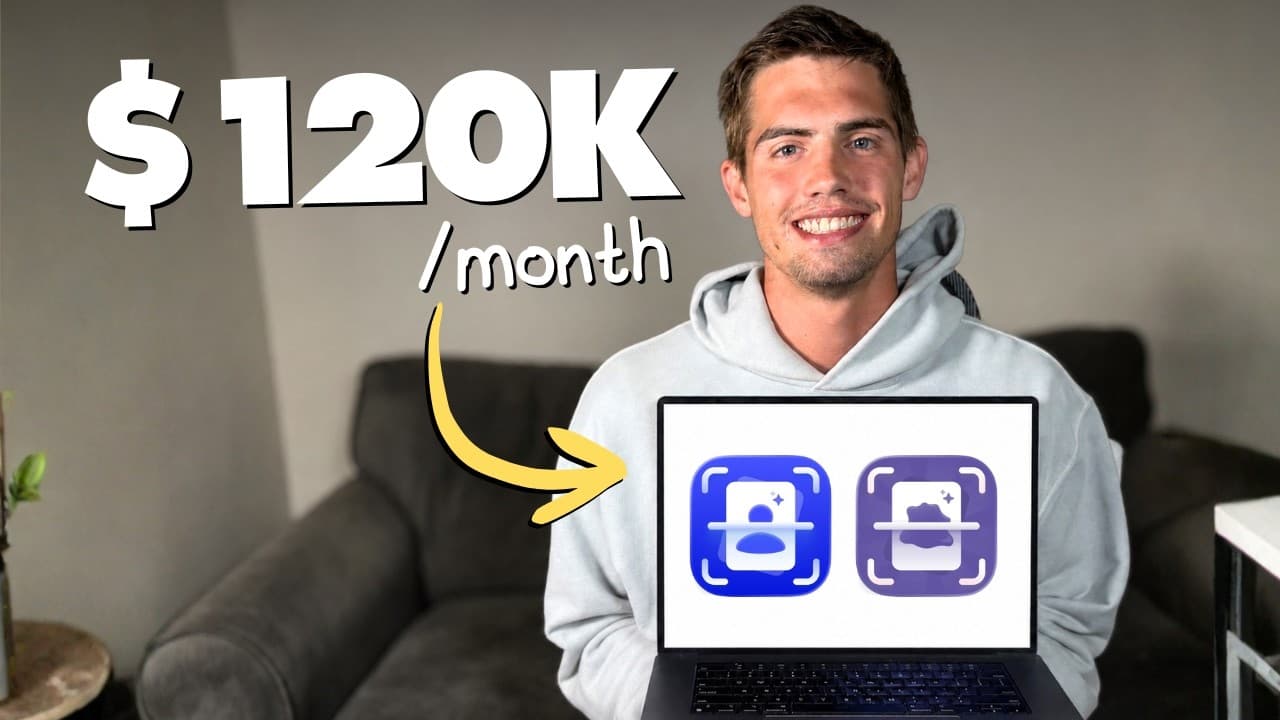
Start by recording repetitive problems in your hobbies, define the smallest useful solution, build it, add subscriptions, and test repeatable marketing. Kyle Fowler used this approach to create Cardstock and Scanémon, two card-scanning apps that reportedly generate $120,000 per month together, while demonstrating that personal utility can provide meaningful validation even before market demand is proven.
Transcript
Everyone wants to find the perfect app idea. So, you spend hours researching and scrolling YouTube for inspiration, only to come out of the other side with nothing. But what if I told you there was a better way? Meet Kyle. He finds his app ideas hiding in plain sight. And today, those apps make over $120,000 a month. He doesn't chase trends or shin... Read More
Key Insights
- Personal problems are a practical source of app ideas because solving a recurring frustration for yourself establishes immediate usefulness. Fowler conceived Cardstock after realizing that his physical card collection could not be identified, sorted, or reviewed remotely without a digital catalog on his phone.
- Cardstock is a sports-card scanner that uses a phone camera to identify cards, estimate market value, save cards in a collection, and track their value over time. It also displays recent sales, which Fowler describes as especially important information for collectors assessing a card.
- Cardstock has about 15,000 active subscriptions, up to $75,000 in monthly recurring revenue, and approximately 13,000 monthly downloads. Fowler says the business grew from three people making a few hundred dollars per month in a basement to five people traveling while earning $1.5 million annually.
- Scanémon applies a similar scanning and valuation model to Pokémon cards. About one year after launch, Fowler reports roughly 3,400 active subscriptions, $17,000 in monthly recurring revenue, and 16,000 new customers per month, which exceeds Cardstock's reported monthly download volume.
- AI-assisted development substantially shortened Fowler's build cycle. Cardstock required roughly six months from idea to completion, including a three-month pause, while Scanémon's minimum viable product was created in one day during 2025 with Cursor's agent generating much of the application.
- The minimum viable solution is the fastest version that adequately solves the identified problem. Fowler recommends avoiding unnecessary scope, building that focused version, and then implementing subscriptions with tools such as Superwall or RevenueCat, which he believes AI can help configure.
- TikTok slideshows are Fowler's preferred repeatable marketing format because creators can test structures that generate views and structures that convert viewers into downloads. He recommends finding a balance between those outcomes and testing through personal accounts before expanding distribution.
- Commercial success is not guaranteed even after an app is built, published, and marketed. Fowler argues that a project still produces value when it addresses a problem the developer personally cares about, because the creator retains a useful solution regardless of whether customers pay for it.
Install to Summarize YouTube Videos and Get Transcripts
Explore YouTube Video Summarizer or Get YouTube Transcript Extractor
Questions & Answers
Q: How can personal problems become profitable app ideas?
A personal problem can become an app idea when it involves a recurring, slow, repetitive, or frustrating task that software could simplify. Fowler began by wanting to catalog and remotely identify his own card collection, then discovered that the App Store lacked the solution he wanted. He built Cardstock for himself, reasoning that other collectors could share the same need, although willingness to pay still required testing.
Q: What does the Cardstock app do for sports-card collectors?
Cardstock lets collectors use a phone camera to identify a sports card and find its estimated market value. Users can add identified cards to a digital collection, monitor their value over time, review detailed card information, and inspect recent sales. If the application matches a card incorrectly, users can edit the identifying information and try to correct the result.
Q: How much revenue and usage does Cardstock report?
Fowler reports that Cardstock has about 15,000 active subscriptions, reaches up to $75,000 in monthly recurring revenue, and receives approximately 13,000 downloads per month. He also says the broader operation grew from three people in a basement earning a few hundred dollars monthly to a five-person team traveling internationally and generating $1.5 million per year.
Q: How does Scanémon compare with Cardstock?
Scanémon uses essentially the same scanning concept as Cardstock but focuses on Pokémon cards rather than sports cards. Fowler says it had been operating for about one year and had reached approximately 3,400 active subscriptions, $17,000 in monthly recurring revenue, and 16,000 new customers per month. Its monthly customer figure was already higher than Cardstock's reported 13,000 monthly downloads.
Q: What technology was used to build the card-scanning apps?
Cardstock was built with Swift and SwiftUI, while Core Data handled storage. Fowler initially relied heavily on Stack Overflow, later integrated third-party tools such as RevenueCat for subscriptions, and used an AWS EC2 server for the card-database backend. His broader workflow also includes tools such as Cursor, Supabase, Railway, CodeRabbit, Framer, Notion, Slack, Claude, WhisperFlow, and Granola.
Q: How long did it take to build and launch the apps?
Fowler started building Cardstock in the winter of 2019 and estimates that the path from idea to completion took roughly six months, including a three-month gap. Downloads arrived quickly after he posted a completion update on Reddit. Scanémon followed a dramatically shorter process in 2025, when he used Cursor's agent to generate much of the application and produced its minimum viable product in one day.
Q: What is the step-by-step process for finding a strong app idea?
Fowler recommends first keeping a note on your phone and recording problems, opportunities, and repetitive tasks as you encounter them. Next, define the smallest and quickest solution that resolves the problem. Build that focused version, then add monetization with a subscription tool such as Superwall or RevenueCat. Publishing and marketing test whether other people share the need and are willing to pay.
Q: How should a new mobile app be marketed with TikTok?
Fowler recommends creating simple, repeatable TikTok slideshows and testing formats for two separate outcomes: gaining views and converting viewers into downloads. A founder can begin with one or several personal accounts to validate whether the content attracts attention. Noise can later distribute a slideshow template to creators, with payment based on the number of views their posts receive.
Summary & Key Takeaways
-
Kyle Fowler turned his interest in collectible cards into Cardstock, an app that identifies sports cards, estimates their market value, records collections, and tracks values over time. He reports growing from three people in a basement earning a few hundred dollars monthly to a five-person team generating $1.5 million annually.
-
Cardstock took roughly six months from idea to completion, including a three-month gap, and was originally built with Swift, SwiftUI, Core Data, Stack Overflow, RevenueCat, and an AWS EC2 backend. By contrast, Fowler says Cursor's agent helped him create Scanémon's minimum viable product in a single day during 2025.
-
Fowler's playbook begins with documenting slow, repetitive, or frustrating tasks from everyday life. He recommends defining the smallest solution, using AI to accelerate development, adding monetization through tools such as Superwall or RevenueCat, and testing TikTok slideshows that balance audience reach with conversion into app downloads.
Read in Other Languages (beta)
Share This Summary 📚
Summarize YouTube Videos and Get Video Transcripts with 1-Click
Try YouTube Summary with ChatGPT & Claude or YouTube Transcript Generator
Explore More Summaries from Starter Story 📚



Summarize YouTube Videos and Get Video Transcripts with 1-Click
Try YouTube Summary with ChatGPT & Claude or YouTube Transcript Generator