What is a microcontroller and how does it work?
TL;DR
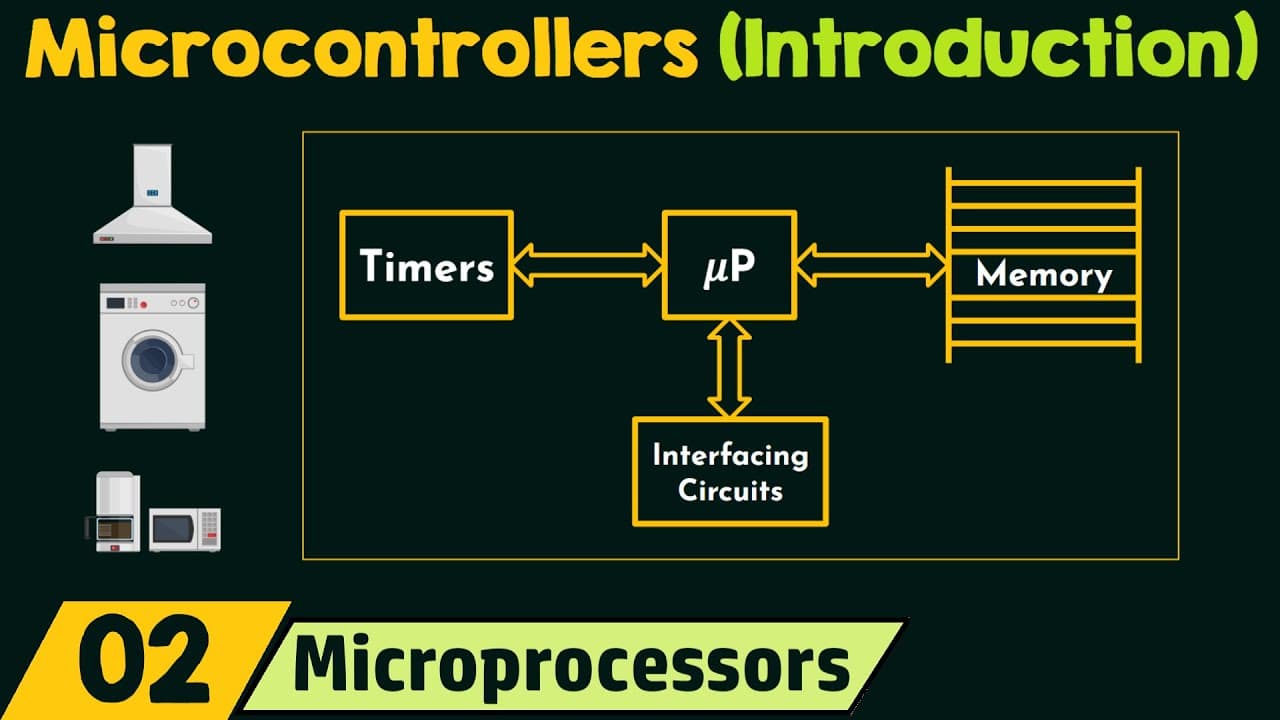
A microcontroller is a compact computer on a single chip that combines a basic microprocessor, memory, timers and interfacing circuits. It controls everyday appliances by storing instructions and generating delays to execute button commands. The 8051 is a common microcontroller architecture introduced in the lesson, with multiple functional blocks and memory organization.
Transcript
hello everyone and welcome back in this session we are going to be introduced to microcontrollers so let's get to learning coming to the topic that we are going to cover in this particular session in this session we will understand the microcontrollers now in the previous session when we learned about the microprocessors we also learned that these ... Read More
Key Insights
- A microcontroller is a compact single chip that includes a basic microprocessor, memory for instructions and data, timers and interfacing circuits.
- The main idea is to perform control tasks for appliances like washing machines by responding to button inputs and generating appropriate delays.
- On a microcontroller, the processor, memory and I/O are integrated on one chip, unlike larger microprocessors used in general purpose computers.
- Microcontrollers use timers to create delays and manage timing related tasks in devices and appliances.
- Interfacing circuits and push buttons inside an appliance feed instructions to the microcontroller to perform specific actions.
- The Intel 8051 is introduced as a representative microcontroller, with a focus on its main features and block structure.
- Understanding memory structure is essential for storing programs and data used by the microcontroller during operation.
- The course plans to cover addressing modes, instruction set, programming examples and advanced topics such as interrupts and serial interfaces.
Install to Summarize YouTube Videos and Get Transcripts
Explore YouTube Video Summarizer or Get YouTube Transcript Extractor
Questions & Answers
Q: How does a microcontroller differ from a microprocessor in a device?
A microcontroller embeds a basic microprocessor along with memory, timers and interfacing circuits on a single chip, which allows it to control appliances by processing inputs and generating outputs directly. This integration enables compact designs and targeted control for everyday devices, unlike a separate microprocessor that would require additional components to function.
Q: What role do memory and instructions play in a microcontroller?
Memory stores the instructions that tell the microcontroller how to behave and the data it needs to operate. When a button is pressed or a sensor changes state, the microcontroller fetches the relevant instruction from memory, executes it, and updates outputs or internal state accordingly, enabling predictable control of the appliance.
Q: Why are timers important in microcontrollers?
Timers generate delays and manage timing related tasks, such as how long a washing cycle runs. They provide precise timing control so the machine can perform sequential steps with correct durations, which is essential for reliable operation and user satisfaction.
Q: What is the 8051 in this course context?
The 8051 is presented as a representative microcontroller used to illustrate main features and the block structure of microcontrollers. The course will cover its functional blocks, program and data memory structure, addressing modes and instruction set, plus programming examples and advanced topics.
Q: How do interfaces and buttons interact with a microcontroller in devices?
Interfaces and buttons on the device send user commands to the microcontroller, which stores and interprets these inputs as instructions. The microcontroller then uses its memory and timers to perform the requested action, such as starting a wash cycle or changing a setting.
Q: What future topics are planned after the basics of microcontrollers?
After covering the basics, the course plans to discuss evolution of computers, advanced topics related to 8051 such as interrupt structure, timers, serial interface, port operation and power saving modes, to deepen understanding of MCU design and programming.
Q: What is the general purpose of studying microcontrollers in everyday appliances?
Studying microcontrollers helps explain how everyday appliances perform controlled tasks automatically. By understanding the integrated chip that handles processing, memory and timing, learners can grasp how devices respond to user inputs, carry out programmed sequences and operate efficiently with minimal external hardware.
Q: How are microcontrollers positioned in the overall course on microprocessors?
Microcontrollers are positioned as a practical extension of microprocessor concepts, showing how a single chip can replace multiple external components by integrating a processor, memory, timers and interfaces. This sets a foundation for learning programming, hardware interaction and system design within a compact architecture.
Summary & Key Takeaways
-
Microcontrollers combine a basic processor, memory and I/O interfaces on one chip and drive everyday appliances through stored instructions.
-
They differ from microprocessors by integrating timing circuits and interfaces directly on the chip, enabling compact and targeted control.
-
The session introduces the Intel 8051 microcontroller and outlines its main features, memory structure and programming concepts.
Read in Other Languages (beta)
Share This Summary 📚
Summarize YouTube Videos and Get Video Transcripts with 1-Click
Try YouTube Summary with ChatGPT & Claude or YouTube Transcript Generator
Explore More Summaries from Neso Academy 📚





Summarize YouTube Videos and Get Video Transcripts with 1-Click
Try YouTube Summary with ChatGPT & Claude or YouTube Transcript Generator