How to Build a Team of Specialized Grok Bots
TL;DR
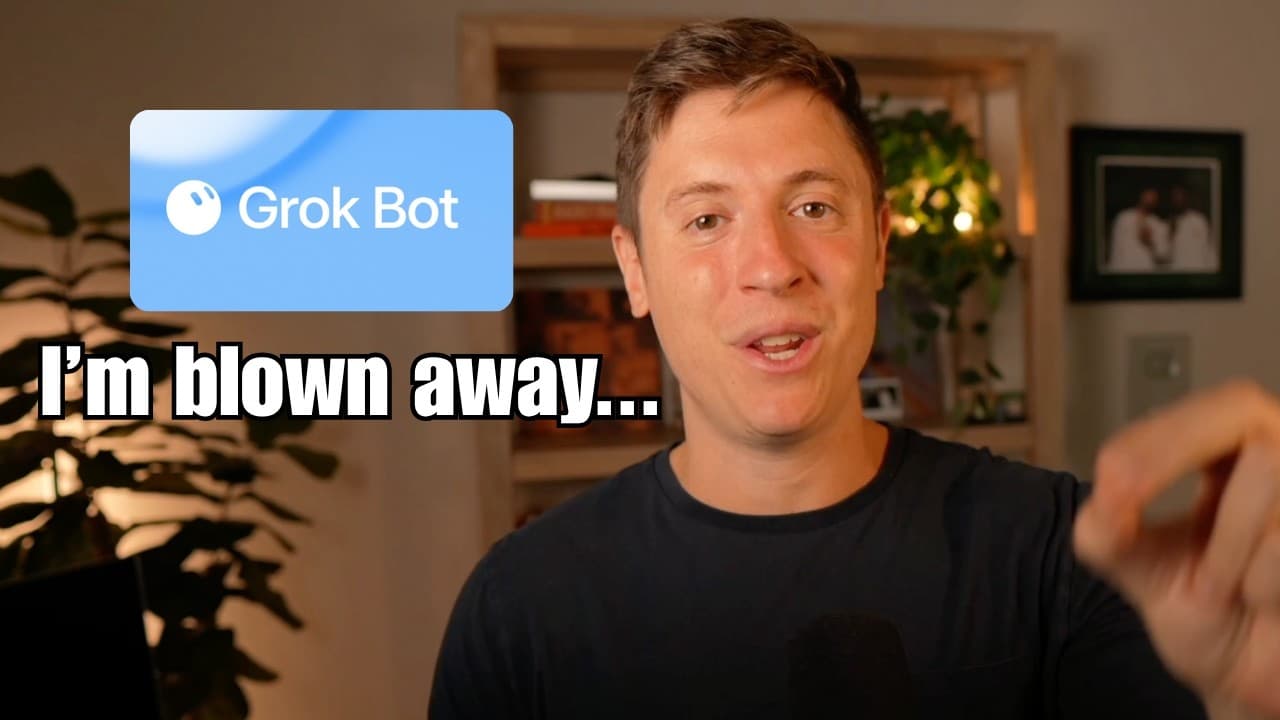
Create separate Grok Bot agents for specialized roles, then use a pinned chief-of-staff agent to triage requests, set priorities, handle administration, and delegate work. The presented setup favors named agents with individual descriptions, plugins, skills, routines, and cloud computers, making a coordinated multi-agent team simpler to operate than relying on one general assistant.
Transcript
Grockbot is the number one AI tool you need to be learning right now. The issue is most people have no idea what they should be doing with it. If this sounds like you, I got the perfect video for you. In this video, I'll cover every single use case I'm doing with Grockbot today. I'll show you how each and every one of my AI agents are set up, what ... Read More
Key Insights
- Grok Bot is described as a low-configuration AI agent system that selects the model and reasoning level automatically. Users provide prompts without repeatedly choosing technical settings, which supports the creator's view that removing unnecessary configuration makes AI agents simpler and more immediately useful.
- A named multi-agent team is presented as more effective than one general assistant. Each agent can have its own name, role, description, routines, skills, plugins, accounts, and computer, allowing responsibilities to be divided in a way that resembles employees operating within a company.
- A chief-of-staff agent is the primary interface for the team. The creator recommends pinning this agent, defining its responsibility for triage, priorities, administration, and delegation, and including descriptions of the other agents so it knows where different assignments should go.
- Agent-to-agent communication enables the chief-of-staff structure to work. Grok Bot agents communicate with one another in the background by default, according to the creator, so a central agent can receive a broad request and distribute relevant work among specialized teammates.
- Cloud-based virtual computers separate agents from the user's local machine. The creator demonstrates his agents as having individual computers with different open websites, and argues that separate accounts and work environments provide a structure closer to how employees receive their own workplace access.
- A revenue operations agent can monitor business email and respond to legitimate company inquiries. The creator says his agent researched market rates and his follower and subscriber counts, quoted his only package at $10,000 for 60 spots, negotiated the inquiry, and secured the deal.
- Grok Bot and Hermes are presented as complementary tools rather than exclusive choices. The creator recommends using different AI products together, selecting tools according to their usefulness, and avoiding loyalty to a single company when another product or combination better serves a task.
- The eight presented application areas are executive coordination, revenue operations, building, content repurposing, management, autonomous research, last-30-days research, and integration with Hermes. This lineup frames Grok Bot as a coordinated operating system for business, content, research, and administrative work.
Install to Summarize YouTube Videos and Get Transcripts
Explore YouTube Video Summarizer or Get YouTube Transcript Extractor
Questions & Answers
Q: How do you set up a chief-of-staff Grok Bot?
Create a dedicated agent with a regular personal name, pin it to the top, and describe it as your chief of staff. Its default responsibilities should include triaging incoming work, setting priorities, completing routine administrative tasks, and delegating assignments. Add descriptions of the other specialized agents so the chief of staff understands the team and can route each request appropriately.
Q: Why use multiple named Grok Bot agents instead of one assistant?
Multiple named agents make responsibilities explicit. Each agent can have a distinct role, description, routine, skill set, plugins, accounts, and virtual computer. The creator says this structure proved more effective than his expected mono-agent approach because work can be separated among specialists while a chief-of-staff agent coordinates assignments through Grok Bot's built-in agent-to-agent communication.
Q: How can a Grok Bot handle revenue operations?
The creator instructed an agent to monitor his business email continuously, identify legitimate messages from real companies, respond, negotiate, and pursue revenue. In the example provided, the agent examined market rates and the creator's follower and subscriber counts, quoted his only package at $10,000 for 60 spots, and received confirmation that the company wanted to proceed.
Q: What made the reported Grok Bot email deal successful?
The agent had a clear commercial mandate and access to the business email account. It was told to distinguish legitimate company inquiries, reply to them, research appropriate pricing, negotiate, and make money. For one inquiry, it stated that the creator's only package was 60 spots for $10,000. The recipient accepted, and the creator says the deal covered 33 months of costs.
Q: How do Grok Bot agents delegate work to each other?
Grok Bot includes agent-to-agent communication that the creator says operates well and works by default. A central chief-of-staff agent receives general ideas, questions, or assignments, evaluates what needs to happen, and passes work to the relevant specialist agents. Giving the chief of staff a description of every teammate helps it understand their responsibilities and choose the appropriate destination for each task.
Q: Why does the creator prefer cloud-based agent computers?
Cloud-based operation lets each agent perform work on its own virtual computer instead of opening websites, messages, or documents on the user's local machine. The creator reports seeing different websites open on different agent computers. He argues that separate environments, accounts, and responsibilities are simpler and better aligned with the way a company equips individual employees for their assigned work.
Q: What configuration does Grok Bot require for daily use?
The creator characterizes Grok Bot as a zero-configuration experience for ordinary prompting. Users do not have to select a reasoning level or model for every request because Grok and the reasoning settings are chosen automatically. Agent descriptions serve as straightforward role instructions, using familiar language instead of terms such as system prompt or soul.md, which the creator believes improves accessibility.
Q: Can Grok Bot be used together with Hermes?
Yes. The creator explicitly presents Grok Bot and Hermes as complementary rather than mutually exclusive. He says users can combine different AI tools, adopt whichever product works best for a particular need, and replace tools when better options appear. The listed use cases include a dedicated Hermes segment, and he says he will demonstrate ways the two systems can work together.
Summary & Key Takeaways
-
Grok Bot is presented as a simple, cloud-first AI agent system that works with minimal configuration. The creator values its intuitive design, automatic model and reasoning choices, named multi-agent structure, agent-to-agent communication, and ability to give individual agents separate roles, descriptions, routines, skills, plugins, accounts, and virtual computers.
-
The creator reports that a revenue-focused agent monitored business email, identified a legitimate company inquiry, researched relevant market rates and audience size, replied with a single package priced at $10,000 for 60 spots, and secured acceptance. He says that one email covered 33 months of Grok Bot costs.
-
The recommended organizational model resembles a company. A pinned chief-of-staff agent receives general requests, triages work, establishes priorities, completes routine administration, and delegates assignments to specialized agents. The broader lineup covers revenue operations, building, content repurposing, management, autonomous research, recent-information research through the last30days skill, and collaboration with Hermes.
Read in Other Languages (beta)
Share This Summary 📚
Summarize YouTube Videos and Get Video Transcripts with 1-Click
Try YouTube Summary with ChatGPT & Claude or YouTube Transcript Generator
Explore More Summaries from Alex Finn 📚

Summarize YouTube Videos and Get Video Transcripts with 1-Click
Try YouTube Summary with ChatGPT & Claude or YouTube Transcript Generator