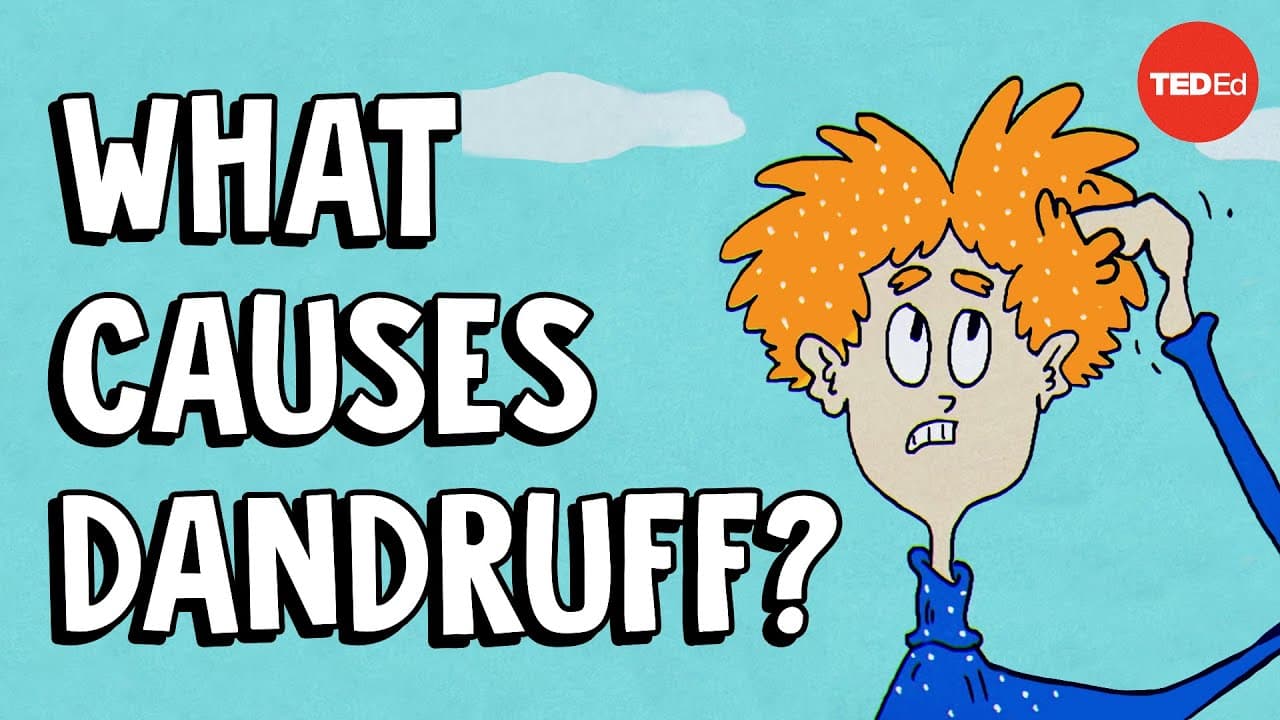
What causes dandruff, and how do you get rid of it? - Thomas L. Dawson
TL;DR
Dandruff is caused by Malassezia yeast feeding on scalp oils, leading to inflammation and flaking. The most effective way to treat dandruff is with antifungal shampoos that eliminate this yeast. While susceptibility varies among individuals, ongoing research is exploring the underlying genetic and environmental factors.
Transcript
Here in this abundant forest, Malassezia is equipped with everything it could ever need. Feasting constantly, it’s in paradise. But wait— what’s this? In fact, Malassezia is a type of yeast that lives and dines on all of our scalps. And in about half of the human population, its activity causes dandruff. So, why do some people have more dandruff ... Read More
Key Insights
- 🤱 Malassezia yeast feeds on scalp oils, causing dandruff in half the population.
- 🥺 The yeast's consumption of oils and subsequent inflammation leads to flaking and itching.
- ❓ Antifungal shampoos are the main treatment for dandruff.
- ❓ Susceptibility to dandruff is still not clearly understood.
- ❓ Researchers are exploring potential benefits of the relationship with Malassezia.
- ❓ Malassezia communicates with the immune system using oxylipins, regulating inflammation.
- 🧑⚕️ Dandruff is not contagious and does not pose a significant health threat.
Install to Summarize YouTube Videos and Get Transcripts
Explore YouTube Video Summarizer or Get YouTube Transcript Extractor
Questions & Answers
Q: What causes dandruff on the scalp?
Dandruff is caused by Malassezia yeast feeding on skin oils, leading to inflammation, excess skin cell production, and flaking.
Q: Why do some people have more dandruff than others?
Susceptibility to dandruff remains unclear, with factors like genetic predisposition or skin permeability being investigated as potential reasons.
Q: How is dandruff treated effectively?
Antifungal shampoos are the most effective way to treat dandruff by directly targeting and killing the Malassezia yeast on the scalp.
Q: Are there any potential benefits to our relationship with Malassezia despite dandruff?
Scientists are researching potential benefits of Malassezia, hypothesizing that dandruff may provide a reliable food source for the yeast and help defend against harmful microbes.
Summary
This video explores the phenomenon of dandruff and its relationship with a type of yeast called Malassezia. It delves into the reasons why some people have more dandruff than others and discusses potential treatments for dandruff caused by Malassezia.
Questions & Answers
Q: What is Malassezia and where does it live?
Malassezia is a type of yeast that lives and dines on our scalps. It makes itself at home on our skin shortly after we're born, particularly in the follicles, which are tiny cavities that grow hairs all over our body.
Q: Why are the follicles popular living quarters for Malassezia?
Follicles are popular living quarters for Malassezia because they contain glands that secrete an oil called sebum. This oil is thought to lubricate and strengthen our hair, making the follicles a prime habitat for the yeast.
Q: How does Malassezia feed on our scalp's oils and why does dandruff form?
Malassezia evolved to consume our skin's proteins and oils. Our scalp, being one of the oiliest places on our body due to its many sebum-secreting follicles, becomes a thriving location for Malassezia. As these fungi feast on our scalp's oils, dandruff may form. This is because sebum contains both saturated and unsaturated fatty acids. Malassezia only consumes the saturated fats, leaving the unsaturated ones behind. These unsaturated fats soak into the skin, pry open its barrier, and allow water to escape, causing inflammation and itchiness, which are characteristic of dandruff.
Q: What happens to the skin cells during dandruff?
Normally, the skin's outer surface renews itself every two to three weeks. However, with dandruff, the body's response to the barrier damage caused by Malassezia results in rapid cell proliferation. The skin cells churn out quickly to repair the broken barrier, but they don't mature and differentiate properly. Instead, they form large, greasy clumps around the hair follicle, which are shed as visible flakes.
Q: How is dandruff currently treated?
The most effective way to get rid of dandruff is by using antifungals found in shampoos. These antifungal shampoos are applied directly to the scalp to kill Malassezia.
Q: Why does dandruff occur more in some people than others?
While Malassezia colonizes everyone to a similar extent, not everyone experiences dandruff. The reasons behind this susceptibility are still unclear. It is currently being investigated whether people with dandruff have a certain genetic predisposition or if their skin barrier is more permeable.
Q: What are scientists researching in terms of dandruff?
Scientists are investigating whether individuals with dandruff lose more water through their scalps, and if this is what leads to skin cell proliferation. Additionally, they are exploring how Malassezia communicates with our immune system using oxylipins, which are small, oily molecules that regulate inflammation. If scientists can inhibit inflammatory oxylipins and boost anti-inflammatory ones, new treatments for dandruff could be developed.
Q: Is there any benefit to our relationship with Malassezia?
Scientists hypothesize that dandruff, although uncomfortable and embarrassing for us, creates a reliable oily food source for Malassezia. Furthermore, Malassezia excels at defending our skin from other, potentially more harmful microbes like Staphylococcus aureus.
Q: Is dandruff contagious or a threat to our health?
Dandruff is neither contagious nor a significant threat to our health. While it can be bothersome, particularly in terms of itchiness and flaking, it does not pose a severe risk.
Q: Have scientists fully unraveled all the mysteries surrounding dandruff?
Although a lot of progress has been made in understanding dandruff, it remains a head-scratcher for scientists, and there are still some unanswered questions.
Takeaways
Dandruff is caused by the activity of Malassezia, a type of yeast that lives on our scalps. It feeds on our skin's oils and proteins, which can lead to inflammation and the shedding of visible flakes. Currently, the most effective way to eliminate dandruff is by using antifungal shampoos. Scientists are researching factors that contribute to varying degrees of dandruff among individuals and exploring potential treatments that target inflammation-regulating molecules. While dandruff can be uncomfortable, it does not pose a significant threat to our health, and Malassezia's presence may even protect us from other harmful microbes.
Summary & Key Takeaways
-
Malassezia yeast colonizes our scalp, feeding on skin oils and causing dandruff in half the human population.
-
The yeast's consumption of scalp oils and subsequent inflammation leads to the formation of visible flakes.
-
Dandruff can be treated with antifungal shampoos, but the exact reasons for susceptibility to dandruff remain uncertain.
Read in Other Languages (beta)
Share This Summary 📚
Summarize YouTube Videos and Get Video Transcripts with 1-Click
Try YouTube Summary with ChatGPT & Claude or YouTube Transcript Generator
Explore More Summaries from TED-Ed 📚




Summarize YouTube Videos and Get Video Transcripts with 1-Click
Try YouTube Summary with ChatGPT & Claude or YouTube Transcript Generator