The three different ways mammals give birth - Kate Slabosky
TL;DR
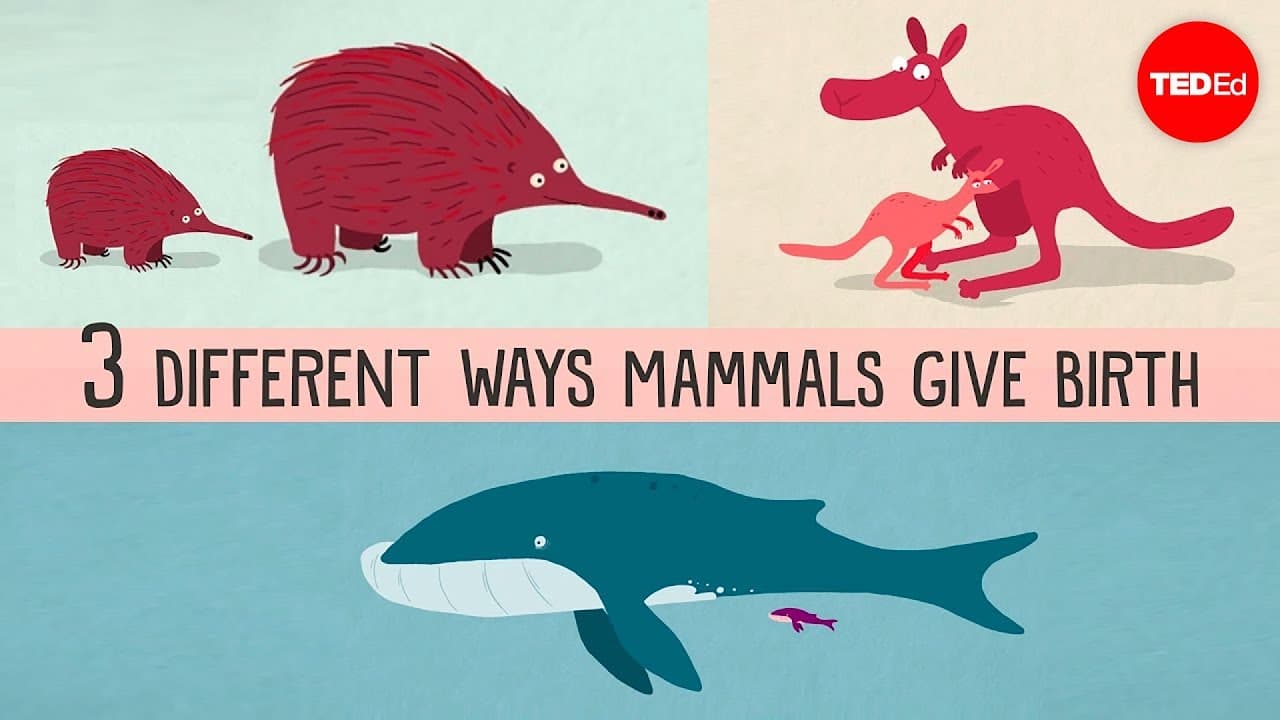
Mammals give birth in three distinct ways: placental mammals, which have a placenta that nourishes developing embryos; marsupials, where newborns finish developing in a pouch; and monotremes, which lay eggs and nurse their young with milk. Each method has evolved to ensure the survival and diversity of these species.
Transcript
What do these animals have in common? More than you might think. Along with over 5,000 other species, they're mammals, or members of class mammalia. All mammals are vertebrates, meaning they have backbones. But mammals are distinguished from other vertebrates by a number of shared features. That includes warm blood, body hair or fur, the ability t... Read More
Key Insights
- 🫁 Mammals share common characteristics like warm blood and lungs, but have diverse birthing methods.
- ❓ Placental mammals sustain their offspring with a placenta during pregnancy.
- 🥳 Marsupials give birth to tiny babies that continue developing in the mother's pouch.
- 😌 Monotremes lay eggs and have unique adaptations like the platypus's venomous spur.
- 🥳 Mammals, whether placental, marsupial, or monotreme, have evolved diverse birthing methods to bring new life into the world.
Install to Summarize YouTube Videos and Get Transcripts
Explore YouTube Video Summarizer or Get YouTube Transcript Extractor
Questions & Answers
Q: What distinguishes mammals from other vertebrates?
Mammals are distinguished by features like warm blood, fur, lungs, and nourishing their young with milk, setting them apart from other vertebrates.
Q: How do placental mammals like blue whales sustain their babies during pregnancy?
Placental mammals like blue whales have a placenta that attaches to the uterus, providing nutrients, oxygen, and waste removal for the developing fetus.
Q: What is unique about marsupial birth?
Marsupials like kangaroos give birth to tiny babies that continue developing in the mother's pouch, where they suckle milk until they are ready to venture out.
Q: How do monotremes like echidnas and platypuses give birth?
Monotremes lay eggs and when the babies hatch, they suckle milk from their mother's pores until they are able to feed themselves.
Summary
This video explores the commonalities and differences among mammals, focusing on their unique birthing methods. While all mammals share traits like warm blood, body hair, lungs for breathing, and nourishing their young with milk, they exhibit diverse reproductive strategies. Placental mammals, such as humans and whales, have a developed placenta that supports the developing embryo before birth. Marsupials, like kangaroos, give birth to underdeveloped babies that continue to grow and nurse in the mother's pouch. Monotremes, such as the platypus, lay eggs and nurse their young until they can feed themselves.
Questions & Answers
Q: What features distinguish mammals from other vertebrates?
All mammals have warm blood, body hair or fur, lungs for breathing, and nourish their young with milk. These traits set them apart from other vertebrates.
Q: How do placental mammals give birth to their young?
Placental mammals, including humans and whales, have a placenta that attaches to the wall of the uterus, nourishing and supporting the developing embryo. The placenta connects to the mother's blood supply, providing nutrients and oxygen to the growing calf through the umbilical cord. This allows placental mammals to undergo longer gestation periods compared to other mammals.
Q: How do marsupials differ in their birthing method?
Marsupials, found in Australia, have a unique reproductive strategy. When marsupial babies are born, they are underdeveloped and must continue developing in the mother's pouch. For example, kangaroos give birth to tiny, jelly bean-sized babies that crawl into the pouch. The baby kangaroo, or joey, will spend months nursing and growing in the pouch before venturing out.
Q: Can a female kangaroo nurse multiple offspring at the same time?
Yes, a female kangaroo can simultaneously care for multiple offspring. While one joey might be nursing inside the pouch, another might be growing in the mother's uterus. In harsh conditions, a kangaroo can pause her pregnancy and produce different types of milk to care for both the newborn joey and the older sibling.
Q: What are monotremes, and how is their reproductive method unique?
Monotremes, including the platypus and echidnas, are a group of mammals that lay eggs instead of giving birth to live young. They possess a single orifice for reproduction, excretion, and egg-laying, hence the name "monotreme." After hatching, the young monotremes suckle milk from the mother's pores until they are large enough to feed themselves.
Q: Are there any peculiar adaptations among monotremes?
Yes, monotremes have several unique adaptations. For example, the duck-billed platypus has webbed feet and a bill, similar to a duck. Male platypuses also possess venomous spurs on their feet. These adaptations, along with laying eggs, make monotremes fascinating examples of evolutionary diversity among mammals.
Q: How have mammals managed to diversify and thrive with such varied birthing methods?
Despite their different birthing methods, all mammals share the foundational characteristics of mammalia. These shared traits have allowed mammals to adapt to various environments and reproductive strategies, ensuring the survival and proliferation of their species over many millennia.
Takeaways
The video highlights the commonalities and unique characteristics of mammals, focusing on their diverse birthing methods. Placental mammals rely on a developed placenta to support the developing fetus, while marsupials care for underdeveloped young in their pouches. Monotremes lay eggs and nurse their offspring until they reach independence. Despite their differences, all these strategies have been instrumental in the success of mammalian species and the preservation of biodiversity within the mammal kingdom.
Summary & Key Takeaways
-
All mammals share common features such as warm blood, body hair, and lungs, but they have unique birthing methods.
-
Placental mammals like blue whales have a placenta that sustains the fetus during pregnancy.
-
Marsupials like kangaroos give birth to tiny babies that continue developing in the mother's pouch.
Read in Other Languages (beta)
Share This Summary 📚
Summarize YouTube Videos and Get Video Transcripts with 1-Click
Try YouTube Summary with ChatGPT & Claude or YouTube Transcript Generator
Explore More Summaries from TED-Ed 📚






Summarize YouTube Videos and Get Video Transcripts with 1-Click
Try YouTube Summary with ChatGPT & Claude or YouTube Transcript Generator