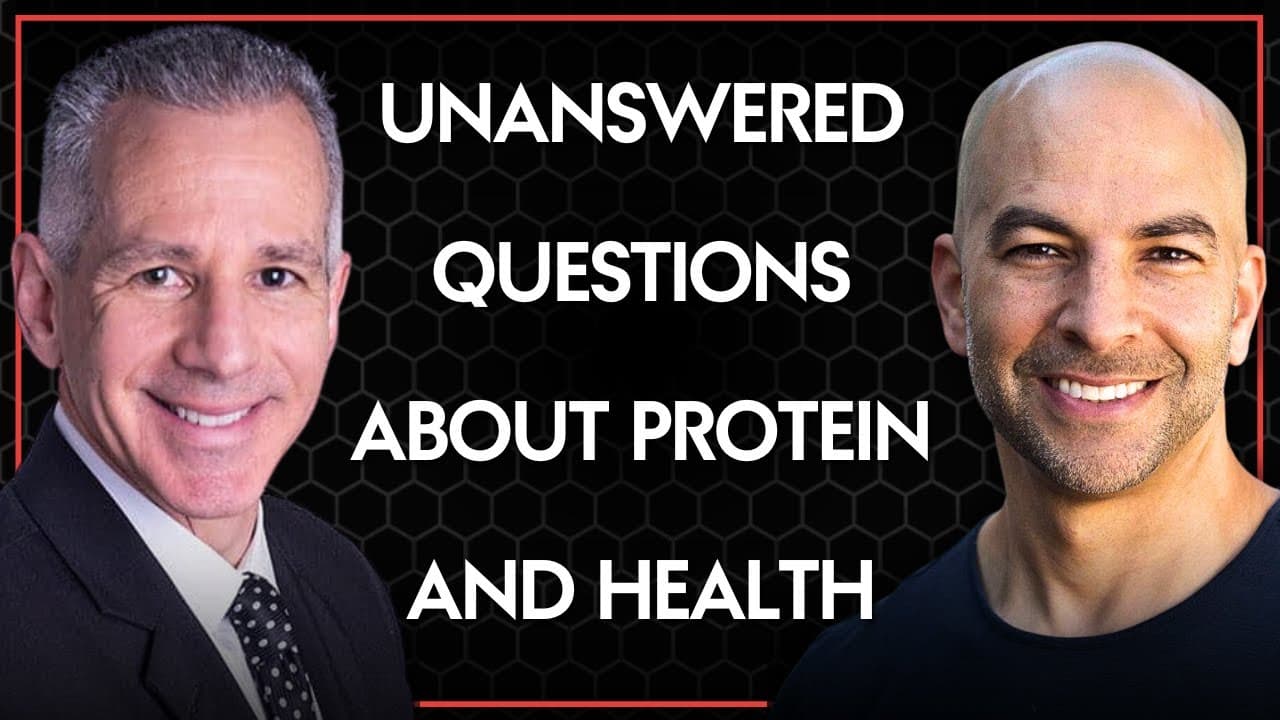
What Questions About Protein Intake and Health Remain Unanswered? | Peter Attia & David Allison
TL;DR
The optimal protein intake for health and longevity remains unknown, although Peter Attia and David Allison argue that the RDA of 0.8 grams per kilogram of body weight is probably too low for thriving. Evidence for a 20–30-gram anabolic threshold per sitting comes from small studies, while amino-acid findings in animals may not apply to humans. Read on to understand what protein research establishes, and where uncertainty remains.
Transcript
all right let's pivot to something a little bit easier to talk about you've already alluded to protein um it's a it's a huge interest of yours clinically personally um it's a topic I've addressed a number of times um what do we know about protein and what do we at least in your view what do you what do you think we think we know that we don't know ... Read More
Key Insights
- Protein is essential for life, composed of amino acids that have various effects on the body.
- Traditional protein intake recommendations may be too low for optimal health and longevity.
- Concerns about high protein intake causing kidney damage or bone loss lack strong evidence.
- Studies on extreme diets, such as all-potato or all-meat, show surprisingly balanced outcomes.
- The concept of minimum protein thresholds per meal is debated, with no clear consensus.
- Current studies on protein intake are limited in size and scope compared to pharmaceutical research.
- The idea of a biological threshold for protein intake is plausible but not definitively proven.
- More comprehensive studies are needed to understand the long-term effects of protein intake on health.
Install to Summarize YouTube Videos and Get Transcripts
Explore YouTube Video Summarizer or Get YouTube Transcript Extractor
Questions & Answers
Q: How much protein is needed for optimal health?
The discussion does not identify a proven optimal amount. The RDA is 0.8 grams per kilogram of body weight, but Peter Attia and David Allison say this is probably too low for optimizing health or longevity, even if it may be enough for survival.
Q: Why is protein essential for human health?
The body is heavily made of proteins, which are essential for its functioning. Proteins consist of amino acids, including some that the body can synthesize and others that must be obtained through food.
Q: Can people obtain enough protein from plant-based foods?
David Allison says people can obtain the proteins they need from plant-based foods or combinations of foods. He raises taurine as a possible exception but notes that it is unclear whether humans must consume it.
Q: Does eating 20–30 grams of protein at a meal trigger an anabolic response?
The proposed minimum of 20–30 grams per sitting is not established with certainty. Allison questions whether biology follows a sharp threshold and suggests the response could instead rise gradually before flattening.
Q: What evidence supports a protein threshold per meal?
The proposed threshold is based partly on small amino-acid-labeled tracer studies that give people different protein doses and measure muscle protein synthesis. The speakers explain that these studies are small because they are complex and receive limited funding.
Q: Do specific amino acids affect muscle growth or longevity?
Leucine appears important for skeletal muscle growth and anabolic effects. The conversation also mentions longevity findings involving isoleucine, taurine, and methionine in mice or other species, but whether those findings apply to humans is unclear.
Q: Can one diet optimize weight, strength, and longevity at the same time?
Not necessarily, because different goals may require different diets. A diet intended to make someone 10 pounds thinner may differ from one designed to add 10 pounds to a bench press or extend life by 10 years.
Q: Why are protein recommendations still uncertain?
Randomized controlled trials examining protein needs have involved far fewer people than studies of COVID-19 vaccines, statins, or GLP-1 agonists. Because everyone needs protein, Allison argues that nutrition research needs substantially greater scale and stronger evidence.
Summary & Key Takeaways
-
Protein is a crucial nutrient made up of amino acids, necessary for bodily functions. While traditional intake recommendations may be too low, the optimal amount for health and longevity remains debated. Concerns about high protein intake, such as kidney damage, lack strong evidence, and more research is needed to clarify these effects.
-
Extreme diets, like all-potato or all-meat, have shown balanced outcomes, challenging common views on diet variety. The idea of minimum protein thresholds per meal is debated, with no clear consensus. Current studies on protein intake are limited compared to pharmaceutical research, highlighting the need for more comprehensive studies.
-
The concept of a biological threshold for protein intake is plausible but not definitively proven. More research is needed to understand the long-term effects of protein intake on health, as current studies are limited in size and scope. Understanding these effects is important for optimizing health and longevity.
Read in Other Languages (beta)
Share This Summary 📚
Summarize YouTube Videos and Get Video Transcripts with 1-Click
Try YouTube Summary with ChatGPT & Claude or YouTube Transcript Generator
Explore More Summaries from Peter Attia MD 📚



Summarize YouTube Videos and Get Video Transcripts with 1-Click
Try YouTube Summary with ChatGPT & Claude or YouTube Transcript Generator