What Is Context Engineering for n8n AI Agents?
TL;DR
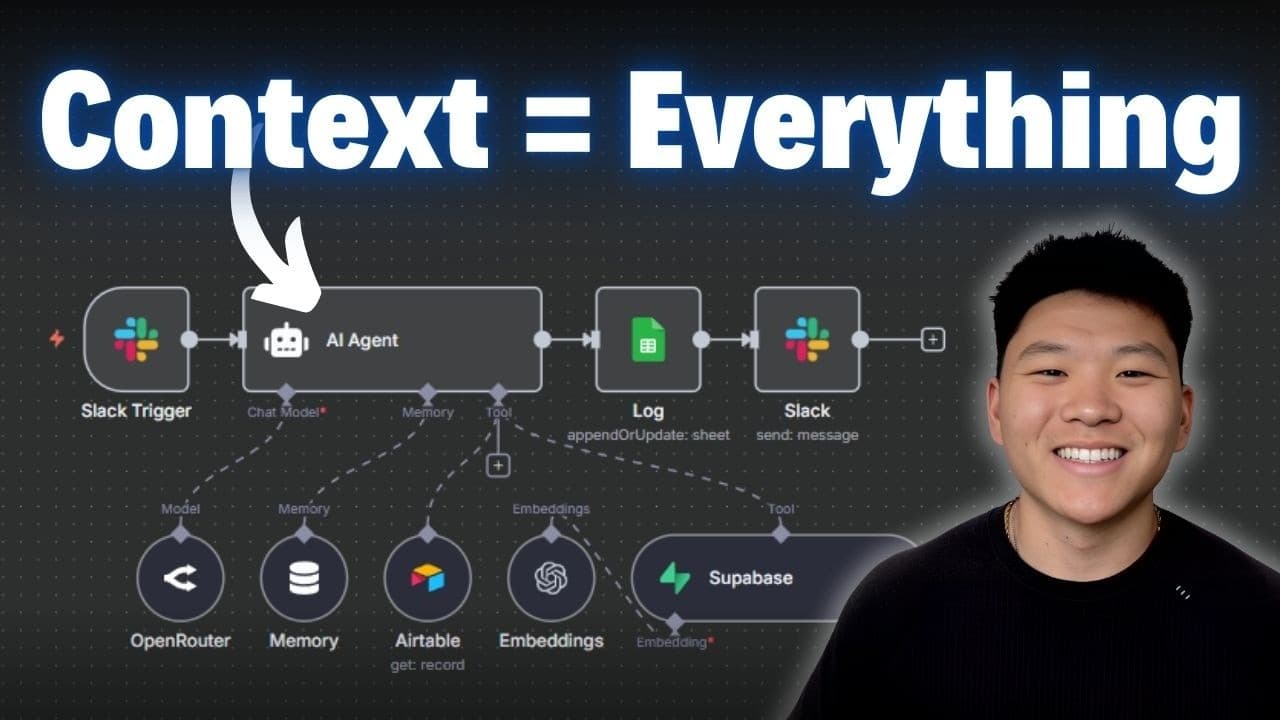
Context engineering means giving an AI agent the right information it needs to complete tasks well, and after more than 200 no-code automations it matters most for quality and consistency. It builds systems that supply relevant information dynamically through six parts: user input, system prompt, memory, retrieved knowledge, tools, and structured output. A single prompt instruction is only one of those parts.
Transcript
After building over 200 nocode AI automations, I've come to realize that context engineering is the most important thing in determining the quality and consistency of the AI systems. So today I'm going to be going over the six most important context engineering lessons that I've learned, breaking it all down and applying it to NAN AI agents. So I d... Read More
Key Insights
- Context engineering is the practice of feeding an AI agent the right information it needs to complete tasks effectively. After building over 200 no-code AI automations, the creator considers it the most important factor in the quality and consistency of AI systems.
- Prompt engineering focuses on writing the best possible single instruction. Context engineering is broader: it builds systems that can dynamically give the agent relevant information, so the agent can decide which tools and data sources to use for each request.
- An AI agent without context engineering is like a conversation partner who forgets everything right after you say it. Tools that supply extra context let the agent remember things and act intelligently, so it works as an assistant rather than a simple question and answer tool.
- The six components of context engineering follow an agent's flow: user input, system prompt, memory, retrieved knowledge, tools, and a structured output parser. Not every agent needs all six, but each one is a setting builders can adjust.
- Short-term memory in n8n is conversation history with an adjustable context window length. A longer window keeps more conversation history but processes more tokens, which makes each run more expensive.
- A session ID lets one agent keep separate conversations with different people. It can be linked to an email address, a phone number for an SMS bot, or an employee ID for an internal Slack agent.
- Long-term memory is persistent knowledge that survives across sessions. It can be stored as a user graph in Zep, a simple Google Doc, a vector store for chunk-based retrieval, or a CRM where the agent looks up a lead or client.
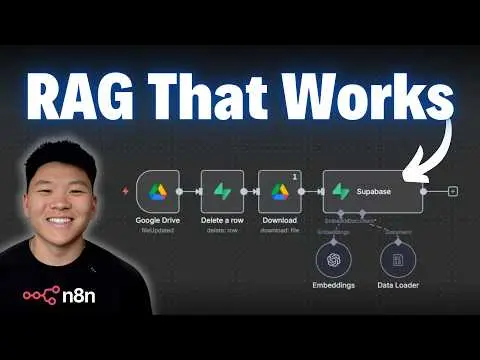
- Tool calling, also called function calling, lets agents interact with external systems, request data, and take actions beyond generating text. RAG, retrieval augmented generation, is a technique where agents retrieve relevant documents or data at query time to answer more accurately.
Install to Summarize YouTube Videos and Get Transcripts
Explore YouTube Video Summarizer or Get YouTube Transcript Extractor
Questions & Answers
Q: What is context engineering in AI agents?
Context engineering is the practice of feeding an AI agent the right information it needs to complete tasks effectively. Instead of relying on one carefully written instruction, it builds systems that dynamically provide relevant information. The agent receives a triggering message, recognizes which tools and data sources it has, and decides which ones to use to answer correctly or perform the right task.
Q: What is the difference between prompt engineering and context engineering?
Prompt engineering focuses on writing the best possible single instruction. Context engineering builds systems that dynamically provide relevant information to the agent. One analogy compares prompt engineering to studying for an exam the week before, and context engineering to bringing a cheat sheet you can check whenever you face a problem you do not know. The best results come from having both.
Q: What are the six components of context engineering for an AI agent?
In the order an agent works through them, the six components are: user input, the dynamic request that triggers the agent; the system prompt with its instructions; memory of past conversations; retrieved knowledge from sources such as vector databases, web searches, or CRMs; tools such as Supabase or Gmail; and a structured output parser that defines how the agent must format its output. Not every agent needs all six.
Q: What types of memory do n8n AI agents use?
There are three categories. Working memory is the agent processing within a single execution, using its system prompt and chat model to track what it has done and what remains. Short-term memory is conversation history inside a context window. Long-term memory is persistent knowledge that survives across sessions, so the agent can remember user preferences and earlier conversations.
Q: How does context window length affect an AI agent's memory and cost?
The context window length sets how many recent interactions the agent remembers. Each user message and agent reply are stored as one pair, so a window of two keeps only the two most recent exchanges. You can change the length in memory setups such as simple memory, Postgres memory, or Zep in n8n. A longer window keeps more history but processes more tokens, which costs more.
Q: What is a session ID used for in AI agent memory?
A session ID lets an agent keep separate conversations with different people, such as person A, person B, and person C. It can be linked to an email address, so the agent checks past conversations with that sender when a new email arrives. It can also be a phone number for an SMS bot or an employee ID for an internal Slack agent.
Q: How can you store long-term memory for an AI agent?
Long-term memory can be stored in several ways. Zep provides a user graph that links facts about a user, such as preferences, location, and daily activities, through relationships, which makes it more useful than a list of unrelated facts. Simpler options include a Google Doc the agent is told to check, a vector store for chunk-based retrieval, or a CRM where the agent looks up a lead or client.
Q: What are tool calling and RAG in AI agents?
Tool calling, also called function calling, lets an agent interact with external systems: it sends requests, receives data, and takes actions beyond generating text, like giving the agent hands and feet in the digital world. Without tools, a chatbot can only talk. RAG, retrieval augmented generation, is a technique where agents retrieve relevant external documents or data at query time so they can answer more accurately.
Summary & Key Takeaways
-
Context engineering means feeding an AI agent the right information so it can complete tasks well. Prompt engineering refines a single instruction, while context engineering builds systems that supply relevant information dynamically. The creator calls it the most important factor in AI system quality, following the principle that garbage in leads to garbage out.
-
An AI agent draws on six sources of context: user input, system prompt, memory, retrieved knowledge, tools, and a structured output parser. An analogy compares the two disciplines: prompt engineering is like studying for an exam, while context engineering is like bringing a cheat sheet to the exam.
-
Agents in n8n have three kinds of memory. Working memory is processing within one execution. Short-term memory is conversation history, with an adjustable window and session IDs. Long-term memory persists across sessions in Zep user graphs, Google Docs, vector stores, or CRMs. Tool calling and RAG let agents fetch external knowledge.
Read in Other Languages (beta)
Share This Summary 📚
Summarize YouTube Videos and Get Video Transcripts with 1-Click
Try YouTube Summary with ChatGPT & Claude or YouTube Transcript Generator
Explore More Summaries from Nate Herk | AI Automation 📚




Summarize YouTube Videos and Get Video Transcripts with 1-Click
Try YouTube Summary with ChatGPT & Claude or YouTube Transcript Generator