Why Does Your Brain Blind You for 2 Hours and Edit Reality Every Day?
TL;DR
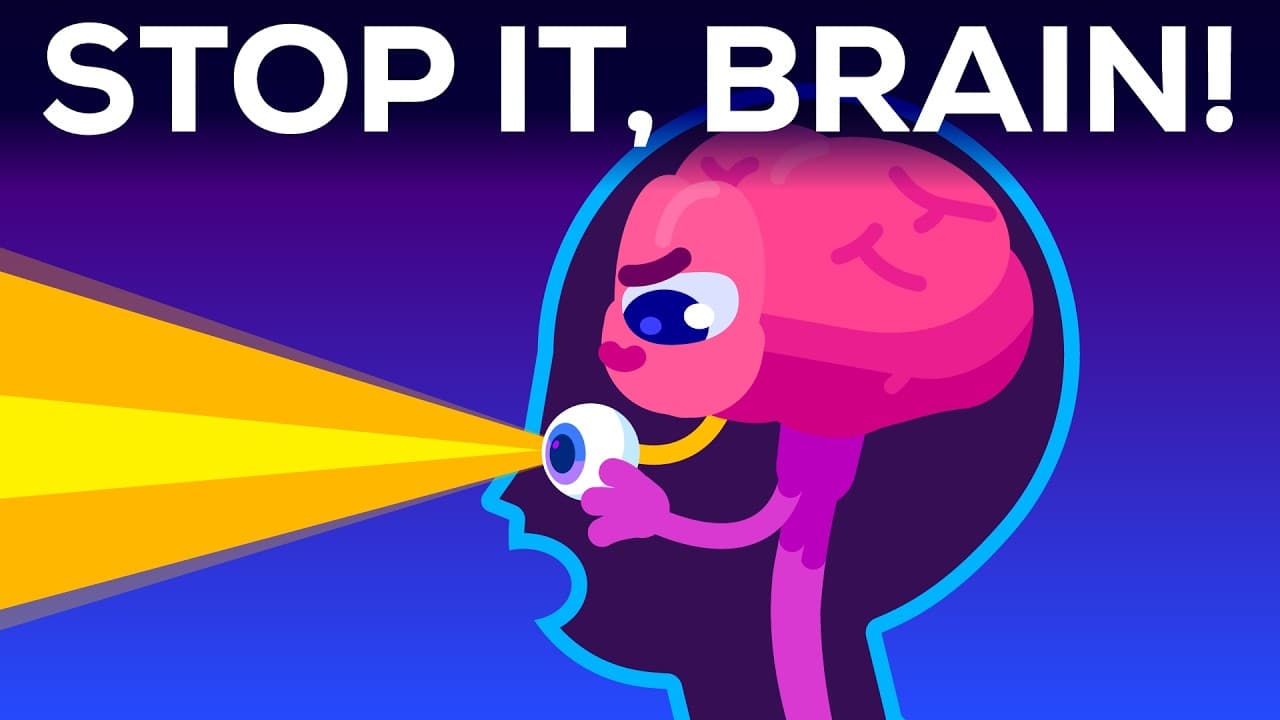
Your brain edits reality by combining incomplete, delayed sensory signals with predictions based on past information. During saccades, 50-millisecond eye movements occurring 3 to 4 times per second, it shuts down vision, leaving you blind for around 2 hours each day while filling the gaps with its best guesses. Read on to discover how this process shapes sight, time, movement, and conscious decisions.
Transcript
The world you see is not real – you're not living in this very moment that you are experiencing and nothing is like it seems. It turns out your brain constructs your reality as you are experiencing it, it edits your memories as they happen, it lives in totally different time spheres and tells you a story about the world that feels real. What's... Read More
Key Insights
- Your brain constructs your perception of reality, editing sensory information to create a cohesive experience.
- During saccades, rapid eye movements, your brain temporarily shuts down vision, leading to about two hours of daily blindness.
- Sensory inputs are processed at different speeds, yet your brain synchronizes them to create a seamless experience.
- Your perception of the present is actually a prediction based on past data, occurring 0.3 to 0.5 seconds after events.
- In fast-paced activities, like table tennis, your brain predicts future positions of objects to react in time.
- Walking involves your brain predicting future movements, operating in multiple time spheres simultaneously.
- Emotions and physical sensations are predictions based on past experiences and expected future needs.
- Your conscious self is a storyteller, integrating predictions into a coherent narrative that influences your perception of reality.
Install to Summarize YouTube Videos and Get Transcripts
Explore YouTube Video Summarizer or Get YouTube Transcript Extractor
Questions & Answers
Q: Why are you blind for around two hours every day?
Your eyes make 3 to 4 rapid movements called saccades each second, and each lasts about 50 milliseconds. During every saccade, your brain shuts down vision to prevent motion blur; across a day, these interruptions total around 2 hours, and the brain fills the gaps with its best guesses.
Q: How does your brain construct the reality you experience?
Your brain receives incomplete sensory information at different times, processes it, and edits it into one smooth experience. It also fills visual gaps and predicts what is happening, so conscious reality is a constructed account rather than a direct, uninterrupted view of the world.
Q: How much of your visual field is actually in high resolution?
Only a thumbnail-sized area of your visual field is in high resolution, while the rest is out of focus. Rapid saccades collect different sharp images, which the brain edits together so the whole scene appears detailed.
Q: Why do sight, sound, and touch seem simultaneous?
The signals arrive at very different times: reflected light from a spoon reaches the eyes after 1.3 nanoseconds, sound reaches the ear in 1.2 milliseconds, and heat signals reach the brain in 50 milliseconds. The brain processes and combines them into one smooth, connected moment.
Q: Are you consciously experiencing the present moment?
What feels like the present is a selectively edited version of the recent past. According to the transcript, you consciously experience the world about 0.3 to 0.5 seconds after events occur, while the brain uses prediction to compensate for that delay.
Q: How does the brain predict a table tennis ball's position?
A professional table tennis ball can travel at 25 meters per second, while visual signals take about 100 milliseconds to reach the brain for processing. The brain uses the ball's location, speed, and direction to calculate where it should be when the information becomes available.
Q: Does the brain decide how to react before conscious awareness?
In table tennis, the brain predicts several possible ball trajectories and prepares corresponding muscle responses before the opponent completes the swing. It then selects the most likely future and triggers movement, so the body may already have returned the ball by the time the conscious mind experiences deciding how to hit it.
Q: How does prediction help the brain control walking?
While walking, the brain processes past sensory feedback, calculates the body's current state, and predicts future movement at the same time. Before feedback from one foot touching the ground reaches the brain, it has already ordered the next step and calculated muscle patterns for the following two.
Summary & Key Takeaways
-
Your brain constructs your reality by editing and predicting sensory inputs, creating a seamless experience. During rapid eye movements, you're blind for about two hours daily, but your brain fills in these gaps. This process means your conscious experience is a prediction based on past data, affecting your perception of time and decision-making.
-
In activities like table tennis, your brain predicts future positions of objects to react in time. Walking involves predicting future movements, operating in multiple time spheres simultaneously. Emotions and physical sensations are predictions based on past experiences and expected future needs, influencing your perception of reality.
-
Your conscious self acts as a storyteller, integrating predictions into a coherent narrative. This narrative influences your perception of reality, making your conscious experience a prediction based on past data. This process affects how you perceive time, make decisions, and experience emotions and sensations.
Read in Other Languages (beta)
Share This Summary 📚
Summarize YouTube Videos and Get Video Transcripts with 1-Click
Try YouTube Summary with ChatGPT & Claude or YouTube Transcript Generator
Explore More Summaries from Kurzgesagt – In a Nutshell 📚






Summarize YouTube Videos and Get Video Transcripts with 1-Click
Try YouTube Summary with ChatGPT & Claude or YouTube Transcript Generator