How AI Agents Change Web Search and Ads Economics
TL;DR
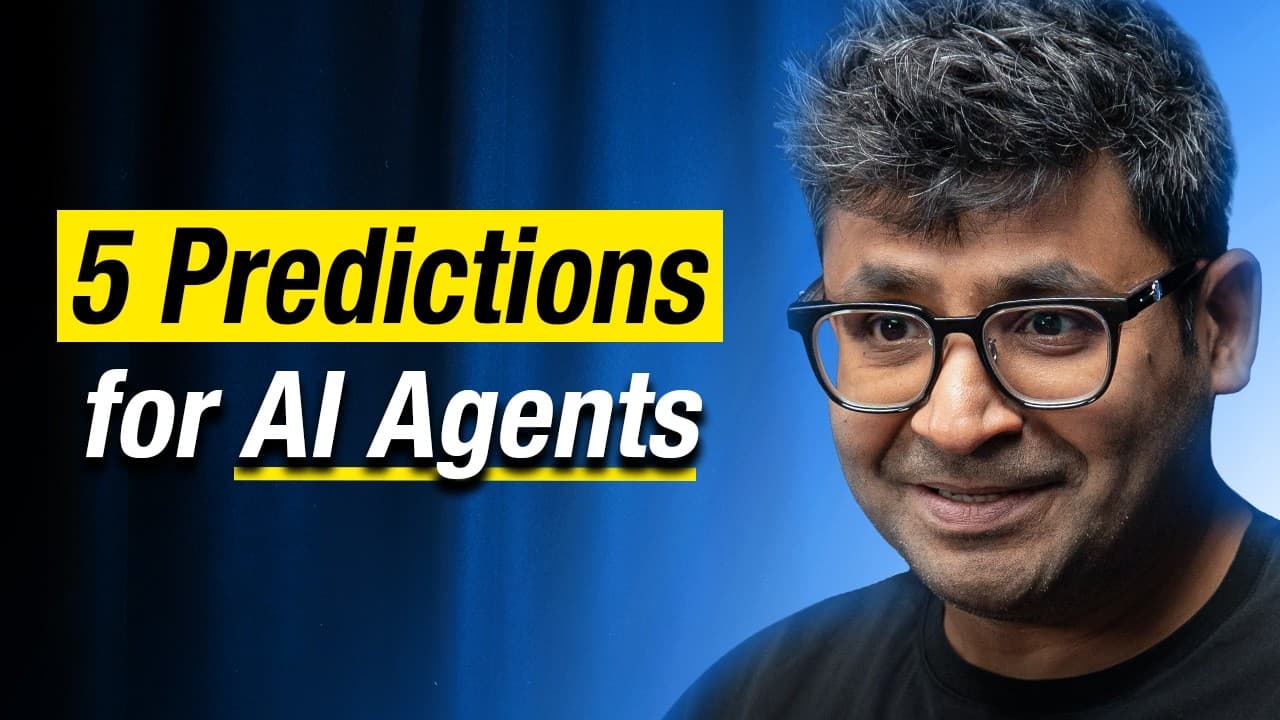
Agents will drive web search to require new compute stacks and new business models. Parallel aims to power agents with scalable, fast search while offering different modes for latency, cost, and accuracy. The company also envisions an AdSense style model for agent ads and a broader shift in data licensing and value.
Transcript
Agents will use the web thousandx more than humans. Hence, new tech is needed and new business models are needed. >> How does the world of agents change web search in terms of the technology required? Power is the founder of parallel, changing the future of how agents do web search efficiently. This is an incredible discussion on the future of aant... Read More
Key Insights
- AI agents will multiply web search usage by orders of magnitude, demanding new tech and business models to scale efficiently.
- Agent search requires rethinking compute allocation, where most documents cost zero compute and only a subset undergo deeper analysis to fit model context.
- Latency tolerances and output formats differ for agents compared to humans, necessitating multiple optimized search pathways and modes.
- There is a clear distinction between fast, voice friendly search and deeper, expensive search used for high precision results.
- Engineering tasks already involve significant web search overhead, while law, sales, and science show higher dependence on up to date, web based information.
- The rise of agents will push demand for cheaper, faster search stacks that can scale with thousands of tokens rather than a few dozen.
- Data licensing and ownership emerge as critical considerations as agents rely on vast, potentially proprietary information.
- Parallel envisions an ads ecosystem for agents, akin to AdSense, to monetize agent driven traffic and interactions.
Install to Summarize YouTube Videos and Get Transcripts
Explore YouTube Video Summarizer or Get YouTube Transcript Extractor
Questions & Answers
Q: How do AI agents change the requirements for web search technology
AI agents change web search by introducing the need for scale, speed, and flexibility that far exceeds traditional human search. Agents may be impatient and require results within milliseconds, or they may perform background searches with different constraints. This shift forces a redesign of the search stack to support multiple modes, token budgets, and models, ensuring the system can deliver accurate answers quickly while managing compute costs.
Q: What is Parallel’s core product for AI agents
Parallel provides a specialized web search infrastructure designed for agents. The platform focuses on enabling agents to search the web efficiently and to produce outputs suited to the agent context. It includes a scalable retrieval system, selective compute strategies, and configurable API parameters to balance accuracy, latency, and cost according to the application and model in use.
Q: Why is new compute architecture needed for agents
New compute architecture is needed because agents operate at a scale thousands of times higher than typical human use and must accommodate varied input and output forms. The search process must allocate compute intelligently: zero compute on most data, small compute on a larger subset, and more compute on a narrow set of highly relevant results to fit the model’s context window.
Q: How do agents trade off accuracy, latency, and cost
Agents balance accuracy, latency, and cost by selecting different service modes and model configurations. A fast mode prioritizes low latency and cost for voice or time sensitive tasks, while an advanced mode uses more compute to improve accuracy and depth. The API can be tuned for each use case based on application needs and model choice.
Q: Which use cases currently rely most on web search for agents
Knowledge work domains such as coding, AI law, and science show strong web search reliance when up to date or external information is essential. Coding prompts often rely on internal code for inference, but law and insurance underwriting require comprehensive web based facts and case law, making web search a central component in many workflows.
Q: What is the role of data licensing in AI agents
Data licensing becomes crucial as agents rely on large, diverse data sources across the web. Controlling access, usage rights, and monetization models for data used by agents can define competitive advantage and compliance. This creates potential new markets and regulatory considerations as AI driven agents proliferate.
Q: What is Parallel’s vision for advertising in agents
Parallel envisions an AdSense like model for agents, where advertising revenue is generated from agent driven interactions. This approach would align monetization with agent usage patterns, potentially expanding the economic footprint of AI agents while requiring careful alignment with user experience and safeguards to minimize negative outcomes.
Q: What could stop AI search from becoming commoditized
Commoditization could be slowed by the need for specialized compute stacks, differentiated model performance, and unique data licensing arrangements that give certain platforms a competitive moat. As agents proliferate, ongoing innovation in retrieval, ranking, and cost efficiency will be critical to maintain performance advantages and avoid pure price competition.
Summary & Key Takeaways
-
Parallel positions itself as the AI agent search platform, aiming to optimize the web search stack for agents and to create sustainable business models around agent powered search.
-
The discussion covers compute efficiency, token budgets, and the tradeoffs between latency, cost, and accuracy across different agent use cases, including voice agents and knowledge work.
-
The conversation previews future shifts in data licensing, advertising, and the economics of AI driven web search, with plans for an ads based revenue model for agents and broader market implications.
Read in Other Languages (beta)
Share This Summary 📚
Summarize YouTube Videos and Get Video Transcripts with 1-Click
Try YouTube Summary with ChatGPT & Claude or YouTube Transcript Generator
Explore More Summaries from 20VC with Harry Stebbings 📚




Summarize YouTube Videos and Get Video Transcripts with 1-Click
Try YouTube Summary with ChatGPT & Claude or YouTube Transcript Generator