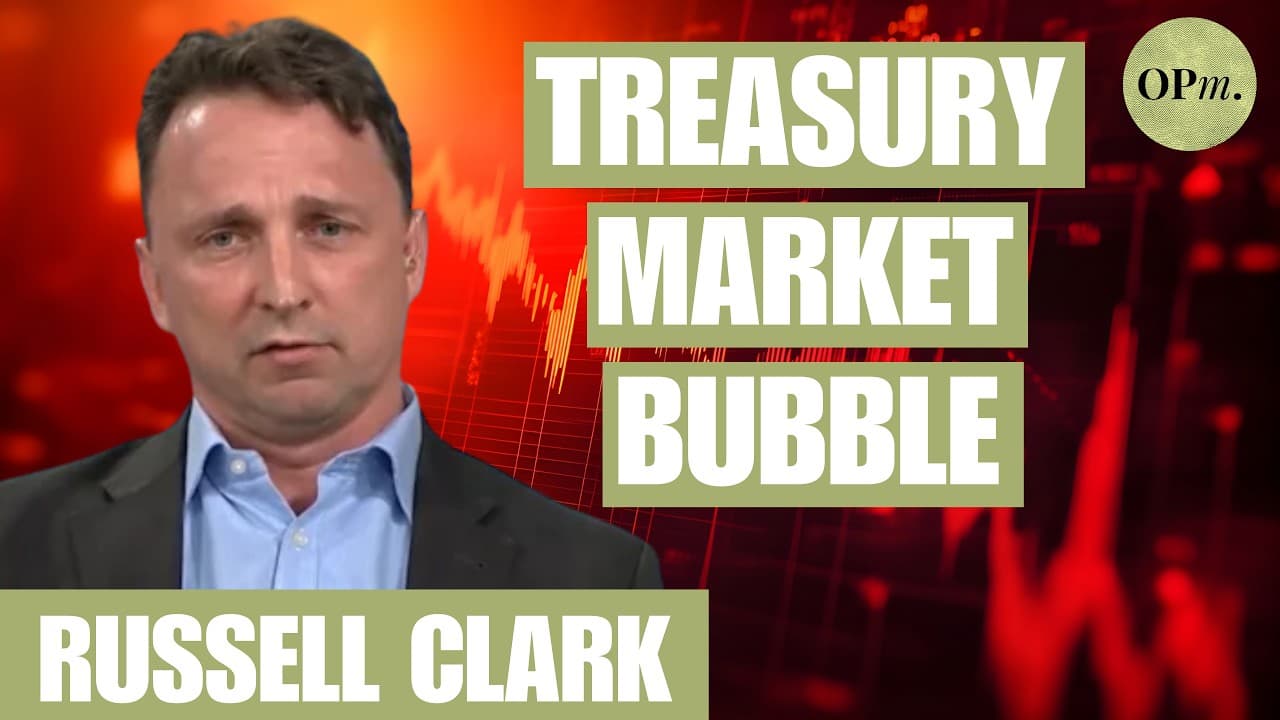
Why Could US Treasury Yields Reach 10 Percent?
TL;DR
US Treasuries may pose a larger speculative risk than AI because government spending remains high while taxation and traditional sovereign bond demand weaken. Russell Clark argues that a political shift toward full employment and roughly 7% annual wage growth could create persistent inflation, keep housing prices flat in nominal terms, and eventually push the 10-year Treasury yield toward 10%.
Transcript
If I look at people 40 and under, those in their 20 and 30s, their number one problem is they can't afford housing. If you want to get housing back to some more reasonable levels, you need to have wages rising at about 7% a year, so it's sort of doubling in 10 years. And then you need to have the housing market be flat in nominal terms, so falling ... Read More
Key Insights
- US Treasury risk is Clark's primary macroeconomic concern because persistent government spending, limited taxation, and disappearing structural buyers could force bond yields materially higher even if the market has remained relatively resilient so far.
- Federal fiscal pressure is visible in Clark's estimate that government revenue covers only about 90% of mandated expenses such as Social Security and interest payments, before accounting for defense, education, infrastructure, and other discretionary commitments.
- Foreign reserve diversification accelerated in Clark's thinking after Russian reserves were frozen following the invasion of Ukraine, showing governments that assets held abroad may become inaccessible when political relationships deteriorate.
- Currency-based foreign reserves are historically novel in Clark's account because gold dominated reserves until around 1980, after which Japan, China, and other countries accumulated Treasuries partly to prevent their currencies from appreciating.
- The post-1980 economic model was deflationary because governments favored free trade, privatization, weaker unions, flexible capital, and currency depreciation as ways to reduce domestic labor costs and restore export competitiveness.
- The emerging political model prioritizes full employment and rising wages, resembling the post-World War II environment more closely than the market-oriented period that followed the Reagan revolution, according to Clark's political analysis.
- Housing affordability could improve through approximately 7% annual wage growth combined with nominally flat home prices, allowing housing costs to decline relative to incomes rather than requiring a direct nominal housing crash.
- A 10% 10-year Treasury yield is Clark's target because his affordability scenario combines roughly 7% wage growth with a real interest rate near 3%, encouraging people to retain deposits instead of continually buying real assets.
- More videos from this channel:
- More from this channel: The Monetary Matters Network
Install to Summarize YouTube Videos and Get Transcripts
Explore YouTube Video Summarizer or Get YouTube Transcript Extractor
Questions & Answers
Q: Why does Russell Clark think US Treasuries are riskier than AI?
Russell Clark believes Treasuries contain greater systemic risk because governments have normalized spending whatever is required to sustain growth while showing little willingness to raise taxes, particularly on large corporations. At the same time, traditional foreign and institutional buyers of sovereign bonds appear to be retreating. That combination weakens the fiscal foundation supporting a much larger market than the AI trade.
Q: How could the 10-year Treasury yield reach 10 percent?
Clark's 10% yield target follows from his housing affordability framework. He argues that wages may need to rise around 7% annually while nominal housing prices remain flat, producing a substantial real decline in housing costs. Adding a real interest rate of roughly 3% to that wage and inflation environment leads him to a nominal interest rate near 10%.
Q: How could higher wages make housing more affordable?
Housing could become more affordable without nominal prices falling if wages rise substantially while home prices remain unchanged. Clark proposes wage growth of approximately 7% a year, which would roughly double wages over ten years. If housing stayed flat in nominal terms during that period, its price would decline relative to earnings, improving affordability for people in their 20s, 30s, and early 40s.
Q: Why might foreign governments reduce their Treasury holdings?
Foreign governments may question Treasury holdings because overseas reserves can become inaccessible during geopolitical conflicts. Clark points to the freezing of Russian foreign reserves after Russia invaded Ukraine as the event that changed his outlook in 2022. He reasons that any country expecting possible disagreement with a US administration could prefer reserves that carry less political access risk, particularly gold.
Q: Why does Russell Clark expect foreign reserves to shift toward gold?
Clark argues that holding another country's currency or fixed-income securities as reserves is a relatively recent practice. In his account, gold was effectively the principal reserve asset until around 1980. Because sanctions showed that foreign financial reserves can be frozen, he expects governments to reconsider Treasury exposure and move toward gold, which historically served as the core reserve asset.
Q: How did the post-1980 economic model support Treasury demand?
The post-1980 model encouraged competitive countries such as Japan and Germany to limit currency appreciation and preserve export competitiveness. Japan, China, and other countries accumulated US dollars and Treasuries partly to keep their currencies weak. Clark says this created substantial capital flows into US fixed income while a broader system of free trade, privatization, and weaker labor power restrained wages and inflation.
Q: What signals suggest sovereign bond markets are becoming unstable?
Clark points to sharply rising yields in Japan and recurring weakness at the long end of the UK gilt market as evidence that sovereign bond stress extends beyond the United States. Although Treasuries have held up relatively well, he believes their fundamental buyer base is slowly disappearing. These peripheral market moves therefore serve as warnings about vulnerabilities that could eventually reach US government bonds.
Q: Is Russell Clark's Treasury forecast based only on historical data?
No. Clark explicitly describes his argument as political rather than purely empirical. He believes data from the previous 30 years reflect a different policy regime focused on free markets, wage restraint, globalization, and currency devaluation. His forecast assumes politics is shifting toward full employment, higher wages, tariffs, and government involvement in corporations, creating a more inflationary environment.
Summary & Key Takeaways
-
Russell Clark considers US Treasuries a larger speculative danger than AI. He argues that government revenue barely covers mandated expenses such as Social Security and interest payments, leaving defense, education, infrastructure, and other spending dependent on borrowing while politicians remain willing to spend to sustain economic growth.
-
Clark believes foreign demand for Treasuries is weakening as governments reconsider holding another country's bonds as reserves. Russia's frozen foreign reserves demonstrated that access can depend on political alignment. He expects some reserve managers to favor gold, while rising Japanese and UK sovereign yields signal broader pressure within government bond markets.
-
Clark connects bond risk to a political shift away from wage suppression, currency devaluation, free trade, and union weakening. He expects greater emphasis on full employment and rising wages. In his scenario, wages grow around 7% annually, housing stays nominally flat, real rates approach 3%, and 10-year Treasury yields reach 10%.
Read in Other Languages (beta)
Share This Summary 📚
Summarize YouTube Videos and Get Video Transcripts with 1-Click
Try YouTube Summary with ChatGPT & Claude or YouTube Transcript Generator
Explore More Summaries from The Monetary Matters Network 📚

Summarize YouTube Videos and Get Video Transcripts with 1-Click
Try YouTube Summary with ChatGPT & Claude or YouTube Transcript Generator