How Can the Fed Safely Shrink Its Balance Sheet?
TL;DR
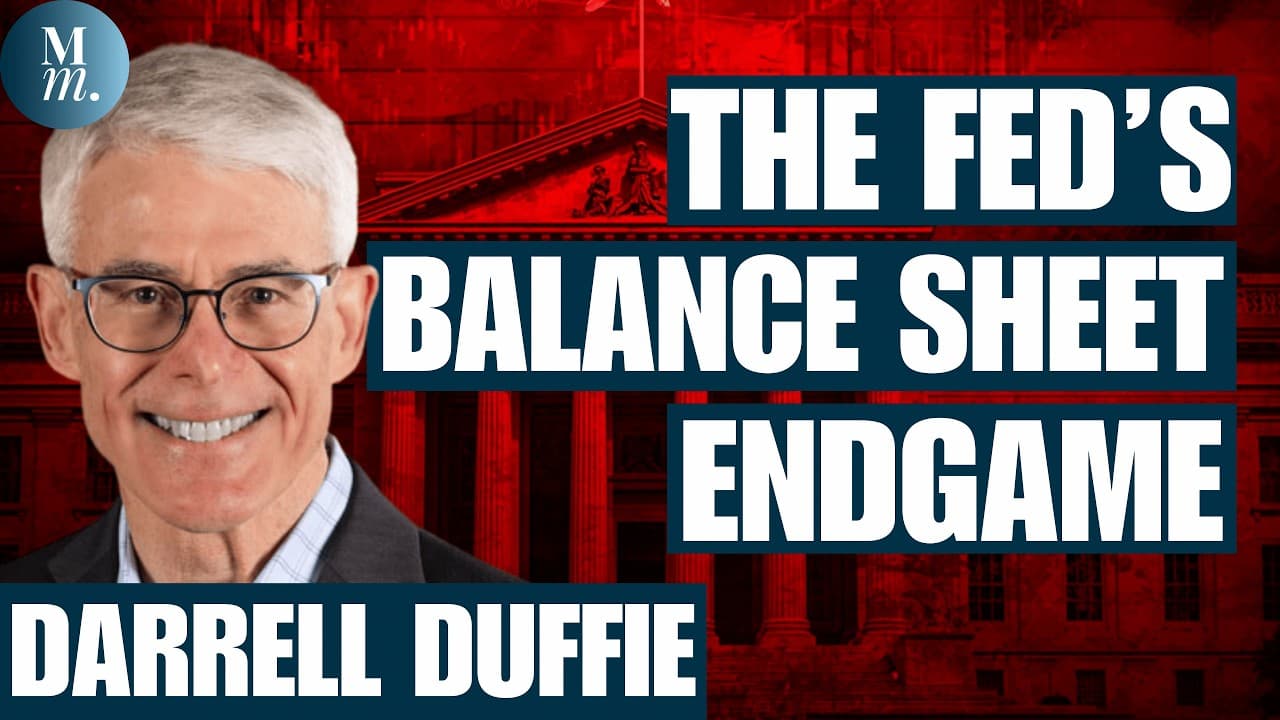
The Federal Reserve can safely shrink its balance sheet only by first reducing banks’ demand for reserve balances. Selling assets without addressing that demand would extinguish reserves dollar for dollar and could destabilize repo funding markets, as occurred in September 2019. Darrell Duffie proposes temporary open market operations, regulatory easing, liquidity-saving software, and tiered interest on excess reserves.
Transcript
My objective is to provide options if the Fed were to decide to reduce its balance sheet. How could it do it? >> The Fed's not going to send the SWAT team, the military to the banks to people's houses to get all the cash. It's not not going to happen at all. So, the only real channel to reduce it is reducing reserves. >> I also have the view that t... Read More
Key Insights
- The Federal Reserve’s assets cannot be analyzed independently from its liabilities because its assets must be at least as large as the liabilities they support. A smaller balance sheet therefore requires reducing liabilities or lowering the financial system’s need to hold them.
- Paper currency creates a substantial baseline for the Federal Reserve’s balance sheet because approximately $2.5 trillion is in circulation. The Fed cannot realistically retrieve that cash from banks and households, making currency an impractical target for any major balance-sheet reduction.
- Reserve balances are the principal channel for substantially shrinking the Federal Reserve’s balance sheet because commercial banks hold about $3 trillion at the Fed. The Treasury General Account may offer some reduction, but even cutting its roughly $1 trillion balance in half would be comparatively limited.
- Banks use reserve balances to settle enormous daily payment obligations through the Federal Reserve. Fedwire processes about $4.5 trillion each day for activities including tax payments, bond purchases, derivatives margin, customer transactions, and the final settlement of netted retail payments.
- Federal Reserve asset sales extinguish reserve balances dollar for dollar because private-sector buyers pay for those assets using reserves. Selling $100 billion of assets therefore removes $100 billion of reserve balances, potentially leaving banks with insufficient liquidity for payments and regulatory expectations.
- The September 2019 repo disruption demonstrated that banks may decline to lend reserves even when market interest rates rise sharply. JPMorgan’s Jamie Dimon attributed this constraint to a regulatory red line and expectations that systemically important banks remain self-sufficient in meeting liquidity needs.
- The lowest comfortable level of reserves is constrained by payment needs and banks’ reluctance to risk exhausting their Federal Reserve balances. When reserves approached that level, the Fed began expanding them again by purchasing Treasury bills at around $40 billion per month.
- Duffie’s four proposed tools are temporary open market operations, easing stringent liquidity regulations, software-driven liquidity-saving mechanisms, and tiered interest rates on excess reserves. Their shared purpose is to reduce banks’ demand for reserves before the Fed attempts a much smaller balance sheet.
- More videos from this channel:
- More from this channel: The Monetary Matters Network
Install to Summarize YouTube Videos and Get Transcripts
Explore YouTube Video Summarizer or Get YouTube Transcript Extractor
Questions & Answers
Q: Why can’t the Federal Reserve simply sell assets to shrink its balance sheet?
Selling assets directly reduces reserve balances because private-sector purchasers pay with reserves held at the Federal Reserve. Every $100 billion of assets sold extinguishes $100 billion of reserves. If banks still need those balances for payments and regulatory expectations, scarcity can drive repo rates sharply higher, disrupt funding markets, and weaken the Fed’s control over interest rates.
Q: What determines the minimum size of the Federal Reserve’s balance sheet?
The minimum size is constrained by liabilities that the Federal Reserve must support with assets. These include about $2.5 trillion of paper currency, roughly $3 trillion of commercial-bank reserve balances, about $1 trillion in the Treasury General Account, deposits from foreign central banks, and other smaller items. Some liabilities are difficult or unrealistic to reduce.
Q: Why are reserve balances essential to commercial banks?
Reserve balances allow commercial banks to complete daily payments to one another without taking their Federal Reserve accounts below zero. Fedwire alone processes about $4.5 trillion each day. Those transactions serve customer needs such as tax payments, bond purchases, derivatives margin, and other activities, while even smaller retail payments eventually settle through reserve balances after netting.
Q: What happened when reserves became scarce in September 2019?
Repo interest rates increased by hundreds of basis points on September 17, 2019, while major banks did not deploy enough reserves to calm the market. Jamie Dimon explained that JPMorgan faced a regulatory red line against allowing its Federal Reserve balance to fall below zero and was expected to remain self-sufficient in meeting its own liquidity requirements.
Q: Which Federal Reserve liabilities could realistically be reduced?
Reserve balances offer the greatest potential for a substantial reduction because commercial banks hold about $3 trillion at the Federal Reserve. Paper currency, at approximately $2.5 trillion, cannot realistically be retrieved from banks and households. The roughly $1 trillion Treasury General Account might be reduced, potentially by about half, but that would produce a comparatively limited change.
Q: How do Federal Reserve asset purchases affect reserve balances?
Federal Reserve purchases expand the supply of reserve balances held by commercial banks. After determining that reserves had fallen as low as they comfortably could, the Fed began increasing them again at around $40 billion per month through purchases of Treasury bills. This process contrasts with asset sales, which extinguish reserves when private buyers pay for the securities.
Q: What four tools could help the Federal Reserve reduce reserve demand?
Darrell Duffie proposes temporary open market operations, easing stringent liquidity regulations, implementing software-driven liquidity-saving mechanisms, and tiering the interest rates paid on excess reserves. Each tool addresses banks’ high structural demand for reserve balances. Lower reserve demand would create room for the Federal Reserve to reduce its assets without causing severe funding-market volatility.
Q: Why do liquidity regulations affect banks’ willingness to lend reserves?
Liquidity regulations and supervisory expectations encourage globally systemically important banks to remain self-sufficient in meeting their liquidity needs. Banks may therefore preserve reserve balances instead of lending them into repo markets, even when repo rates become unusually attractive. JPMorgan identified Regulation Y and resolution, liquidity, and planning requirements as relevant constraints during the September 2019 disruption.
Summary & Key Takeaways
-
The size of the Federal Reserve’s balance sheet is constrained mainly by its liabilities, not by a simple preference about which assets it should own. Paper currency accounts for about $2.5 trillion and cannot realistically be recalled, while reserve balances of roughly $3 trillion offer the greatest potential scope for reduction.
-
Commercial banks need reserve balances primarily to settle payments with one another. Fedwire alone processes about $4.5 trillion in payments each day, including transactions related to taxes, bond purchases, derivatives margin, and netted retail activity. This enormous payment flow creates a structural floor beneath banks’ aggregate demand for reserves.
-
Duffie proposes four ways to lower reserve demand: temporary open market operations, less stringent liquidity regulations, software-based liquidity-saving mechanisms, and tiered interest rates on excess reserves. These options could let the Fed reduce assets more safely, without recreating the funding-market stress that appeared when reserve balances became scarce in September 2019.
Read in Other Languages (beta)
Share This Summary 📚
Summarize YouTube Videos and Get Video Transcripts with 1-Click
Try YouTube Summary with ChatGPT & Claude or YouTube Transcript Generator
Explore More Summaries from The Monetary Matters Network 📚






Summarize YouTube Videos and Get Video Transcripts with 1-Click
Try YouTube Summary with ChatGPT & Claude or YouTube Transcript Generator