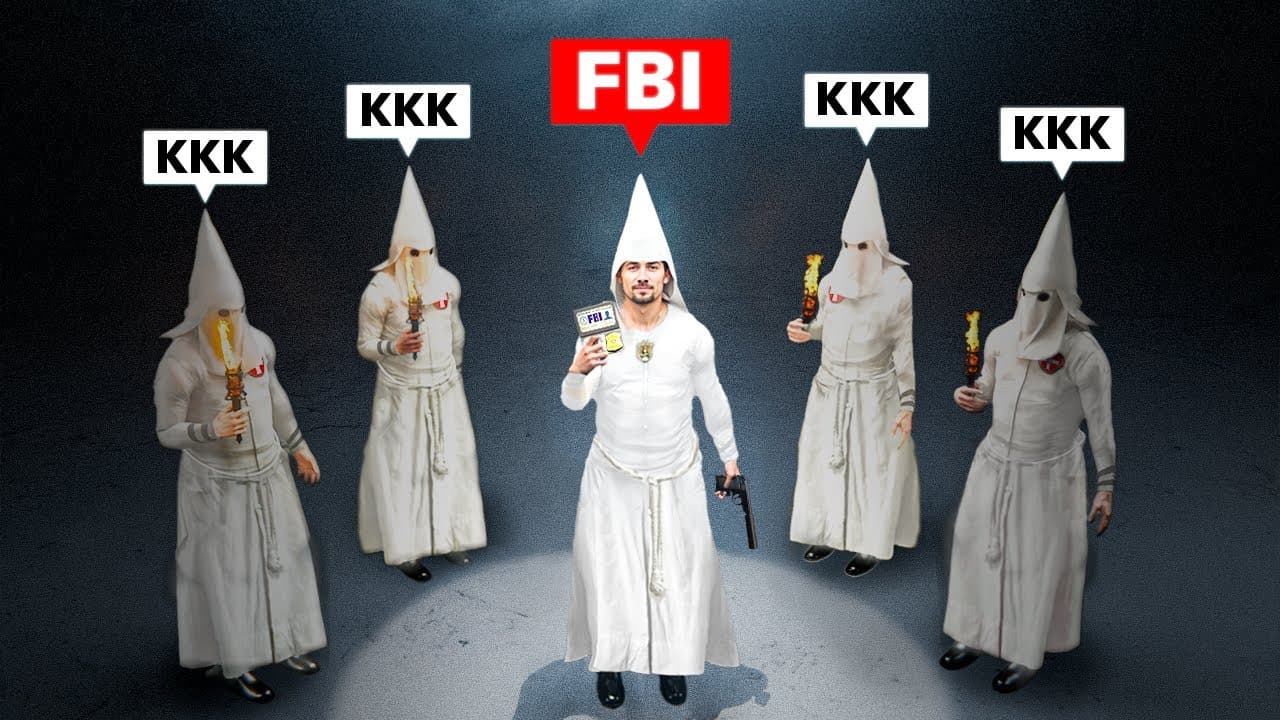
How did the FBI infiltrate the KKK undercover?
TL;DR
The FBI used undercover agents to embed within white supremacist groups and gather evidence that led to arrests. Scott Payne trained at the FBI Academy, then infiltrated the Outlaws Motorcycle Club and worked under deep cover, building relationships to betray criminal networks from drug trafficking to violence. His work spanned years and multiple cases.
Transcript
If there's any snitches in the group, we kill the snitches and they fire shots out of a gun. Boom. Boom. And everybody's kind of getting scared. >> April 21, 2017. A group of men stand in a remote field in the middle of Alabama. >> It was nighttime and I am blindfolded. I've been instructed to place my right hand on the right shoulder of the person... Read More
Key Insights
- The Brotherhood is the Ku Klux Clan, a hate group the undercover agent infiltrates.
- The FBI uses long training pipelines, including a 20-week program, to certify undercover agents.
- Undercover work involves building relationships that will later be betrayed for operation success.
- Payne adopts a redneck persona, which helps him blend with certain criminal groups.
- Undercover missions require navigating dangerous scenarios, sleep deprivation, and intense roleplay.
- Infiltration targets include both white supremacist groups and criminal motorcycle clubs like the Outlaws.
- The narrative connects undercover work to broader countercrime efforts and online data protection concerns.
- The corrections note acknowledges real world entities like the Azov brigade, illustrating the documentary editing context.
- More videos from this channel:
- More from this channel: fern
Install to Summarize YouTube Videos and Get Transcripts
Explore YouTube Video Summarizer or Get YouTube Transcript Extractor
Questions & Answers
Q: What is the central method the FBI uses to dismantle criminal groups as described in the video?
The FBI relies on undercover agents who embed themselves inside criminal organizations, build trust and relationships, and then use the acquired information to prosecute members and dismantle operations. This approach involves extensive training, realistic role playing, and prolonged exposure to illicit activities to gather actionable evidence without arousing immediate suspicion.
Q: Who is the key undercover agent highlighted in the story, and what role does he play?
The key undercover agent is Scott Payne, nicknamed Big Country, who trains at the FBI Academy, becomes certified as an undercover agent, and infiltrates groups like the Outlaws Motorcycle Club. His work involves posing, adapting to dangerous environments, and ultimately using his position to thwart violence and drug trafficking.
Q: What kind of training does the FBI undercover program require, according to the video?
The FBI undercover program is described as a rigorous, two week school with no days off during which candidates undergo sleep deprivation, multiple scenarios, and intense testing. A total of 20 weeks of preparation is involved before becoming fully certified, with only about half of the admitted students completing the program.
Q: How does Payne’s training and background influence his effectiveness as an undercover agent?
Payne’s lack of a fancy degree and foreign language skills is offset by his willingness to embrace an authentic persona and his ability to blend into certain subcultures. His background as a redneck helps him relate to some targets, enabling him to establish plausible relationships and gather critical intelligence.
Q: What ethical and emotional challenges are highlighted in the undercover work described?
The video notes that undercover work involves building relationships you plan to betray, and it shows the personal strain of maintaining deception over long periods. Agents must balance risk, the potential for violence, and moral considerations as they navigate dangerous environments and dual identities.
Q: What organizations are mentioned as targets of undercover operations in Payne’s work?
Targets include the Outlaws Motorcycle Club, Hell�s Angels rivals, and other criminal networks involved in drug trafficking, prostitution rings, and money laundering. Infiltration aims to disrupt these networks and prevent violence, with the actor ultimately working to bring these groups to justice.
Q: What broader themes does the video connect to undercover work beyond law enforcement?
The narrative connects undercover work to online safety and data protection, highlighting how criminals exploit data brokers and the need for protective measures. It also references the challenges of safeguarding personal information in a world where law enforcement and criminals alike study and exploit data.
Q: What correction is noted in the description and how does it relate to the documentary context?
The description includes a correction stating that an image is of the Ukrainian Azov brigade, not The Base, illustrating the importance of accuracy in documentary editing and how real world entities can appear in visual materials. This underscores the documentary’s emphasis on context and factual attribution.
Summary & Key Takeaways
-
The video recounts how an FBI undercover operative joined a hate group and used forged trust to gather intelligence and prosecute members. It covers training, deployment, and the personal challenges of long term undercover work.
-
The narrative centers on Scott Payne, his recruitment, and his missions within criminal organizations, illustrating how undercover work evolves from field presence to active intervention.
-
The story links Payne�s undercover experiences to broader themes of data protection, online risk, and the ongoing threat posed by organized crime across different groups.
Read in Other Languages (beta)
Share This Summary 📚
Summarize YouTube Videos and Get Video Transcripts with 1-Click
Try YouTube Summary with ChatGPT & Claude or YouTube Transcript Generator
Explore More Summaries from fern 📚





Summarize YouTube Videos and Get Video Transcripts with 1-Click
Try YouTube Summary with ChatGPT & Claude or YouTube Transcript Generator