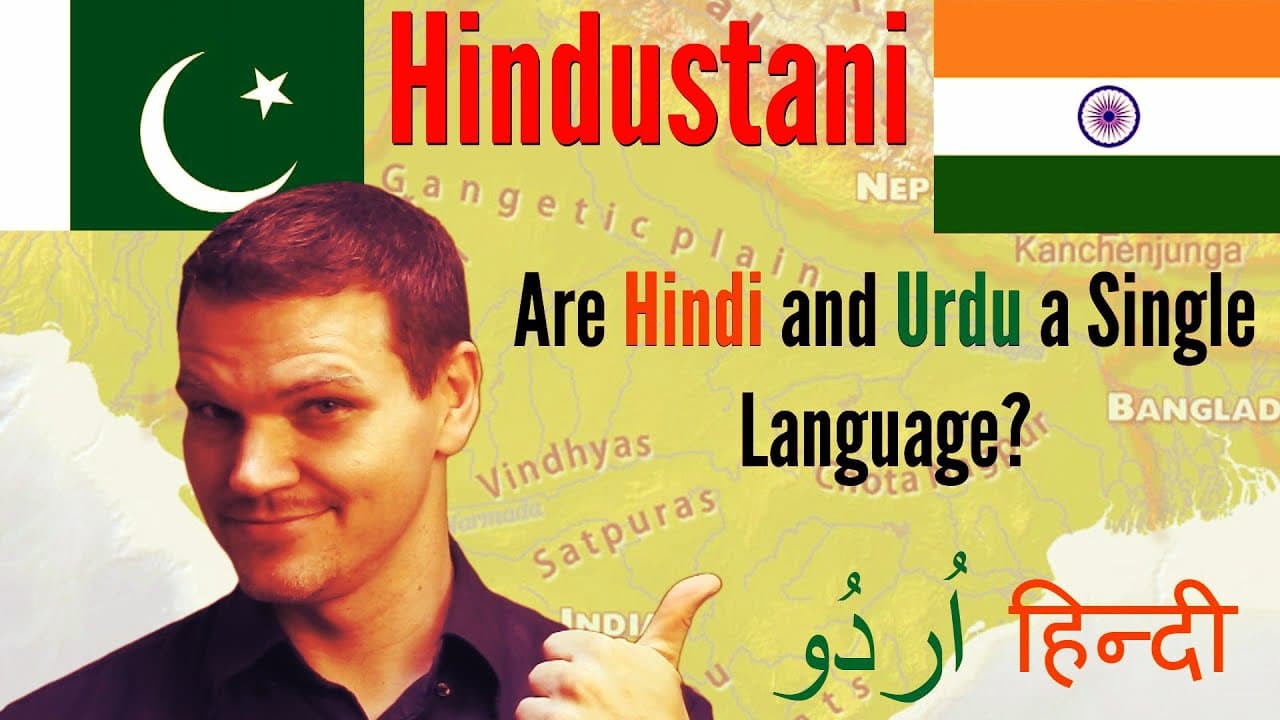
Hindi and Urdu - THE SAME LANGUAGE? (Hindustani)
TL;DR
Hindustani encompasses Hindi and Urdu as a single spoken language.
Transcript
Hello everyone, welcome to the Langfocus channel and my name is Paul Today I'm going to talk about a language called Hindustani Or it's sometimes called Hindustani There are countries with names like Pakistan, Afghanistan, Kazakhstan... Is there a country called Hindustan? Well, kind of. At certain points throughout history, the term Hindustan h... Read More
Key Insights
- Hindustani is a pluricentric language with two standard varieties: Hindi and Urdu, reflecting cultural and religious identities.
- Historically, Hindustani was a single language, but modern standard languages have diverged due to script and vocabulary differences.
- Hindustani serves as a lingua franca in linguistically diverse regions, with millions of native and second-language speakers.
- Hindi and Urdu share a common spoken form but differ significantly in their literary forms due to vocabulary influences.
- The development of Hindi and Urdu scripts contributed to cultural and religious identity, causing significant linguistic divergence.
- The influence of Persian and Arabic languages on Hindustani was significant, especially during Islamic rule in the Indian subcontinent.
- Bollywood often uses a neutral form of Hindustani, avoiding vocabulary specific to either Hindi or Urdu to reach a broader audience.
- Learning Hindustani is facilitated by its Indo-European roots, but challenges include grammatical differences and widespread English fluency.
Install to Summarize YouTube Videos and Get Transcripts
Explore YouTube Video Summarizer or Get YouTube Transcript Extractor
Questions & Answers
Q: What is Hindustani and how is it related to Hindi and Urdu?
Hindustani is a pluricentric language that includes Hindi and Urdu as its two standard varieties. While the spoken form of Hindustani is essentially the same for both Hindi and Urdu, the written forms diverge significantly due to different scripts and vocabulary choices influenced by cultural and religious identities.
Q: How did historical influences shape the development of Hindustani?
The development of Hindustani was significantly influenced by historical Islamic rule in the Indian subcontinent, particularly during the Delhi Sultanate and Mughal Empire. Persian was introduced as the language of the elite and the courts, while Arabic influenced religious vocabulary. These influences led to the integration of Persian and Arabic words into Hindustani, especially in Urdu.
Q: Why did the Hindi and Urdu scripts become a point of contention?
The script became a point of contention because when the British made the Persianized variety of Hindustani (Urdu) the official language, it was written in the Nastaliq script. This decision angered Hindu communities who believed the language should be written in the native Devanagari script, reflecting their cultural and religious identity. This dispute contributed to the divergence of the standard languages.
Q: In what ways are Hindi and Urdu similar in spoken communication?
In spoken communication, Hindi and Urdu are nearly identical, with speakers of both languages able to understand each other easily. Differences mainly arise in vocabulary influenced by local dialects or literary language, and slight accent variations. Bollywood films often use a neutral Hindustani to appeal to speakers of both languages.
Q: What role does Hindustani play in India and Pakistan today?
In India, Hindi is one of the official languages, while Urdu is recognized in several states. In Pakistan, Urdu is the national language and serves as a lingua franca despite only a small percentage speaking it natively. It is widely learned for education and communication across diverse linguistic communities in both countries.
Q: How does the grammar of Hindustani compare to other Indo-European languages?
Hindustani shares some grammatical concepts with other Indo-European languages, making it somewhat familiar to speakers of those languages. However, it has distinct features, such as a subject-object-verb (SOV) order, auxiliary verbs following main verbs, and gendered nouns with three cases. These differences can pose challenges to learners.
Q: What challenges might learners face when trying to practice Hindustani?
Learners might find it challenging to practice Hindustani due to the widespread fluency in English among educated individuals in the Indian subcontinent. This can lead to people defaulting to English in conversations. However, interacting with everyday people can provide ample opportunities for practicing the language.
Q: How does the cultural and religious identity influence the choice between Hindi and Urdu?
Cultural and religious identities significantly influence the choice between Hindi and Urdu. Urdu speakers often identify with Islamic and Persian heritage, while Hindi speakers align with Sanskrit and Hindu traditions. This choice is more about cultural identity than linguistic differences, as the spoken language remains largely the same.
Summary & Key Takeaways
-
Hindustani, encompassing Hindi and Urdu, is a major language in the Indian subcontinent, with shared spoken forms but distinct literary traditions.
-
The divergence between Hindi and Urdu is primarily due to script and vocabulary differences influenced by cultural and religious identities.
-
Despite differences in literary forms, Hindi and Urdu speakers can communicate effortlessly, highlighting the shared roots of Hindustani.
Read in Other Languages (beta)
Share This Summary 📚
Summarize YouTube Videos and Get Video Transcripts with 1-Click
Try YouTube Summary with ChatGPT & Claude or YouTube Transcript Generator
Explore More Summaries from Langfocus 📚


Summarize YouTube Videos and Get Video Transcripts with 1-Click
Try YouTube Summary with ChatGPT & Claude or YouTube Transcript Generator