How Similar Are Arabic and Hebrew Languages?
TL;DR
Arabic and Hebrew are both Semitic languages with common origins, sharing similar vocabulary and grammar structures. Despite these similarities, they have diverged significantly over time, making them mutually unintelligible without study. Modern Hebrew's revival and pronunciation changes further differentiate it from Arabic, though both languages retain a system of roots and templates for word formation.
Transcript
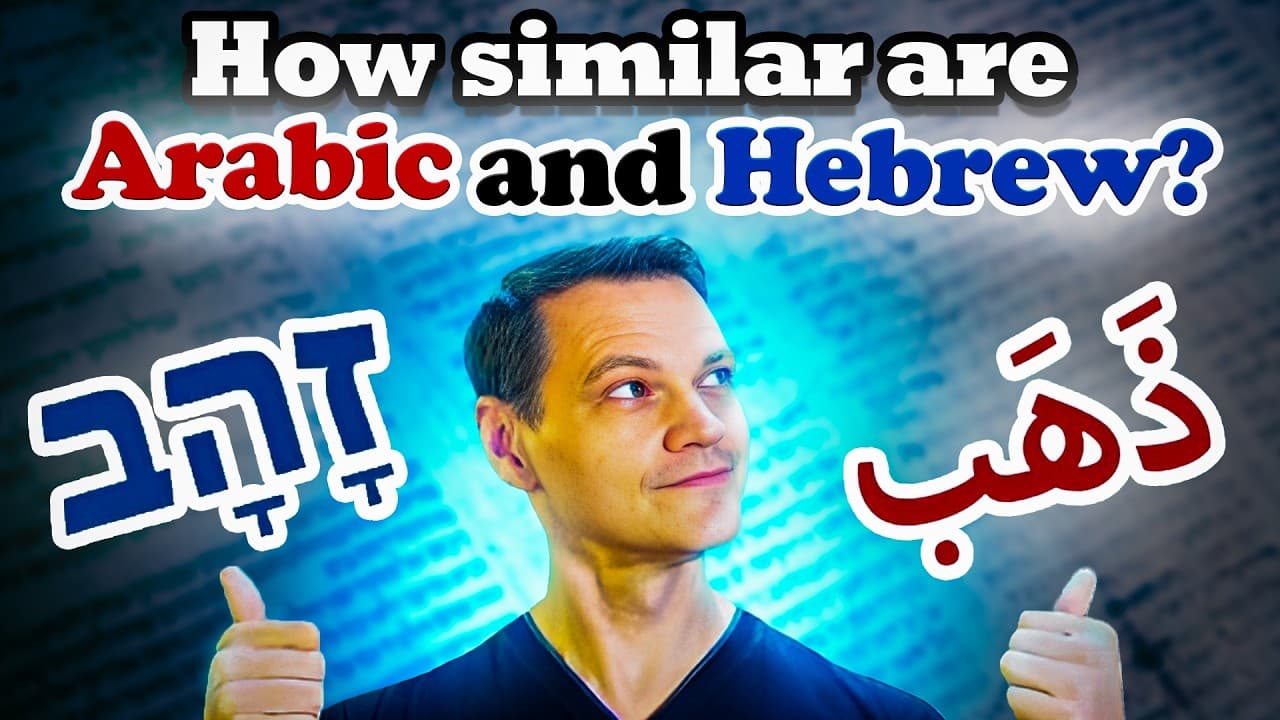
in this video I'm going to show you how similar the Arabic and Hebrew languages are I actually made a video about this back in the early days of this channel but like most of my videos from that era it was trash and an important topic like this deserves an upgrade so here we are Arabic and Hebrew are both Semitic languages and developed from the sa... Read More
Key Insights
- Arabic and Hebrew are both Semitic languages originating from a common ancestor.
- The word for peace is 'Salam' in Arabic and 'Shalom' in Hebrew, showcasing their shared roots.
- Hebrew died as a daily spoken language around 200 CE but was revived in the 1800s.
- Modern Hebrew has added new vocabulary using Hebrew roots and sometimes Arabic influences.
- Both languages use a root system, typically three consonant letters, to form words.
- Pronunciation systems are similar, but some consonants have diverged over time.
- Many basic vocabulary words are similar, but there are significant differences in usage and meaning.
- Modern Hebrew's pronunciation was influenced by European languages during its revival.
Install to Summarize YouTube Videos and Get Transcripts
Explore YouTube Video Summarizer or Get YouTube Transcript Extractor
Questions & Answers
Q: How are Arabic and Hebrew similar?
Arabic and Hebrew are similar because they are both Semitic languages with common origins. They share vocabulary and grammar structures, such as a system of roots and templates for word formation. Despite these similarities, they have diverged significantly over time, with different pronunciation and vocabulary.
Q: What is the root system in Arabic and Hebrew?
The root system in Arabic and Hebrew involves using a set of typically three consonant letters to form the core meaning of a word. These roots are placed into templates with different vowels and affixes to create various words and meanings, allowing for a rich and flexible vocabulary.
Q: Why did Hebrew die as a spoken language?
Hebrew died as a daily spoken language around 200 CE, primarily continuing in written form, especially in religious and scholarly contexts. It was preserved through Jewish religious practices and texts until efforts to revive it as a spoken language began in the 1800s, leading to the development of Modern Hebrew.
Q: How did Modern Hebrew's pronunciation change?
Modern Hebrew's pronunciation changed during its revival as it was influenced by the native languages of its adopters, such as Yiddish, Russian, and German. Some sounds merged or changed, like the rolled R becoming a guttural sound. These changes made Modern Hebrew pronunciation distinct from its ancient form.
Q: What are some examples of false friends between Arabic and Hebrew?
False friends are words that sound similar in Arabic and Hebrew but have different meanings. For example, 'Medina' means 'city' in Arabic, while 'Medina' means 'state' in Hebrew. Similarly, 'basar' means 'meat' in Arabic, but 'basar' means 'bread' in Hebrew, illustrating the divergence in meaning despite phonetic similarity.
Q: How does word formation differ in Arabic and Hebrew?
Word formation in Arabic and Hebrew is based on a system of roots and templates, but the specific templates and affixes used can differ. While both languages use this system to create words, the resulting vocabulary and grammatical structures have diverged, leading to differences in meaning and usage.
Q: What role did European languages play in Modern Hebrew's development?
European languages played a significant role in the development of Modern Hebrew's pronunciation. As Hebrew was revived, speakers of Yiddish, Russian, Polish, and German influenced its sounds, leading to changes like the rolled R becoming guttural and the merging of certain consonants, making it distinct from ancient Hebrew.
Q: Why is it easier for Arabic speakers to learn Modern Hebrew?
It is easier for Arabic speakers to learn Modern Hebrew because Modern Hebrew has a simpler pronunciation and grammar compared to Standard Arabic. The shared Semitic roots also provide a familiar framework for vocabulary and structure, facilitating the learning process for Arabic speakers despite the languages' differences.
Summary & Key Takeaways
-
Arabic and Hebrew share a common Semitic origin, which is evident in their similar vocabulary and grammar structures. However, over time, they have diverged significantly, making them mutually unintelligible without study. Modern Hebrew, revived in the 1800s, incorporated new vocabulary and pronunciation changes influenced by European languages.
-
Both Arabic and Hebrew utilize a root system for word formation, typically involving three consonant letters. Despite shared roots, pronunciation and vocabulary have diverged, with Hebrew adopting sounds and vocabulary influenced by languages like Yiddish and Russian during its revival.
-
The languages have numerous false friends—words that sound similar but have different meanings. While Arabic and Hebrew share some basic vocabulary, many words differ, and modern Hebrew's simpler pronunciation and grammar make it easier for Arabic speakers to learn.
Read in Other Languages (beta)
Share This Summary 📚
Summarize YouTube Videos and Get Video Transcripts with 1-Click
Try YouTube Summary with ChatGPT & Claude or YouTube Transcript Generator
Explore More Summaries from Langfocus 📚



Summarize YouTube Videos and Get Video Transcripts with 1-Click
Try YouTube Summary with ChatGPT & Claude or YouTube Transcript Generator