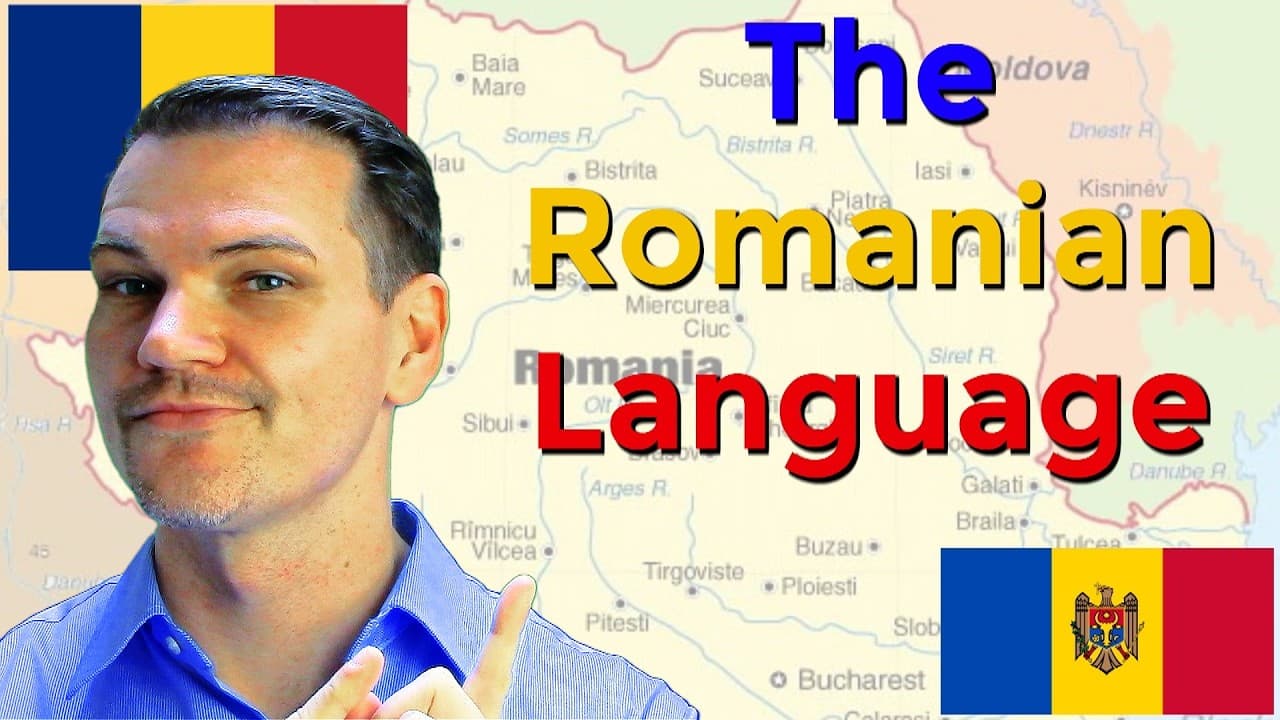
ROMANIAN (The Forgotten Romance Language)
TL;DR
Romanian is a unique Romance language influenced by Slavic languages.
Transcript
hello everyone welcome to the langfocus channel and my name is paul today's topic is the romanian language or limba romuna in romanian as you can see the word romanian contains the word roman in it why because it developed from the language of the romans latin to clarify romanian is a member of the romance language family when speaking of romance l... Read More
Key Insights
- Romanian is a Romance language that developed from Latin, sharing similarities with other Romance languages like Italian and French.
- Romanian's geographic isolation in Eastern Europe contributes to its distinct development compared to other Romance languages in Western Europe.
- Slavic languages have significantly influenced Romanian's vocabulary, pronunciation, and grammar due to historical contact.
- Romanian has a unique feature among Romance languages: it retains case declensions, a characteristic more common in Slavic languages.
- Efforts to standardize and re-latinize Romanian began in the 18th and 19th centuries, focusing on removing Slavic influences.
- Romanian is the official language of Romania and Moldova, where it is sometimes referred to as Moldovan.
- The Romanian language has maintained a neuter gender, unlike most other Romance languages, which have lost this feature.
- Despite its Slavic influences, the majority of Romanian vocabulary remains of Latin and Romance origin.
Install to Summarize YouTube Videos and Get Transcripts
Explore YouTube Video Summarizer or Get YouTube Transcript Extractor
Questions & Answers
Q: What makes Romanian unique among Romance languages?
Romanian is unique among Romance languages because it developed in geographic isolation in Eastern Europe, which led to significant Slavic influences in its vocabulary, pronunciation, and grammar. Additionally, Romanian retains case declensions, a feature that most other Romance languages have lost, making it more similar to Slavic languages in this regard.
Q: How did Slavic languages influence Romanian?
Slavic languages influenced Romanian primarily through historical contact, especially between the 7th and 9th centuries CE. This influence is evident in Romanian's vocabulary, pronunciation, and some grammatical structures. Many commonly used words in Romanian are of Slavic origin, and the language's phonetic and syntactic features also show Slavic influence.
Q: What efforts were made to re-latinize Romanian?
Efforts to re-latinize Romanian began in the 18th century, with the first Romanian grammar published in 1780. In the 19th century, Romanian linguists aimed to remove Slavic and other foreign influences from the language. They reintroduced Latin-based vocabulary and drew words from Italian and French to replace non-Romance vocabulary, reinforcing the language's Latin roots.
Q: Why is Romanian sometimes referred to as Moldovan?
Romanian is referred to as Moldovan in Moldova due to historical and political reasons. During Soviet rule, the language was officially called Moldovan to emphasize a distinct identity. However, linguistically, Romanian and Moldovan are the same language, with only minor regional variations. The standard written form is identical for both Romanian and Moldovan.
Q: What is the historical background of the Romanian language?
The Romanian language developed from Latin after the Roman Empire's conquest of Dacia in 106 CE. The area became heavily Latinized, and after the Roman military withdrew in 271-272 CE, a Latin-speaking population remained. Over centuries, local dialects evolved into proto-Romanian, influenced by Slavic languages due to migrations and historical contact.
Q: How does Romanian vocabulary compare to other Romance languages?
Romanian vocabulary is predominantly of Latin and Romance origin, with around 63% of its words derived from these sources. However, Slavic languages have contributed significantly, accounting for approximately 11.5% of the vocabulary. Despite this, the most commonly used words in Romanian are predominantly Romance, with about 76% being of Latin origin.
Q: What role did geography play in the development of Romanian?
Geography played a crucial role in Romanian's development. The Carpathian Mountains and other natural barriers provided some insulation from invasions and cultural assimilation, allowing Latin influence to persist in the region. This geographic isolation from other Romance language areas contributed to Romanian's unique evolution and distinct characteristics.
Q: What is the Balkan Sprachbund, and how does it relate to Romanian?
The Balkan Sprachbund is a linguistic area where languages have mutually influenced each other, including Romance, Slavic, Greek, and Albanian languages. Romanian, as part of this Sprachbund, has been influenced by neighboring languages, especially Slavic ones. This interaction has impacted Romanian's vocabulary, pronunciation, and grammatical features, setting it apart from other Romance languages.
Summary & Key Takeaways
-
Romanian, a Romance language, developed from Latin and shares similarities with Italian and French. However, its geographic isolation in Eastern Europe and prolonged contact with Slavic languages have given it unique characteristics.
-
Romanian retains case declensions, a feature that distinguishes it from other Romance languages. The language has been influenced by Slavic languages in vocabulary and grammar, yet efforts in the 18th and 19th centuries aimed to re-latinize it.
-
Romanian is spoken by millions in Romania and Moldova, where it is sometimes called Moldovan. Despite its Slavic influences, the majority of its vocabulary remains Romance, making it a fascinating study of linguistic evolution.
Read in Other Languages (beta)
Share This Summary 📚
Summarize YouTube Videos and Get Video Transcripts with 1-Click
Try YouTube Summary with ChatGPT & Claude or YouTube Transcript Generator
Explore More Summaries from Langfocus 📚



Summarize YouTube Videos and Get Video Transcripts with 1-Click
Try YouTube Summary with ChatGPT & Claude or YouTube Transcript Generator