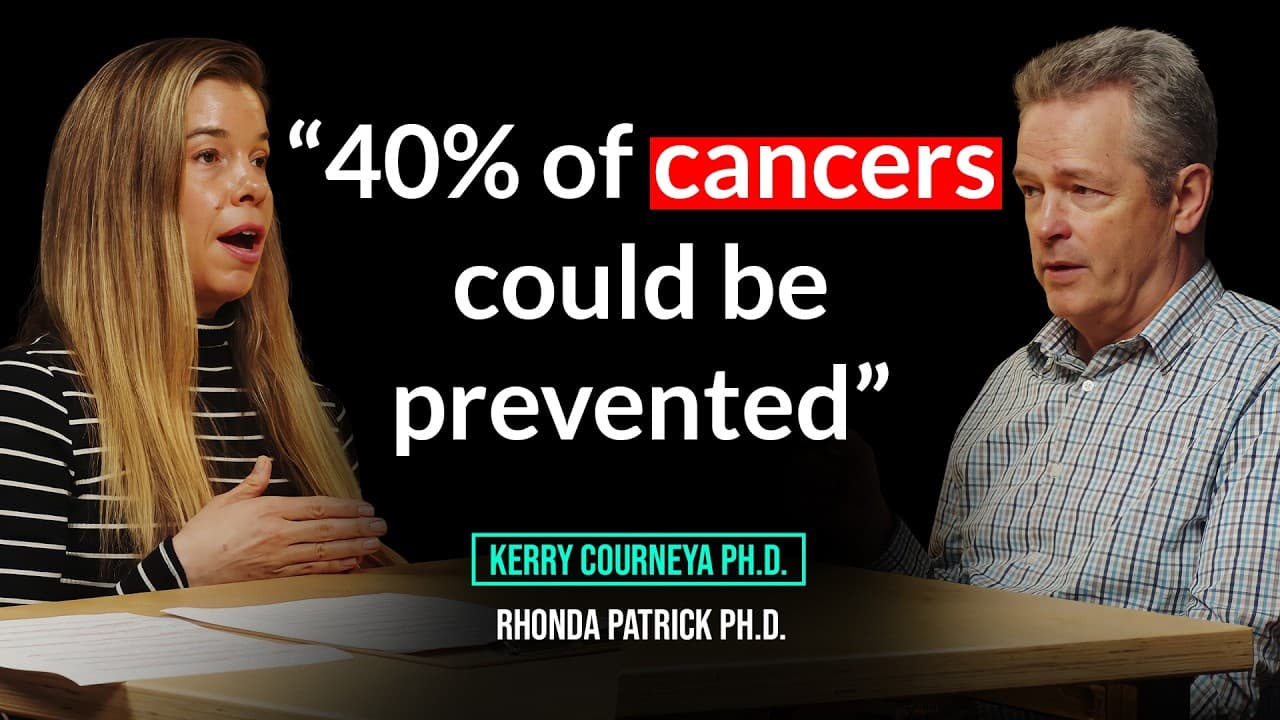
How does effortful exercise reduce cancer risk?
TL;DR
Effortful exercise lowers cancer risk by influencing metabolic and immune processes and can improve treatment response. It benefits cardiovascular and muscular systems, helps manage obesity, and supports prevention across multiple cancer types. Even when risk factors like smoking or obesity are present, structured exercise provides meaningful risk reduction.
Transcript
low muscle mass is really the critical thing driving risk of recurrence and death from cancer and there's some really interesting research suggesting that if you exercise while the tumors are shedding these um circulating tumor cells those uh circulating tumor cells are less likely to survive because of the increased sheer stress so when blood's fl... Read More
Key Insights
- Exercise reduces cancer risk by triggering immune and metabolic changes during blood flow and vascular stress.
- Structured, effortful exercise is linked to higher complete treatment responses prior to surgery for some cancers.
- Obesity and smoking influence cancer risk, but exercise lowers risk even when these factors are present.
- Both aerobic and resistance training are beneficial, with intensity shaping the magnitude of biological adaptations.
- 150 minutes per week is a general target, with higher levels offering more benefit up to a point.
- Pre-diagnosis exercise matters for outcomes, but continuing exercise during treatment supports tolerance and recovery.
- Low muscle mass drives cancer mortality, highlighting the need for muscle-strength strategies.
- BMI alone is insufficient to assess obesity risk; body composition and activity history provide better context.
Install to Summarize YouTube Videos and Get Transcripts
Explore YouTube Video Summarizer or Get YouTube Transcript Extractor
Questions & Answers
Q: What is the basic idea of why effortful exercise helps with cancer risk
Effortful exercise induces a series of biological stressors and metabolic changes that stir the body's biological soup, leading to anti cancer effects. The increased blood flow and shear stress can make circulating tumor cells less likely to survive, which may reduce risk and support better outcomes during treatment.
Q: How does exercise influence treatment response before surgery
Patients who exercise while undergoing chemoradiation therapy are more likely to have a complete response, meaning tumors may be completely gone prior to surgery. This suggests exercise can enhance treatment effectiveness, potentially shifting the trajectory of cancer care toward better outcomes and improved chances for surgical success.
Q: What types of cancer prevention are most influenced by exercise
Exercise lowers the risk of several cancers, notably colon, breast, and endometrial cancers, among others. While there are many cancer types, the evidence supports meaningful risk reduction through regular, structured physical activity that complements other lifestyle changes such as not smoking and maintaining a healthy weight.
Q: Is there a difference between aerobic, resistance, and high intensity exercise for cancer prevention
All three modalities contribute to risk reduction through energy expenditure and consequent biological effects. The specific adaptations differ—cardiovascular, muscular, and metabolic changes—but the overall message is that engaging in moderate to vigorous activity, with a mix of types, yields cancer prevention benefits.
Q: Can exercise benefit people who are obese or smokers in reducing cancer risk
Yes, exercise lowers cancer risk regardless of obesity or smoking status. Even among smokers, or those who are overweight, engaging in regular physical activity reduces risk. This demonstrates that exercise provides protective effects across different risk profiles, though quitting smoking remains the most impactful single change.
Q: What is the role of pre diagnosis exercise in cancer outcomes
Pre diagnosis exercise matters because it primes the body's systems to handle cancer and treatment more effectively. While continuing exercise during treatment is important, starting before diagnosis helps establish healthier baseline physiological conditions that support treatment tolerance, immune function, and overall resilience to the disease.
Q: Why is BMI not a sufficient measure of obesity in cancer risk
BMI fails to capture true obesity risk because it does not reflect body composition or fat distribution. Muscle mass and metabolic health play crucial roles in cancer outcomes, and relying solely on BMI can misclassify risk. Exercise helps improve muscle mass and metabolic health, which are better indicators of cancer risk and prognosis.
Q: How do frequency and intensity of exercise influence the cancer prevention effect
Regular, structured exercise with adequate duration and intensity drives the strongest protective effects. The guidelines point toward moderate to vigorous activity, and more time in the active zone generally increases benefits up to a threshold. Weekend or sporadic activity provides less protection than consistent routine exercise.
Summary & Key Takeaways
-
Exercise is a key pillar of cancer care, not just a health habit, influencing tumor biology and treatment tolerance. It engages energy expenditure that triggers biological changes, including immune and metabolic adaptations, which can reduce cancer risk and improve responses to therapy.
-
The evidence spans prevention and treatment, with recommendations emphasizing at least moderate to vigorous activity. Exercise type (aerobic, resistance, high intensity) matters for specific adaptations, but all contribute to reduced cancer risk and better health outcomes.
-
Prevention benefits extend to those with genetic predispositions or family history, though the magnitude can vary. Exercise lowers risk across obesity and smoking subgroups, indicating broad applicability as a protective factor and a complement to other risk-reducing behaviors.
Read in Other Languages (beta)
Share This Summary 📚
Summarize YouTube Videos and Get Video Transcripts with 1-Click
Try YouTube Summary with ChatGPT & Claude or YouTube Transcript Generator
Explore More Summaries from FoundMyFitness 📚
Summarize YouTube Videos and Get Video Transcripts with 1-Click
Try YouTube Summary with ChatGPT & Claude or YouTube Transcript Generator