What Are LL(1) Parsers and How Do They Work?
TL;DR
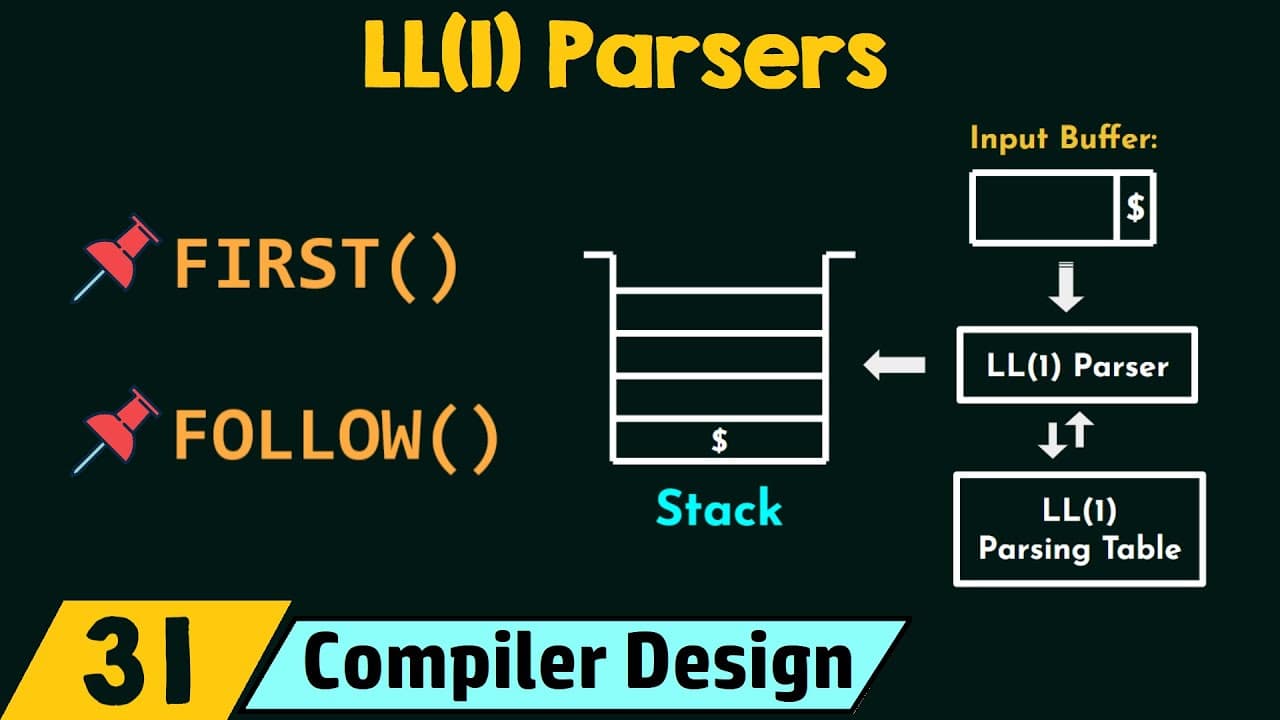
LL(1) parsers are predictive parsers that scan input left to right and utilize a single look-ahead symbol to generate parse trees. This video explains the organization and components of LL(1) parsers, including the input buffer and parsing table, and introduces the critical concepts of first and follow functions used in constructing parsing tables.
Transcript
foreign and welcome back we already have started our journey of learning about the top down Parcels in this session we are going to learn about the ll1 parsers so without any further Ado let's get to learning coming to the outcome of today's session today at first we will observe the organization of ll1 parcel and thereafter we will acquire the und... Read More
Key Insights
- 😒 Recursive descent parsers convert non-terminals into functions and use a recursion stack, descending from the start symbol to generate the parse tree.
- 👨💻 The memory layout of a C program executing the code for a recursive descent parser consists of segments such as text/code, initialized data, uninitialized data (BSS), and stack/heap.
- 😒 LL1 parsers are a type of predictive parser that scans inputs from left to right and use LL1 parsing tables to construct the parse tree.
- 🔣 LL1 parsers derive decisions from the LL1 parsing table based on a one look-ahead symbol from the input buffer.
- 😫 The first set of a non-terminal consists of the terminal(s) that can be derived from it, while the follow set consists of the terminal(s) that can follow the non-terminal during derivation.
- 😫 The first and follow sets are essential for constructing the LL1 parsing table and enabling LL1 parsing.
Install to Summarize YouTube Videos and Get Transcripts
Explore YouTube Video Summarizer or Get YouTube Transcript Extractor
Questions & Answers
Q: Why are recursive descent parsers named as such?
Recursive descent parsers are named so because they use recursion to descend from the start symbol, generating the parse tree for the input stream. The use of a recursion stack during execution contributes to the name "recursive descent."
Q: What segments are present in the memory layout of a C program executing the code for a recursive descent parser?
The memory layout includes the text or code segment where the actual code resides, the initialized data segment for storing initialized variables, the uninitialized data segment or BSS, and the stack and heap segments used during execution.
Q: What is the purpose of the LL1 parsing table in LL1 parsers?
The LL1 parsing table is used by the LL1 parser to make decisions during the construction of the parse tree. It determines which production rule to apply based on the current input symbol and the top of the stack.
Q: How are the first and follow sets determined for non-terminals in LL1 parsing?
The first set of a non-terminal consists of the terminal(s) that can be derived from it. The follow set of a non-terminal consists of the terminal(s) that can follow the non-terminal during the derivation process. Both sets are determined by analyzing the production rules of the grammar.
Summary & Key Takeaways
-
The video introduces LL1 parsers and compares them to recursive descent parsers, explaining how all non-terminals are converted into functions.
-
It discusses the memory layout of a C program executing the code for a recursive descent parser, highlighting the importance of the stack.
-
The video then explains the meaning behind the name "recursive descent parser" and introduces LL1 parsers as a type of predictive parser that scans the input from left to right.
-
It outlines the components required for LL1 parsing, including the input buffer, LL1 parsing table, and stack.
-
The video introduces the concepts of first and follow functions, showcasing examples of how to determine the first and follow sets for different non-terminals.
Read in Other Languages (beta)
Share This Summary 📚
Summarize YouTube Videos and Get Video Transcripts with 1-Click
Try YouTube Summary with ChatGPT & Claude or YouTube Transcript Generator
Explore More Summaries from Neso Academy 📚
Summarize YouTube Videos and Get Video Transcripts with 1-Click
Try YouTube Summary with ChatGPT & Claude or YouTube Transcript Generator