How to Use the Four English Conditionals
TL;DR
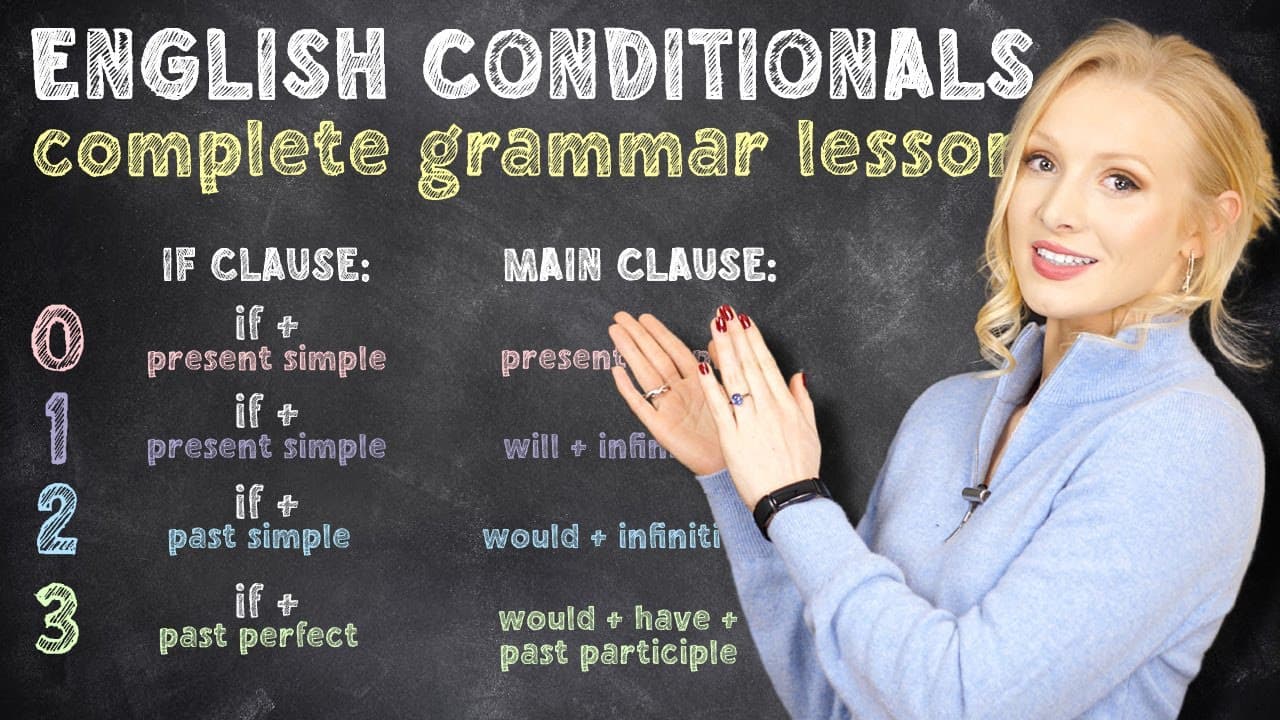
Use the zero conditional for general truths, the first for possible future situations, the second for unlikely or impossible situations, and the third for an unreal past and its imagined result. Every conditional has an if clause and a main clause, and their order can be reversed without changing the core meaning.
Transcript
(bright upbeat music) - Hello, everyone and welcome back to English with Lucy today. Very exciting, I have a We are going to discuss This is a very, very important lesson. I know that this is a topic, that lots of my students struggle with. There's so much to remember, but hopefully I can clarify, lots of your doubts today. To help you even further... Read More
Key Insights
- Every conditional sentence has an if clause and a main clause. The clauses can exchange positions without changing the central meaning, as shown by “If I practise, I will get better” and “I will get better if I practise.”
- The zero conditional uses the present simple in both clauses. It describes general results and facts, such as water evaporating when heated, rather than one particular event occurring on a specific day.
- If can often be replaced by when or whenever in the zero conditional. This substitution works because the construction presents the result as something that generally follows whenever the stated condition occurs.
- The zero conditional can include an imperative in the main clause. Instructions such as texting someone after getting lost use the conditional clause to identify the situation in which the requested action should occur.
- The first conditional uses the present simple after if and normally uses will with an infinitive in the main clause. It concerns specific, realistic situations that might happen in the future, although their outcomes remain uncertain.
- Modals can replace will in the main clause of a first conditional. Forms such as shall, should, might, and be able to can communicate distinctions involving certainty, permission, advice, or ability.
- The second conditional uses the past simple after if and commonly uses would with an infinitive. It describes future situations that probably will not happen, imaginary possibilities such as winning the lottery, and impossible present situations.
- The third conditional uses the past perfect after if and would have with a past participle in the main clause. It considers an unreal past condition and imagines the different result that would have followed.
Install to Summarize YouTube Videos and Get Transcripts
Explore YouTube Video Summarizer or Get YouTube Transcript Extractor
Questions & Answers
Q: How are English conditional sentences structured?
Every conditional sentence contains an if clause and a main clause. Their order is flexible, so “If I practise, I will get better” can become “I will get better if I practise.” Reversing the clauses does not change the central meaning. The verb forms inside the clauses depend on whether the sentence uses the zero, first, second, or third conditional.
Q: When should you use the zero conditional?
Use the zero conditional for general results, repeated patterns, and facts rather than a particular event on one specific occasion. Both the if clause and the main clause use the present simple. “If you heat water, it evaporates” illustrates the pattern because it presents evaporation as the general result of heating water, not merely a future possibility.
Q: Can if be replaced in a zero conditional?
If can usually be replaced by when or whenever in a zero conditional because the sentence describes a result that generally follows the condition. For example, “When I am happy, I smile” expresses the same recurring relationship. The clauses can also be reversed, producing “I smile when I am happy,” without changing the basic meaning.
Q: How do imperatives work with the zero conditional?
An imperative can appear in the main clause of a zero conditional when the sentence gives an instruction connected to a condition. “Text me if you get lost” tells the listener what action to take whenever the stated situation occurs. The conditional clause establishes the circumstance, while the imperative main clause states the requested response.
Q: How is the first conditional formed and used?
The first conditional uses the present simple after if and normally places will plus an infinitive in the main clause. It describes a specific and realistic future situation that might happen. Examples include missing a train if you do not leave now, passing an exam if you study hard, and lighting a fire if the weather gets colder.
Q: Can modal verbs replace will in the first conditional?
Modal expressions can replace will in the main clause of a first conditional to communicate meanings such as certainty, permission, advice, or ability. The lesson gives forms including might, shall, should, and be able to. The if clause still presents the possible condition, while the selected modal changes how the speaker frames the potential response or result.
Q: How is the second conditional formed and used?
The second conditional normally uses the past simple after if and would plus an infinitive in the main clause. It describes future situations that are probably untrue or unlikely, such as winning the lottery and buying a house in Barbados. It also describes impossible present situations and can offer advice through the expression “If I were you.”
Q: How is the third conditional formed and used?
The third conditional uses if plus the past perfect, followed by would have and a past participle in the main clause. It describes an unreal past situation and imagines its result. “If I had studied harder, I would have passed the exam” means the harder studying did not occur and, as a consequence, the imagined result did not occur either.
Summary & Key Takeaways
-
Conditional sentences contain an if clause and a main clause, whose order can be reversed without changing the meaning. The zero conditional uses present simple in both clauses for general truths. The first conditional combines an if clause in the present simple with will or another modal for possible future situations.
-
The second conditional normally combines the past simple after if with would and an infinitive in the main clause. It describes unlikely future situations or impossible present situations. The main clause can also use would be with a present participle when the imagined result is an action that would be happening.
-
The third conditional combines if with the past perfect, followed by would have and a past participle. It imagines a different past situation and its unreal result. Examples about studying harder or leaving earlier show how the structure expresses outcomes that did not happen because the stated condition was not fulfilled.
Read in Other Languages (beta)
Share This Summary 📚
Summarize YouTube Videos and Get Video Transcripts with 1-Click
Try YouTube Summary with ChatGPT & Claude or YouTube Transcript Generator
Explore More Summaries from English with Lucy 📚




Summarize YouTube Videos and Get Video Transcripts with 1-Click
Try YouTube Summary with ChatGPT & Claude or YouTube Transcript Generator