Which AI Model Builds the Better Analytics App?
TL;DR
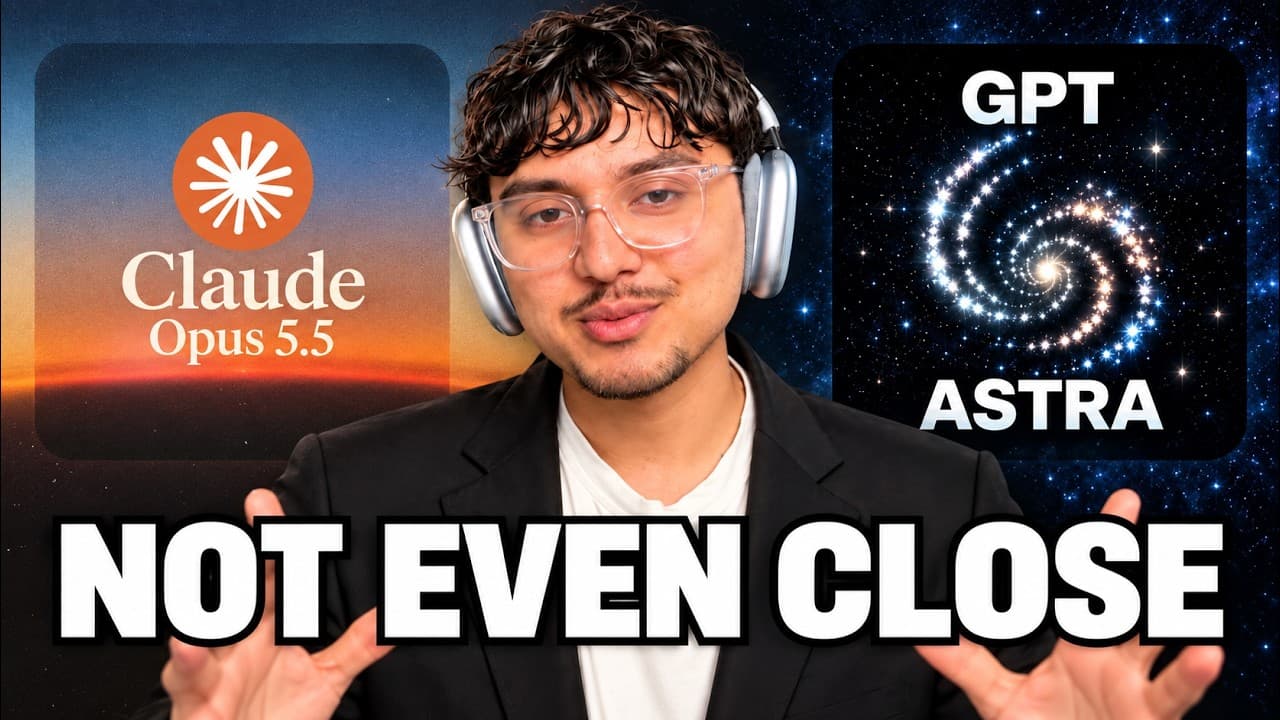
Claude Opus 5.5 produced the more useful competitor intelligence app, with deeper video analysis, outlier comparisons, transcripts, audience comments, and strategic explanations. GPT-6 Astra delivered a cleaner, more spacious interface and started processing sooner, but its analytics appeared less actionable. Neither model generated a convincing short-form script, showing that a polished application does not guarantee strong creative recommendations.
Transcript
You remember when Drake and Kendrick were beefing and Drake posted his diss track and then 54 minutes later Kendrick had already prepared a response? Yeah. Well, now we have multi-rillion dollar AI companies doing the exact same thing with OpenAI releasing the rest of their 6 series just 2 hours after the Opus 5.5 release. Now, Anthropics benchmark... Read More
Key Insights
- Claude Opus 5.5 produced the deeper analytical product, including detailed video breakdowns, transcripts, captions, audience comment samples, target-audience information, related creators, confidence ratings, and performance comparisons against each creator's typical results.
- GPT-6 Astra produced the cleaner initial design, using larger imagery, more spacing, and fewer visible text blocks. The reviewer found this presentation easier on the eyes and less likely to create decision fatigue than Claude's information-dense dashboard.
- Claude's dashboard tracked 435 reels from 18 competitors, with 150 analyzed and 35 classified as breakouts over 30 days. These figures gave the application a concrete overview of the niche and supported exploration of individual high-performing posts.
- Claude's video pages exposed more actionable detail than Astra's pages. Users could inspect why a post broke out, review every frame, read its transcript and caption, examine audience comments, and compare performance with the creator's median results.
- Astra's pattern analysis could become misleading when based on small samples. One story-transformation category reported a 9.3-times outlier average from only two videos, even though one reached 18 times the baseline while the other reached just 0.4 times.
- Both models struggled with script generation despite building polished analytical interfaces. Claude's proposed voice-over contained awkward and unclear lines, while Astra's filming plan was similarly weak, leading the reviewer to question whether excessive choice harmed the recommendations.
- GPT-6 Astra began processing sooner than Claude Opus 5.5 during the observed run. Astra quickly logged substantial prompt-analysis tokens, while Claude initially lagged before later moving ahead in reported token usage during the build.
- Claude Opus 5.5 communicated its completion more clearly and concisely than the reviewer remembered from Opus 5. However, the application itself still displayed large amounts of text, showing that concise model commentary did not automatically produce a restrained interface.
Install to Summarize YouTube Videos and Get Transcripts
Explore YouTube Video Summarizer or Get YouTube Transcript Extractor
Questions & Answers
Q: Which AI model built the better competitor analytics app?
Claude Opus 5.5 built the more useful competitor analytics app according to the review shown in the transcript. Its interface was denser, but it provided richer video pages, outlier comparisons, confidence ratings, transcripts, captions, audience comments, related creators, and explanations of why posts performed well. GPT-6 Astra looked cleaner initially, yet its deeper analysis offered less actionable detail.
Q: Why did GPT-6 Astra have the better interface design?
GPT-6 Astra used a more spacious layout with larger images and fewer blocks of text competing for attention. The reviewer found it more organized, easier on the eyes, and less likely to cause decision fatigue during an initial scan. Claude's interface contained more analytical information, but its dense presentation made the dashboard feel visually overwhelming despite the value of the underlying data.
Q: What analytics did Claude Opus 5.5 include?
Claude Opus 5.5 included an overview of 435 reels from 18 competitors, with 150 analyzed and 35 breakouts identified across 30 days. Individual pages contained frame-level discussion, breakout explanations, transcripts, captions, audience comment samples, intended-audience information, related content, creator-median comparisons, confidence ratings, hook strength, and sortable outlier measures for examining unusually successful posts.
Q: How did GPT-6 Astra analyze individual videos?
GPT-6 Astra provided video transcripts and highlighted important moments, including the reveal and proof sections. It also grouped videos by hook or narrative patterns and compared performance with a baseline. However, the reviewer found its individual video analysis less detailed and less interactive than Claude's, particularly when trying to understand precisely why a post succeeded or how to apply its lessons.
Q: Why was Astra's content pattern analysis questionable?
Astra presented a story-transformation pattern as a 9.3-times outlier, but that result came from only two videos. One video performed at 18 times the relevant baseline, while the other achieved only 0.4 times. Averaging those sharply different results produced an impressive headline figure without a broad sample, which the reviewer felt could direct strategy down the wrong path.
Q: Were the AI-generated short-form scripts useful?
Neither model produced a convincing short-form script in the portion of the test provided. Claude generated a voice-over with unclear, awkward lines even though its application scored the proposal highly for hook, retention, clarity, specificity, originality, and pattern fit. Astra offered a basic prototype-focused filming plan, but the reviewer also judged its actual scriptwriting as weak and insufficiently compelling.
Q: Which model started and processed the task faster?
GPT-6 Astra appeared to start faster during the observed application build. It began analyzing the prompt and logging token activity while Claude Opus 5.5 had not yet responded after roughly a minute. The reviewer noted that Astra tends to begin promptly, while Claude can lag before starting. The supplied transcript does not provide a final completion-time comparison for this test.
Q: What does the comparison suggest about choosing an AI model?
The comparison suggests that model choice should depend on the specific priority rather than interface appearance alone. GPT-6 Astra was stronger at producing a clean, approachable first impression, while Claude Opus 5.5 delivered deeper and more actionable analytics. Both were weak at script generation, so a strong app build does not necessarily mean equally strong creative output within the same workflow.
Summary & Key Takeaways
-
Claude Opus 5.5 built a detailed competitor content intelligence platform covering hundreds of reels, breakout posts, hook strength, transcripts, captions, audience comments, creator benchmarks, and related topics. Its dense interface could cause decision fatigue, but the underlying analysis impressed the reviewer and made the application feel close to a finished subscription product.
-
GPT-6 Astra created a cleaner and more spacious interface that was easier to scan at first glance. Its transcript view highlighted structural moments such as reveals and proof, but its deeper analytics felt less complete. One pattern recommendation was also based on only two sharply conflicting videos, reducing its practical reliability.
-
Both models attempted to generate scripts from observed content patterns, but neither produced a compelling result. Claude assigned strong scores to its own proposed script despite awkward phrasing, while Astra offered a basic filming plan that also lacked persuasive creative quality. The comparison suggests analytics and interface generation currently outperform automated scriptwriting in this test.
Read in Other Languages (beta)
Share This Summary 📚
Summarize YouTube Videos and Get Video Transcripts with 1-Click
Try YouTube Summary with ChatGPT & Claude or YouTube Transcript Generator
Explore More Summaries from Dubibubi 📚



Summarize YouTube Videos and Get Video Transcripts with 1-Click
Try YouTube Summary with ChatGPT & Claude or YouTube Transcript Generator