How to Reduce Claude Token Usage Without Losing Quality
TL;DR
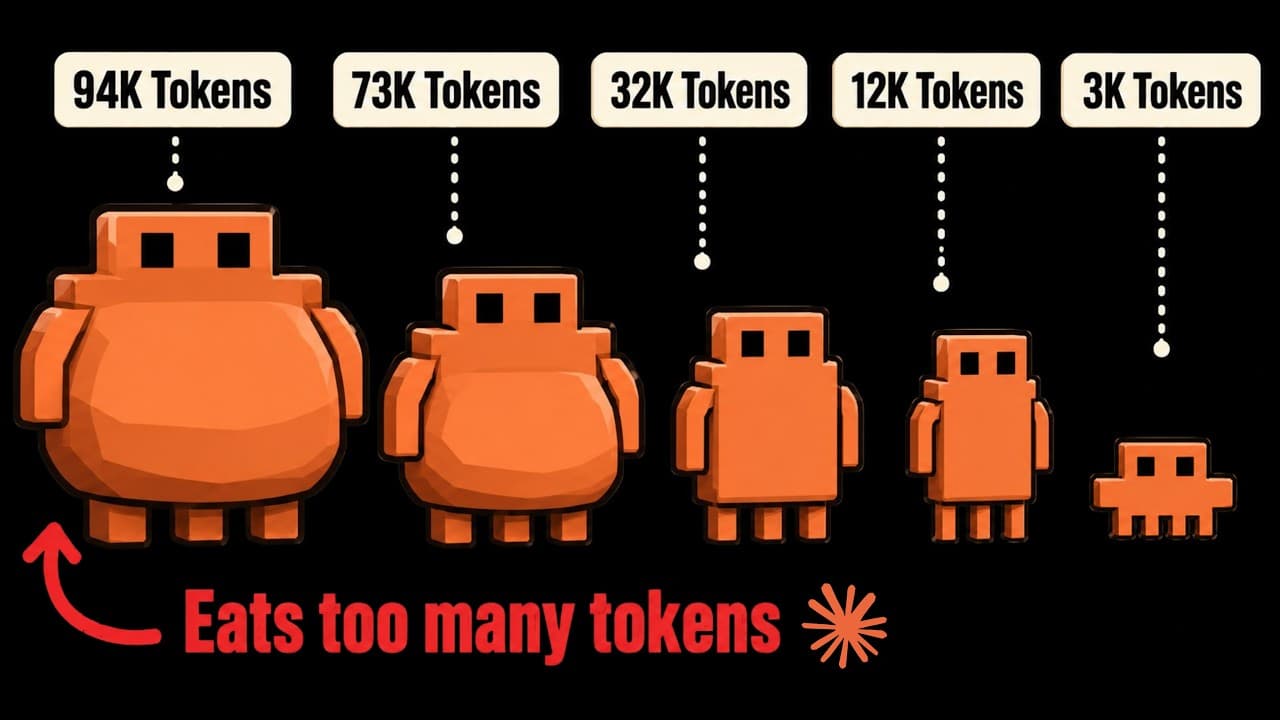
The caveman skill delivered the best straightforward result, reducing token usage by 41% while completing the documentation task with comparable or slightly better output. Codex orchestration initially saved 80%, but reaching better quality required three revisions and 53 minutes, shrinking the cost reduction to 7.1%, while PXPipe increased token usage by roughly 30%.
Transcript
Token saving skills. The ompic of AI agents claiming to save you up to 95% of your token usage. People have been stockpiling these token saving skills like toilet paper during co. Except there's one problem. Some of these claims seem too good to be true. So for the next 24 hours, I'll be turning into a detective testing these claims and putting the... Read More
Key Insights
- The caveman skill reduces output by teaching Claude to remove unnecessary words and communicate in a compressed style. In the documentation test, this approach cut total token usage by 41% while still completing the requested deliverables and producing a useful subtitle list.
- The caveman skill fell short of its claimed savings but remained practically valuable. Its advertised reduction was as high as 75%, while the measured test achieved 41% and saved approximately $2 in API token costs without an obvious decline in task quality.
- PXPipe works by converting text into a compact screenshot for Claude to inspect pixel by pixel. Its premise is that image processing depends mainly on image size rather than the number of words, potentially reducing the cost of reading large text collections.
- PXPipe increased token usage instead of reducing it in both experiments. The first root-cause investigation cost 31% more than vanilla Claude, and a repeated test with a larger database and two full pages of extracted text still produced an increase of about 30%.
- Codex orchestration produced the largest initial cost reduction in the comparison. Fable delegated work to Codex agents, leading to an 80% saving and a measured cost of $1.22 compared with $6.29 for the Fable output.
- The initial Codex result sacrificed output quality for lower cost. When the generated drawing was compared with Fable's version, neither result was judged impressive, but the tester considered Fable's proportions and overall output slightly better than the first Codex attempt.
- Additional iterations improved the Codex output but erased most of its original savings. After three revisions, the tester preferred its proportions and strokes over Fable's version, yet the final cost reduction had fallen from 80% to only 7.1%.
- Completion time is part of the real optimization cost. Producing the improved Codex result required 53 minutes, and the tester concluded that spending an additional 30 to 40 minutes was not worthwhile despite the final output appearing better than Fable's version.
Install to Summarize YouTube Videos and Get Transcripts
Explore YouTube Video Summarizer or Get YouTube Transcript Extractor
Questions & Answers
Q: How can the caveman skill reduce Claude token usage?
The caveman skill instructs Claude to communicate in a compressed style by cutting unnecessary words from its responses. In the test, Claude documented an undocumented duration library while using much less text than vanilla Claude. Both versions completed the task, and the caveman version also provided a subtitle list. The measured reduction was 41%, with approximately $2 saved in API token costs.
Q: How much did the caveman skill save in the test?
The caveman skill reduced measured token usage by 41% compared with vanilla Claude. That was below the advertised claim of savings as high as 75%, but it still represented approximately $2 in API token savings. The shorter response did not prevent task completion, and the tester even argued that the caveman output may have been slightly better because it included a subtitle list for navigation.
Q: What is PXPipe and how is it supposed to save tokens?
PXPipe takes text that an agent needs to read, compresses it into a screenshot, and sends the image to Claude. The proposed advantage is that text usage depends on how much Claude reads, while images are charged mainly according to their size rather than the number of words shown. The test displayed the source material as densely packed text that Claude could inspect pixel by pixel.
Q: Did PXPipe reduce Claude token usage in the experiments?
PXPipe did not reduce token usage in either reported experiment. During the first root-cause investigation, it cost 31% more than vanilla Claude. The tester suspected the original codebase was too small, so the experiment was repeated with a larger database and two full pages of extracted text. The second test produced a similar result, increasing token usage by about 30%.
Q: How did the Codex orchestration method reduce costs?
The orchestration method had Fable delegate work to Codex agents instead of completing all of the work through its original process. On the initial drawing task, this arrangement produced an 80% saving. The Codex run cost $1.22, compared with $6.29 for Fable. However, the first Codex output was visibly weaker, so the initial cost comparison did not represent equivalent output quality.
Q: Why did the Codex method lose most of its initial savings?
The first Codex drawing was cheaper but did not match the quality of the Fable result, so the tester requested additional iterations. Three revisions improved the proportions and strokes enough that the tester preferred the final Codex result. Those revisions consumed more resources and time, reducing the original 80% saving to only 7.1% by the end of the experiment.
Q: How long did the revised Codex output take to complete?
The revised Codex process took 53 minutes after the tester allowed three iterations to improve the output. Although the final drawing was considered better than Fable's version in proportions and strokes, the tester said the additional 30 to 40 minutes was not worthwhile personally. This result shows that lower token use alone does not capture the practical cost of repeated refinement.
Q: Which token-saving skill performed best in the comparison?
The caveman skill offered the strongest balance of savings, completion quality, and simplicity in the reported tests. It reduced token usage by 41% while completing the documentation task and producing output the tester considered comparable or slightly better. Codex orchestration initially saved 80% but needed three revisions and 53 minutes to reach better quality, leaving only a 7.1% saving. PXPipe increased usage.
Summary & Key Takeaways
-
The first experiment compared vanilla Claude with Claude using the caveman skill on an undocumented duration library. Both agents completed the requested documentation, while the caveman version wrote considerably less and included a useful subtitle list. The measured result was a 41% token reduction and approximately $2 in API savings.
-
PXPipe converted text into compact screenshots so Claude could process the information visually. On a root-cause investigation involving dropped orders, it consumed 31% more tokens than vanilla Claude. A second test used a much larger database and two full pages of extracted text, but PXPipe still increased token usage by about 30%.
-
Using Fable to orchestrate Codex agents initially produced an 80% saving, costing $1.22 instead of $6.29, but its first visual output was worse. After three revisions, the Codex result became better than Fable's result, according to the tester, yet required 53 minutes and reduced the final cost advantage to only 7.1%.
Read in Other Languages (beta)
Share This Summary 📚
Summarize YouTube Videos and Get Video Transcripts with 1-Click
Try YouTube Summary with ChatGPT & Claude or YouTube Transcript Generator
Explore More Summaries from Dubibubi 📚






Summarize YouTube Videos and Get Video Transcripts with 1-Click
Try YouTube Summary with ChatGPT & Claude or YouTube Transcript Generator