How Do Logical Operators Work in Python?

TL;DR
Python has three logical operators that combine conditional expressions: 'and' returns true only when both conditions are true, 'or' returns true when at least one condition is true, and 'not' inverts a condition's result. The 'and' and 'or' operators are binary, while 'not' is the only unary logical operator.
Transcript
foreign we will understand logical operators in detail so without any further delay let's get started the first topic is Introduction to logical operators the second topic is various logical operators and after understanding these two topics we will move on to the homework problem of this presentation so without any further delay let's get started ... Read More
Key Insights
- A logical operator is used to combine conditional expressions, where a conditional expression is one that involves comparison operators such as less than, greater than, equal to, and not equal to.
- Python provides exactly three logical operators: logical and (denoted by 'and'), logical or (denoted by 'or'), and logical not (denoted by 'not' written in all small letters).
- Logical not is the only unary logical operator, meaning it works on a single conditional expression, whereas logical and and logical or are binary operators that work on two conditions.
- The logical and operator returns true only if both conditions are true; otherwise it returns false, so if any one condition is false the whole expression is false.
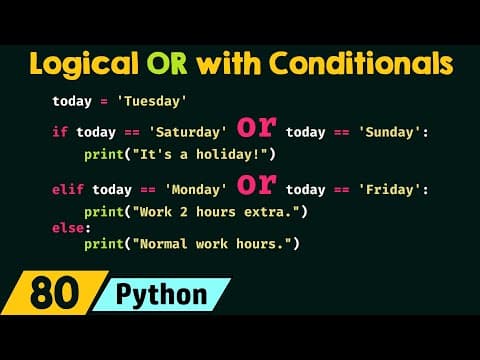
- The logical or operator returns true if at least one of the conditions is true, and it returns false only when both conditions are false.
- The logical not operator returns true if the conditional expression returns false, and returns false if the conditional expression returns true, effectively inverting the result.
- In Python's interactive shell, after typing an if statement ending with a colon and hitting enter, three dots appear indicating continuation, and you must add uniform indentation (two or four spaces) before the code inside the block.
- The colon after if and else is mandatory because it signals to Python that the next indented line is part of that if or else construct.
Install to Summarize YouTube Videos and Get Transcripts
Explore YouTube Video Summarizer or Get YouTube Transcript Extractor
Questions & Answers
Q: What is a logical operator in Python?
A logical operator in Python is an operator used to combine conditional expressions. A conditional expression is an expression that involves comparison operators such as less than, less than or equal to, greater than, greater than or equal to, equal to, and not equal to. Logical operators let you join two or more of these conditional expressions together so their combined truth value can be evaluated in constructs like if statements.
Q: How many logical operators does Python have and what are they?
Python has three logical operators. The first is logical and, denoted by 'and'. The second is logical or, denoted by 'or'. The third is logical not, denoted by 'not' written in all small letters. Logical and and logical or are binary operators because they work on two conditions, while logical not is the only unary logical operator because it operates on a single conditional expression.
Q: How does the logical and operator work in Python?
The logical and operator, denoted by 'and', returns true if both conditions are true; otherwise it returns false. In the example with x=10, y=20, and z=30, the statement 'if x greater than y and y greater than z' checks whether both comparisons hold. Since x is not greater than y, the first condition fails, so the whole expression is false and the else block executes, printing that X is not the largest number.
Q: How does the logical or operator work in Python?
The logical or operator, denoted by 'or', returns true if one of the conditions is true; otherwise it returns false, meaning it returns false only when both conditions are false. In the example with x=30, y=50, and z=10, the statement 'if x greater than y or x greater than z' is satisfied because x is greater than z, even though x is not greater than y, so it prints that X is at least larger than one number.
Q: What does the logical not operator do in Python?
The logical not operator, denoted by 'not' in all small letters, returns true if the conditional expression returns false, and returns false if the conditional expression returns true. It inverts or reverses the result of an expression. For example, with x=10, y=20, z=30, the expression 'not (x greater than y or x greater than z)' evaluates the inner expression to false, and not of false gives true, so the print statement inside the if executes.
Q: Why is logical not different from logical and and logical or?
Logical not is different because it is the only unary logical operator, meaning it operates on a single conditional expression. In contrast, logical and and logical or are binary operators, so they each require two conditions to combine. Not simply inverts the truth value of one expression, while and and or evaluate the relationship between two separate conditions before producing a combined true or false result.
Q: Why do three dots appear in the Python interactive shell when writing an if statement?
In Python's interactive shell, after typing an if statement that ends with a colon and hitting enter, three dots appear to indicate the continuation of the previous line of code. This signals that you are still inside the same construct and should add the indented line that belongs to that block. After finishing the code, you hit enter again on an empty line to tell Python you are done and want it to execute.
Q: Why is indentation important inside a Python if block?
Indentation is mandatory inside a Python if block because it marks which lines belong to that block, such as the print function that runs when the condition is satisfied. The indentation can be two spaces or four spaces; it does not matter which you choose, but the only thing that matters is that the indentation stays uniform throughout the code so Python can correctly interpret the structure.
Summary & Key Takeaways
-
Logical operators in Python combine conditional expressions, which are expressions built from comparison operators covered previously. Python offers three logical operators: logical and, logical or, and logical not. The and and or operators are binary, while not is the only unary logical operator in the language.
-
Logical and returns true only when both conditions are true. Using x=10, y=20, z=30, the check 'if x greater than y and y greater than z' fails because x is not greater than y, so the else block prints that X is not the largest number, which is correct.
-
Logical or returns true if one condition is true. With x=30, y=50, z=10, the check 'if x greater than y or x greater than z' is satisfied because x is greater than z, so it prints that X is at least larger than one number. Logical not inverts a false expression to true.
Read in Other Languages (beta)
Share This Summary 📚
Summarize YouTube Videos and Get Video Transcripts with 1-Click
Try YouTube Summary with ChatGPT & Claude or YouTube Transcript Generator
Explore More Summaries from Neso Academy 📚


Summarize YouTube Videos and Get Video Transcripts with 1-Click
Try YouTube Summary with ChatGPT & Claude or YouTube Transcript Generator