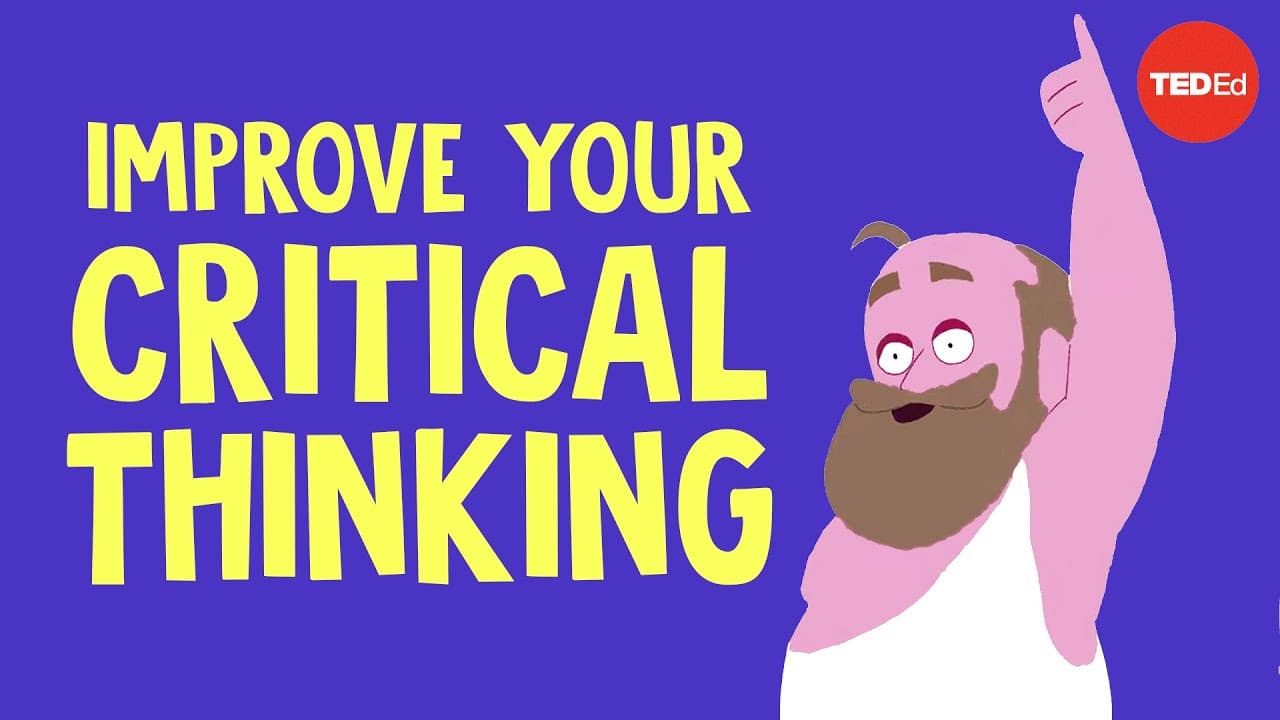
This tool will help improve your critical thinking - Erick Wilberding
TL;DR
The Socratic Method enhances critical thinking by using probing questions to challenge assumptions and clarify beliefs. This inquiry-based approach leads individuals to examine their reasoning, revealing flaws and encouraging deeper understanding across various fields, including medicine, law, and philosophy.
Transcript
Socrates, one of the founding fathers of Western philosophical thought, was on trial. Many Athenians believed he was a dangerous enemy of the state, accusing the philosopher of corrupting the youth and refusing to recognize their gods. However, Socrates wasn’t feared for claiming to have all the answers, but rather, for asking too many questions.... Read More
Key Insights
- 😷 Socrates' Socratic Method involves asking questions to challenge assumptions and reveal flaws in logic, leading to a deeper understanding.
- 👮 The Socratic Method can be applied in various fields such as medicine, sciences, faith, and law.
- ◀️ Effective Socratic educators should be well-versed in their subject, modest, genuinely curious, and affirming of every contribution.
Install to Summarize YouTube Videos and Get Transcripts
Explore YouTube Video Summarizer or Get YouTube Transcript Extractor
Questions & Answers
Q: Why was Socrates feared by many Athenians?
Socrates was feared because he asked too many questions, probing logic and challenging people's assumptions, which often revealed flaws in their beliefs and understanding.
Q: What is the purpose of the Socratic Method?
The purpose of the Socratic Method is to help individuals clarify their questions, challenge their biases, and eliminate contradictory or circular logic, leading to a deeper and more robust understanding.
Q: How was the Socratic Method used in teaching medicine?
During the Renaissance, the Socratic Method was used in medical education to teach clinical medicine. Students proposed diagnoses while a doctor questioned their assumptions and moderated discussions, leading to conclusive results.
Q: How has the Socratic Method been applied in American legal education?
In the 19th century, the Socratic Method became an essential part of American legal education. Professors used it to explore students' understanding of judicial reasoning by challenging them with unforeseen hypothetical situations.
Summary
Socrates, known for his Socratic Method, was a philosopher who asked probing questions to challenge people's assumptions and help them reach a deeper understanding. His method involved engaging in dialogue and continuously questioning, rather than providing explicit advice or answers. This approach has been widely applied in various fields, including medicine, science, law, and education.
Questions & Answers
Q: How did Socrates engage in philosophical discussions?
Socrates frequently engaged friends and strangers in lengthy conversations about morality and society, probing their logic and revealing flaws through a series of questions.
Q: What were Socrates' followers inspired to do after engaging in discussions with him?
Two of Socrates' students, Plato and Xenophon, were so inspired by him that they replicated his process in fictional dialogues, which became known as the Socratic Method.
Q: How did Socrates challenge others' understanding of justice and injustice?
In one of Plato's dialogues, Socrates converses with a young man named Euthydemus, who confidently claims to understand justice and injustice. However, Socrates challenges his values by asking him to categorize actions such as lying and theft as just or unjust, leading Euthydemus to revise his assertions and realize the complexity of the matter.
Q: How did Socrates describe his role in the questioning process?
Socrates described himself as a midwife, assisting others in giving birth to their ideas through questioning. His method aimed to draw out unexamined assumptions and challenge biases, ultimately clarifying questions and eliminating contradictory or circular logic.
Q: In which fields has the Socratic Method been applied?
The Socratic Method has been applied in fields such as clinical medicine, astronomy, botany, mathematics, faith, and legal education. It is a versatile approach that can be adapted to teach any topic that requires critical reasoning.
Q: Provide an example of how the Socratic Method was used in clinical medicine.
During the Renaissance, the Socratic Method was employed in clinical medicine. Students presented their rationale for different diagnoses, while a doctor questioned their assumptions and facilitated a discussion, leading to conclusive results in some cases.
Q: How was the Socratic Method utilized in the field of law?
In the 19th century, the Socratic Method became an essential part of American legal education. Professors challenged students with unforeseen hypothetical scenarios to explore their understanding of judicial reasoning and the potential unintended impacts of passing a law.
Q: What qualities should an effective Socratic educator possess?
An effective Socratic educator should be well-versed in their subject, modest, genuinely curious, and affirming of every contribution. They should approach discussions without bullying or showing off their intellect.
Q: How did Socrates' subversive beliefs impact his teaching?
Socrates was critical of Athens' democracy, and these beliefs were known to have influenced his followers. However, his subversive ideas were distorted in public forums, leading to allegations of treason against two of his pupils.
Q: What was the outcome of Socrates' trial?
Socrates was brought to trial and eventually sentenced to death, likely due to his subversive beliefs and influence on his followers. However, even on his deathbed, he depicted a serene philosopher, always curious to explore the ultimate questions.
Takeaways
The Socratic Method, characterized by rigorous questioning and challenging assumptions, is a versatile approach that can be applied in various fields to enhance critical thinking and deepen understanding. It requires a skilled educator who possesses in-depth knowledge of the subject, while also maintaining a humble and curious disposition. Socrates himself, the originator of the Socratic Method, faced consequences for his subversive beliefs, but his legacy as a great philosopher and teacher continues to inspire generations.
Summary & Key Takeaways
-
Socrates was known for asking questions and engaging in conversations about morality and society, rather than giving explicit advice.
-
The Socratic Method involves probing logic, revealing flaws, and helping both parties reach a deeper understanding.
-
This question-oriented approach is applicable in various fields and has been used in teaching medicine, sciences, faith, and law.
Read in Other Languages (beta)
Share This Summary 📚
Summarize YouTube Videos and Get Video Transcripts with 1-Click
Try YouTube Summary with ChatGPT & Claude or YouTube Transcript Generator
Explore More Summaries from TED-Ed 📚



Summarize YouTube Videos and Get Video Transcripts with 1-Click
Try YouTube Summary with ChatGPT & Claude or YouTube Transcript Generator