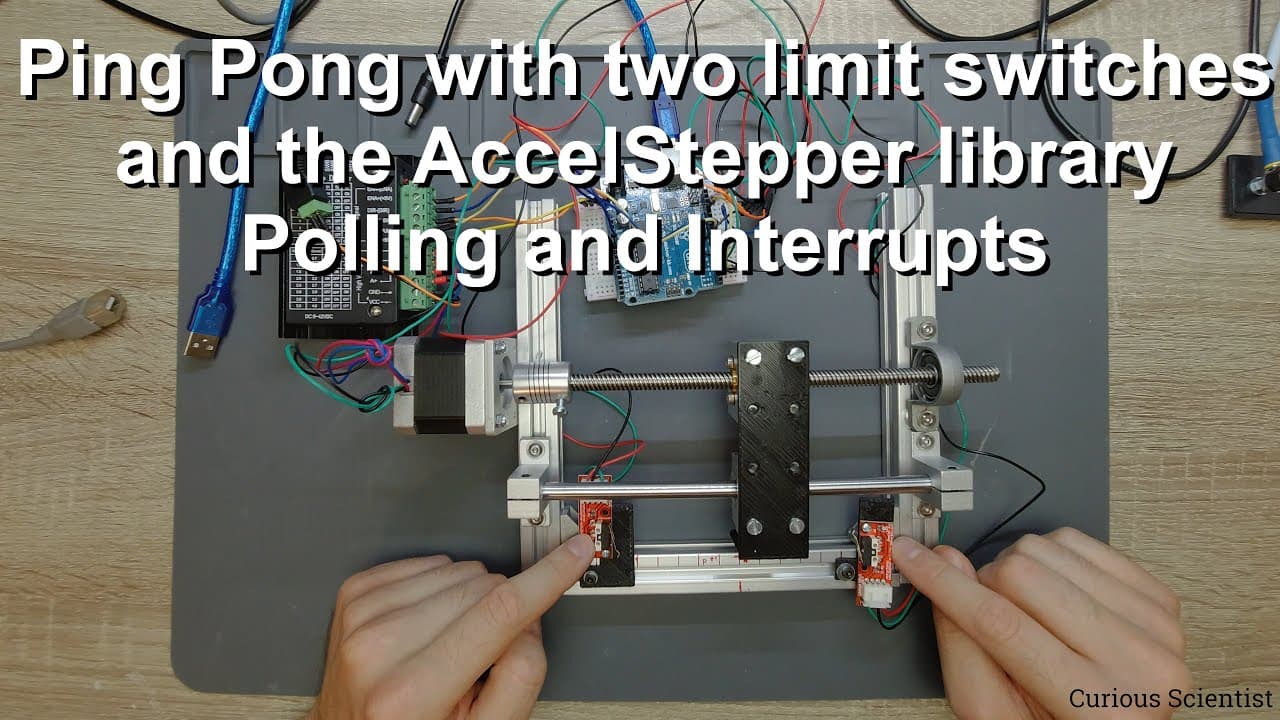
Ping Pong with the AccelStepper library and two limit switches - Polling and interrupts
TL;DR
This video shows how to use limit switches with a stepper motor for effective control.
Transcript
welcome everyone in this video i'm going to show you how to use two limits which is to control the stepper motor with the axle stepper library so a lot of things can be familiar to you if you are following my channel because i usually use this device to demonstrate any kind of uh stepper motor controlling uh things so what you can see here is uh i ... Read More
Key Insights
- 🦾 Limiting motor control using switch feedback prevents mechanical overreach and potential damage.
- 🫠 Different methods for reading switch states vary in efficiency, affecting how the control program interacts with hardware.
- 🥺 Proper setup and testing of limit switches are crucial for a reliable system, as improper configurations can lead to malfunctions.
- 🧑🦼 The TB6600 stepper motor controller seamlessly accommodates various motor sizes and speeds, making it versatile for different applications.
- 🆘 Recognizing the importance of hardware debugging can help identify and mitigate issues before they escalate into failures.
- 🎨 The choice of pull-up versus pull-down resistors in hardware design significantly affects signal clarity and system responsiveness.
- 🧑🦼 Implementing software checks to avoid multiple registered clicks enhances system stability and reliability, preventing undesired motor actions.
Install to Summarize YouTube Videos and Get Transcripts
Explore YouTube Video Summarizer or Get YouTube Transcript Extractor
Questions & Answers
Q: What components are essential for controlling a stepper motor in this setup?
The essential components include a stepper motor (like the NEMA 17 or NEMA 23), limit switches for position feedback, and a stepper motor controller such as the TB6600. You will also need an Arduino to run the controlling code, which integrates these components effectively to allow for movement control based on the limit switch signals.
Q: Why is hardware debouncing important for limit switches?
Hardware debouncing is crucial as it prevents false triggering of limit switches that can occur due to the mechanical bouncing effect inherent in switches. Without proper debouncing, the system may register multiple signals from a single click, causing erratic motor behavior and potential damage to the system. Thus, ensuring that each switch registers only one signal per action is vital for reliable operation.
Q: How do the two programming methods differ in handling limit switches?
The two programming methods involve using an attach interrupt and relying on digital reads in the main loop. The interrupt method only activates when the switch state changes, reducing CPU workload, while the digital read method continuously checks the switch's status, which can be less efficient but simpler to implement when quick responses are not necessary.
Q: What precautions should be taken when using limit switches?
Precautions include thoroughly testing limit switch configurations and responses before implementing them in final designs, ensuring they are in the correct physical positions. Additionally, it is essential to verify the reliability of limit switches and consider vulnerabilities in their wiring. Consider implementing better quality switches if reliability is a recurring issue to prevent potential hardware failures.
Summary & Key Takeaways
-
The video focuses on using two limit switches to control the movement of a stepper motor via the Axes Stepper library, demonstrating practical setup and coding techniques.
-
The presenter emphasizes the importance of correctly wiring and configuring limit switches to securely operate the stepper motor and avoid potential damage from programming errors or hardware failures.
-
Two coding approaches are explained: using the attach interrupt function and performing digital reads in a loop, illustrating how each method influences motor control and system efficiency.
Read in Other Languages (beta)
Share This Summary 📚
Summarize YouTube Videos and Get Video Transcripts with 1-Click
Try YouTube Summary with ChatGPT & Claude or YouTube Transcript Generator
Explore More Summaries from Curious Scientist 📚
![Building a Peltier cooler-based cooling box - First iteration, improvements [Part 2/6] thumbnail](/_next/image?url=https%3A%2F%2Fi.ytimg.com%2Fvi%2F0YlNw0EGnzI%2Fhqdefault.jpg&w=750&q=75)
![Building a coil winder [Part 6] - A few improvements thumbnail](/_next/image?url=https%3A%2F%2Fi.ytimg.com%2Fvi%2F3eyxG_g2iUA%2Fhqdefault.jpg&w=750&q=75)
Summarize YouTube Videos and Get Video Transcripts with 1-Click
Try YouTube Summary with ChatGPT & Claude or YouTube Transcript Generator