How Does the TEC 12 703 Thermoelectric Cooler Perform?
TL;DR
The TEC 12 703 thermoelectric cooler can achieve temperatures as low as -22°C under no heat load, but its efficiency significantly decreases with increased thermal loads. It's crucial to keep the current under three amperes to prevent damage, and insulation is vital for maintaining optimal cooling performance. The cooler is suitable for localized cooling but not effective for cooling entire rooms.
Transcript
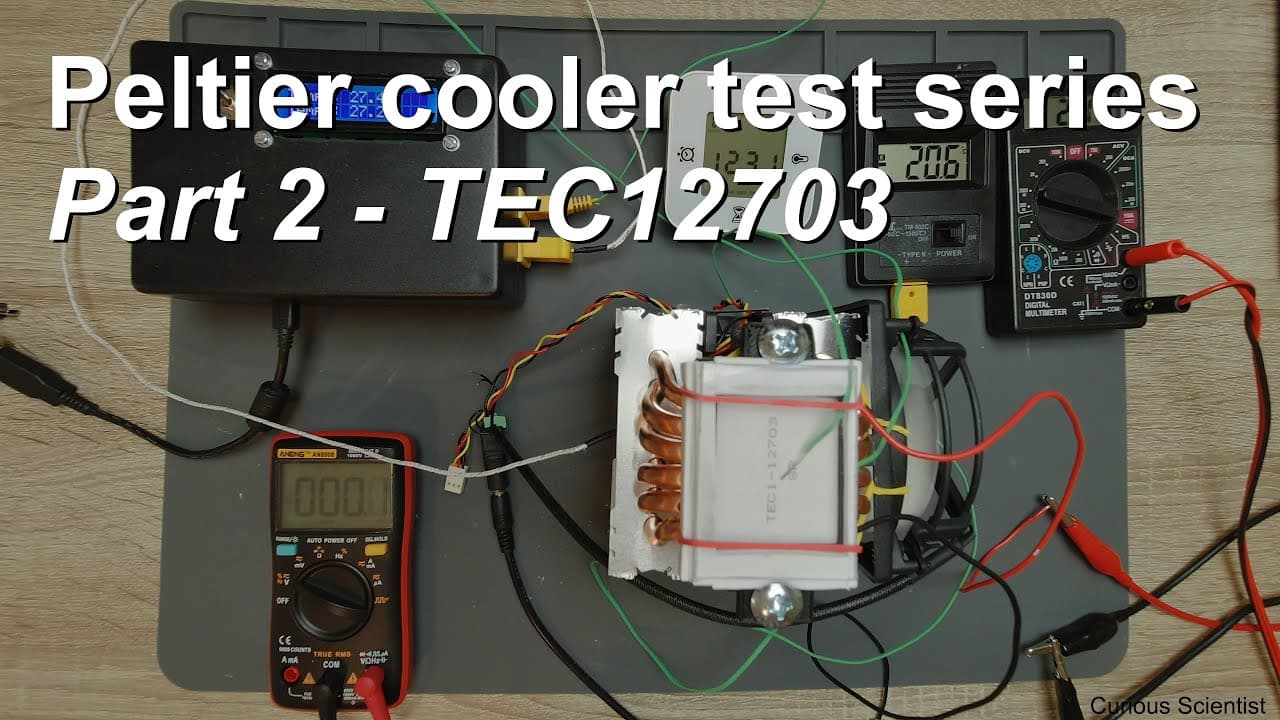
so I assembled the first system which is the Tec 12 703 so this is the smallest cooler and just let me explain what you can see here so this is the thermometer which I built and it contains two thermocouples and you can see there is a green and there is a white wire the green wire should touch the hot side so the the other side of this heating so i... Read More
Key Insights
- 😘 The TEC 12 703 cooler demonstrated the capability to reach notably low temperatures, achieving as low as minus twenty-two degrees Celsius without heat loads.
- 🥵 Its performance is contingent on the current; lowering it allows for manageable heat transfer, but it is vital to maintain the current below three amperes to prevent unit damage.
- 🥵 The experiment highlighted that even under optimal conditions, thermoelectric coolers have limited capacity for continuous cooling due to heat which is generated on the hot side during operation.
- 🥵 Insulation plays a crucial role in the efficiency of the cooling process; inadequate insulation can significantly impact performance by allowing heat exchange with the environment.
- 🛄 The experimental setup aimed to simulate real-world applications, demonstrating that while the TEC can provide localized cooling, it is not efficient for room cooling similar to conventional air conditioning systems.
- 🤒 Proper connection and calibration were critical for accurate results; discrepancies between power supply readings and measured outputs were addressed with a watt meter for verification.
- 🏆 Future experiments will expand upon these findings by testing different models, contributing to a comparative analysis of thermoelectric cooler efficiencies.
Install to Summarize YouTube Videos and Get Transcripts
Explore YouTube Video Summarizer or Get YouTube Transcript Extractor
Questions & Answers
Q: What is the purpose of the experiment conducted with the TEC 12 703?
The purpose of the experiment was to evaluate the cooling performance of the TEC 12 703 thermoelectric cooler at various current levels. It aimed to determine how effectively the cooler could lower temperatures under different conditions and power settings, which is crucial for understanding its potential applications in cooling systems.
Q: How does the experiment measure the temperature differentials?
The experiment measures temperature differentials using thermocouples linked to a thermometer. Multiple thermocouples were placed at different locations: the hot side, cold side, and the air output to accurately gauge the temperature variations created by the cooler at different operational currents.
Q: What challenges were encountered during the experiment?
One challenge included ensuring proper contact between the thermoelectric cooler and the heat sink, as insulation sometimes interfered with heat transfer. Additionally, the setup had to account for potential overheating by not exceeding the maximum current of three amperes, to avoid damaging the device during prolonged usage.
Q: How does increasing the current affect the cooling efficiency of the device?
Increasing the current initially lowers the temperature on the cold side, enabling effective cooling. However, once thermal loads increase, the cooler struggles to maintain these lower temperatures, indicating that higher currents do not linearly translate to better cooling performance under heavy load scenarios.
Summary & Key Takeaways
-
The experiment focused on the TEC 12 703 thermoelectric cooler, measuring temperatures at different currents to assess its cooling efficiency.
-
It utilized thermocouples to measure temperature differences, with a specific emphasis on achieving equilibrium temperatures at various current settings.
-
Observations indicated that while the cooler performed well in low-heat loads, its effectiveness diminished significantly with increased thermal loads.
Read in Other Languages (beta)
Share This Summary 📚
Summarize YouTube Videos and Get Video Transcripts with 1-Click
Try YouTube Summary with ChatGPT & Claude or YouTube Transcript Generator
Explore More Summaries from Curious Scientist 📚


![Building a coil winder [Part 6] - A few improvements thumbnail](/_next/image?url=https%3A%2F%2Fi.ytimg.com%2Fvi%2F3eyxG_g2iUA%2Fhqdefault.jpg&w=750&q=75)

Summarize YouTube Videos and Get Video Transcripts with 1-Click
Try YouTube Summary with ChatGPT & Claude or YouTube Transcript Generator