Testing and comparing different Peltier coolers - Part 3 - TEC12706
TL;DR
Testing five thermoelectric coolers to determine efficiency and temperature limits.
Transcript
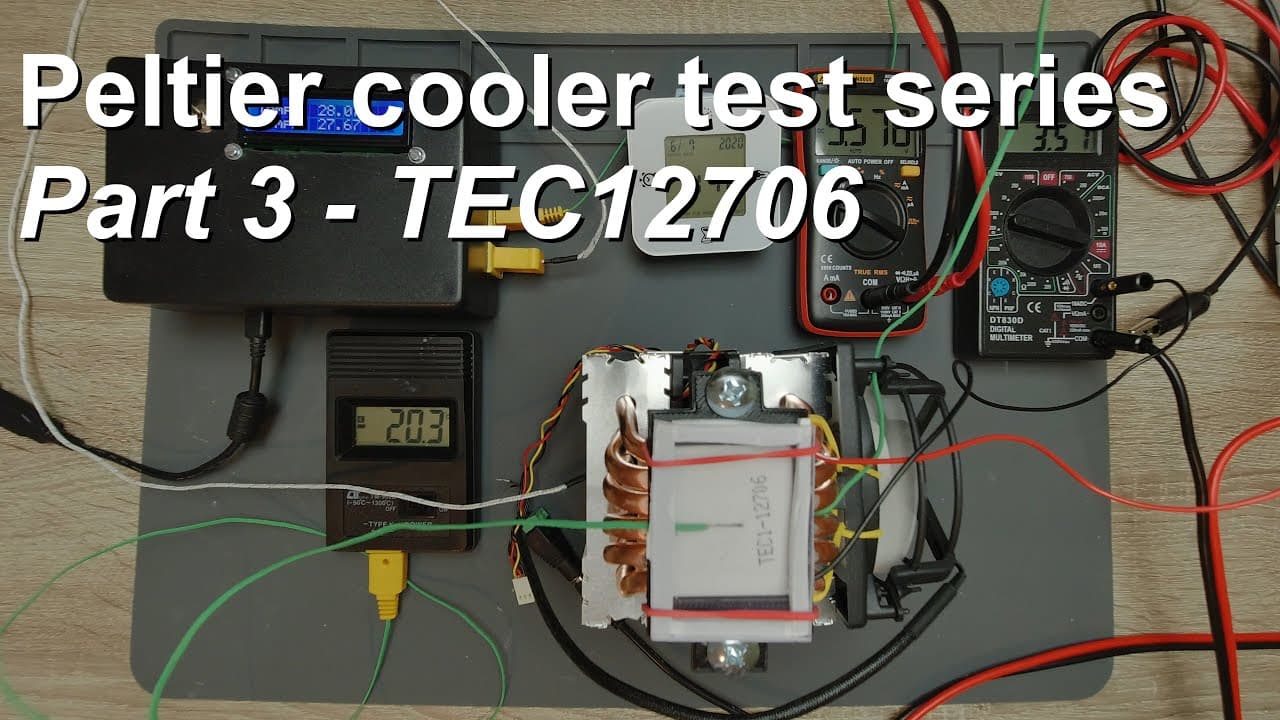
welcome everyone this is the next video of my series where I test five different thermoelectric coolers and this is the test of the Tec 12 706 so this is a 6 ampere unit and as you can see everything is assembled now but if you haven't seen the previous video I quickly explain what is what so here we measure two temperatures with two different ther... Read More
Key Insights
- 😎 The TEC 12 706 thermoelectric cooler was evaluated under various current loads to gauge both efficiency and cooling capacity.
- 😅 Accurate temperature measurement was achieved using thermocouples positioned strategically at both the hot and cold sides of the cooler.
- 🥶 Increasing current leads to improved cold side temperatures up to a point where Joule heating becomes counterproductive, resulting in diminishing returns.
- 🥵 The insulation used during the testing was critical in reducing heat gain from the environment, thus enhancing measurement accuracy.
- 🥵 The experiment revealed that airflow direction and fan setup significantly influenced the heat dissipation process contributing to better thermal management.
- 😘 Temperature readings indicated that the cooler can achieve a chilling effect as low as -23 degrees Celsius depending on the current while maintaining acceptable warm side temperatures.
- 🧡 Observed performance trends highlight the importance of managing the current supply within optimal ranges to prevent overheating due to Joule heating effects.
Install to Summarize YouTube Videos and Get Transcripts
Explore YouTube Video Summarizer or Get YouTube Transcript Extractor
Questions & Answers
Q: What are thermoelectric coolers and how do they work?
Thermoelectric coolers utilize the Peltier effect, where electricity produces a temperature difference across the device, cooling one side while heating the other. They require a heat sink to dissipate heat effectively. By manipulating the current, users can control the temperature on the cool side for various applications.
Q: How does the cooling efficiency of the TEC 12 706 compare to other models?
The video compares the TEC 12 706 to a previous model (TEC 12 703) and finds that the former achieves a lower cold side temperature at higher currents, demonstrating improved efficiency. The setup allows for a detailed assessment of temperature performance at various power levels, which is crucial for understanding its advantages over other models.
Q: What factors affect the performance of a thermoelectric cooler?
A thermoelectric cooler's performance is influenced by several factors, including the current supplied, ambient temperature, heat sink quality, and insulation. Higher currents can lead to Joule heating, which reduces efficiency but is necessary for achieving lower temperatures up to a point. Proper airflow and thermal contact also play vital roles.
Q: Why is the setup designed to minimize thermal gains from the environment?
The insulated chamber in the experiment minimizes external heat interference, providing more accurate test results. By reducing thermal gains, the experiment can focus solely on the cooler's performance without the impact of ambient temperature changes affecting the readings.
Q: What observations were made regarding ice formation during testing?
Observations of ice forming on the cold side indicated effective heat transfer and cooling performance. However, some moisture accumulation reflects how humidity impacts the performance, showcasing a balance between cooling efficiency and environmental factors.
Q: What is Joule heating, and how does it impact cooling performance?
Joule heating refers to the heat generated by an electric current passing through a conductor. In thermoelectric coolers, excessive Joule heating can counteract the cooling effect, leading to higher temperatures as current increases. Understanding this balance is critical for optimizing performance.
Q: How long should the cooler be tested at each current level for accurate readings?
The experiment typically requires a stabilization period of around five to ten minutes at each current setting. This allows the system to reach thermal equilibrium, enabling accurate measurement of temperature changes and ensuring reliable data collection.
Q: What future experiments are suggested based on the results?
Future experiments could involve testing higher amperage models like the TEC 12 708 for comparative analysis. Further optimization of insulation and airflow techniques could also lead to enhanced performance evaluations across different environmental conditions.
Summary & Key Takeaways
-
The video demonstrates experiments with a TEC 12 706 thermoelectric cooler, measuring temperatures at various current settings to evaluate its efficiency.
-
The testing setup includes thermocouples for precise temperature readings and fans for improved airflow, optimizing the cooler's performance in a confined space.
-
Results show the cooler achieving varying cold side temperatures based on current adjustments, highlighting the impact of Joule heating on performance at higher currents.
Read in Other Languages (beta)
Share This Summary 📚
Summarize YouTube Videos and Get Video Transcripts with 1-Click
Try YouTube Summary with ChatGPT & Claude or YouTube Transcript Generator
Explore More Summaries from Curious Scientist 📚
![Building a Peltier cooler-based cooling box - First iteration, improvements [Part 2/6] thumbnail](/_next/image?url=https%3A%2F%2Fi.ytimg.com%2Fvi%2F0YlNw0EGnzI%2Fhqdefault.jpg&w=750&q=75)
![Building a coil winder [Part 6] - A few improvements thumbnail](/_next/image?url=https%3A%2F%2Fi.ytimg.com%2Fvi%2F3eyxG_g2iUA%2Fhqdefault.jpg&w=750&q=75)
Summarize YouTube Videos and Get Video Transcripts with 1-Click
Try YouTube Summary with ChatGPT & Claude or YouTube Transcript Generator