Why is the Peltier cooler-based air conditioning a BAD idea?
TL;DR
The video demonstrates the limitations of a patio cooling system using thermoelectric coolers.
Transcript
welcome everyone in this video i'm going to show you some patio cooling experiments again so in this video i will try to answer some questions which popped up in the comment section under different party cooling videos of mine and i will also try to explain some stuff just to make it more comprehensible so what you see here is not a very difficult ... Read More
Key Insights
- 🥵 The patio cooling system employs thermoelectric coolers which drive heat away from the water but produce significant heat themselves.
- 🥵 Proper airflow is crucial for maintaining cooling efficiency, yet forced airflow can paradoxically increase overall heat within the system.
- ✋ High power consumption is a significant drawback, with the system potentially consuming up to 500 watts which could be costly over time.
- 🥵 A significant challenge in such cooling systems is handling the heat generated by the patio coolers effectively.
- ❓ There are complexities related to the physical arrangements and appropriate insulation necessary for effective operation beyond mere component assembly.
- 😒 The experiment illustrates that cooling capacity is diminished when considering real-world environmental factors that accompany system use.
- 😎 Investing in a conventional air conditioning unit is generally more effective and reliable compared to building a DIY patio cooling system.
Install to Summarize YouTube Videos and Get Transcripts
Explore YouTube Video Summarizer or Get YouTube Transcript Extractor
Questions & Answers
Q: What are the main components of the patio cooling system demonstrated in the video?
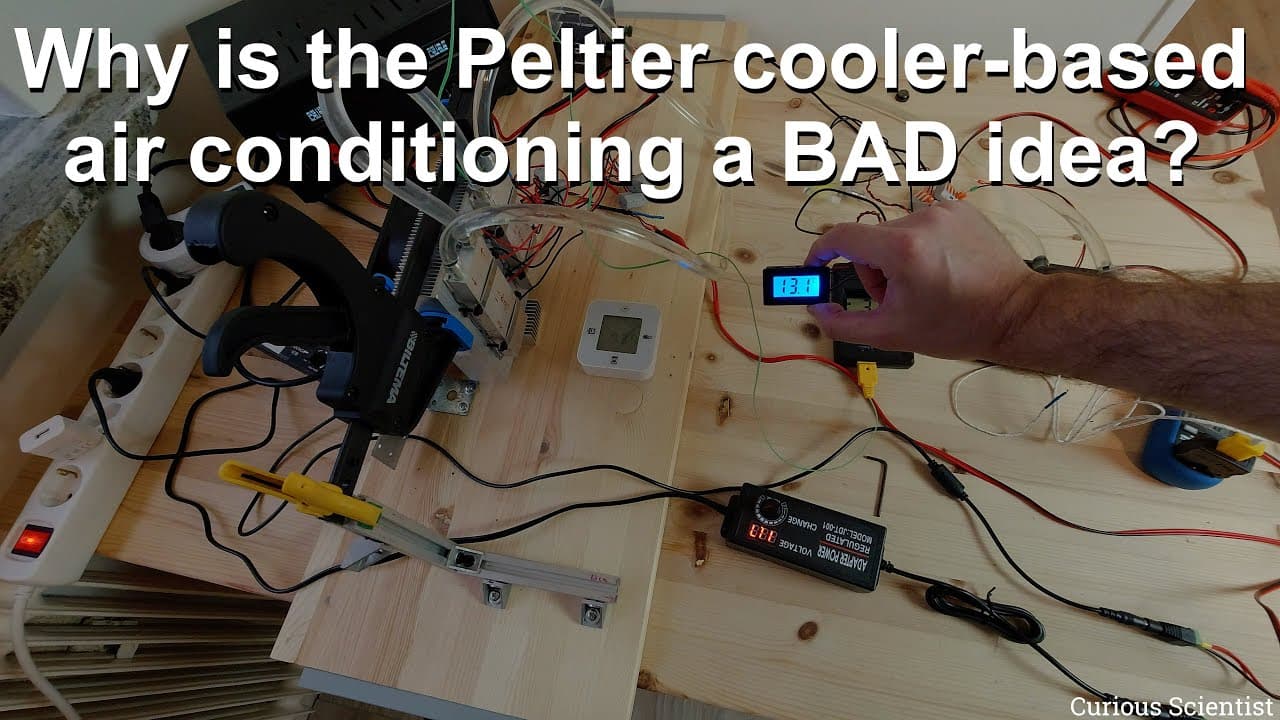
The system includes six TEC-12706 patio coolers, a water cooling loop, two aluminum heat sinks, a reservoir, a pump, and high-performance fans. The TEC coolers provide a cooling effect by transferring heat from one side of the cooler to the other when powered, creating a temperature differential. The heat sinks absorb the heat from the coolers, while fans provide airflow over the heat sinks to dissipate heat into the surroundings.
Q: How does the introduction of forced airflow affect the cooling performance?
Introducing forced airflow tends to increase the heat load on the system. While it may seem beneficial at first, the additional heat introduced by the air can overwhelm the cooling capacity of the patio coolers. The presenter observed that, with the fan running, the water temperature began to rise significantly due to this excess heat, resulting in diminished cooling efficiency.
Q: What are the power requirements of the cooling system?
The cooling system draws significant power, with the TEC coolers running at about 4 amps and 15 volts each, producing roughly 60 watts of heat per unit. With six units, the total power consumption can reach around 360 watts just for the coolers. The additional components, such as pumps and fans, elevate total power consumption to about 500 watts, indicating that energy usage is quite high, especially for cooling applications.
Q: Is the patio cooling system a viable alternative to traditional air conditioning?
The presenter indicates that this patio cooling system is not a practical alternative to traditional air conditioning. The total costs in terms of both setup and operational expenses approach or exceed those of smaller, efficient air conditioners. Moreover, the inefficiencies and noise issues further detract from its practicality, making standard air conditioning units a more effective choice for maintaining comfortable room temperatures.
Summary & Key Takeaways
-
The presenter showcases a water cooling loop using six TEC-12706 patio coolers to cool water, demonstrating the complexities involved in achieving effective cooling.
-
During the experiment, a high-performance fan is used to maintain the temperature of the heatsinks, which dissipate heat generated by the coolers, and the impact of airflow on cooling efficiency is observed.
-
The presenter concludes that the system is costly and inefficient compared to conventional air conditioning, emphasizing that thermoelectric cooling is not practical for space cooling in typical home environments.
Read in Other Languages (beta)
Share This Summary 📚
Summarize YouTube Videos and Get Video Transcripts with 1-Click
Try YouTube Summary with ChatGPT & Claude or YouTube Transcript Generator
Explore More Summaries from Curious Scientist 📚



![Building a Peltier cooler-based cooling box - First iteration, improvements [Part 2/6] thumbnail](/_next/image?url=https%3A%2F%2Fi.ytimg.com%2Fvi%2F0YlNw0EGnzI%2Fhqdefault.jpg&w=750&q=75)


Summarize YouTube Videos and Get Video Transcripts with 1-Click
Try YouTube Summary with ChatGPT & Claude or YouTube Transcript Generator